
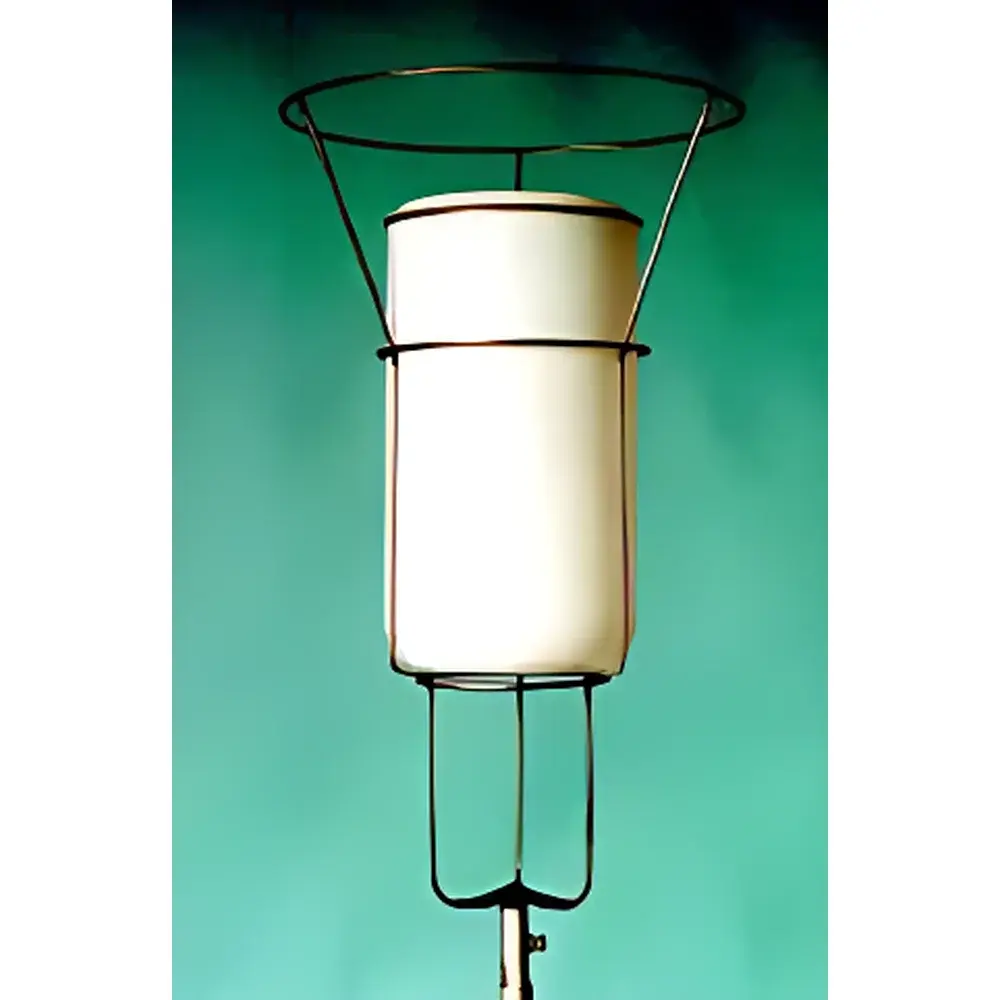
Eigenbrodt NILU SF 1 Dry and Wet Deposition Sampler
| Brand | Eigenbrodt |
|---|---|
| Origin | Germany |
| Model | NILU SF 1 |
| Construction Material | HD-polyethylene |
| Support Frame | Stainless Steel |
| Collection Aperture Diameter | 200 mm (ISO-compliant) |
| Total Height | 400 mm (ISO-compliant) |
| Adjustable Mounting Height | 1.7–2.6 m above ground level (incl. ISO reference height) |
| Standard Kit | Sampler body with lid, stainless steel retaining ring, nested basket, ground stakes |
| Optional Accessories | Telescopic ground anchors (for rocky or paved surfaces), individual component replacement parts |
Overview
The Eigenbrodt NILU SF 1 Dry and Wet Deposition Sampler is a field-deployable, passive atmospheric particulate collector engineered for standardized long-term monitoring of both dry-deposited aerosols and wet-deposited particulates (e.g., dust, soot, heavy metals, and water-insoluble compounds co-precipitated with rain or snow). Designed in strict accordance with the principles outlined in ISO/DIS 4222-2 (Air Quality — Sampling of Atmospheric Particulate Matter — Specifications for Dry and Wet Deposition Samplers), the NILU SF 1 implements a gravimetric and compositional sampling approach based on open-faced, unobstructed collection geometry. Its operational principle relies on gravitational settling and inertial impaction under ambient meteorological conditions—without active aspiration or filtration—ensuring representative integration of time-averaged deposition fluxes across spatially distributed monitoring sites. The device is not intended for gaseous pollutant capture or size-fractionated aerosol analysis; rather, it serves as a reference-grade integrator for bulk deposition mass loading and subsequent laboratory-based elemental, ionic, or organic speciation.
Key Features
- ISO 4222-2 compliant design: 200 mm internal aperture diameter and 400 mm total height ensure metrological consistency with international intercomparison studies.
- HD-polyethylene collector body: Chemically inert, UV-stabilized, and non-reactive toward acidic or alkaline deposition components; minimizes leaching and adsorption artifacts during extended exposure.
- Stainless steel support frame: Corrosion-resistant (AISI 316 grade), fully adjustable in height from 1.7 to 2.6 m above ground surface—enabling compensation for snow accumulation, vegetation growth, or terrain variation while maintaining standardized collection plane elevation.
- Modular, serviceable architecture: All components—including lid, retaining ring, nested basket, and ground anchoring system—are replaceable as discrete units, supporting multi-year deployment under GLP-aligned maintenance protocols.
- Passive operation: No power supply, pumps, or moving parts required—ideal for remote, off-grid, or low-maintenance monitoring networks including EMEP, GAW, and national air quality observatories.
Sample Compatibility & Compliance
The NILU SF 1 is validated for collection of total suspended particulate (TSP) deposition—both dry-settled material and particulate matter co-deposited with precipitation (rain, snow, fog drip). It complies with the geometric and material specifications referenced in ISO/DIS 4222-2 and aligns with methodological frameworks used by the European Monitoring and Evaluation Programme (EMEP), the Global Atmosphere Watch (GAW), and national environmental agencies (e.g., UBA Germany, NIBIO Norway). While not certified to ISO/IEC 17025 as a testing laboratory instrument, its design supports traceable sample acquisition under ISO 5725 (accuracy and precision of measurement methods) and ISO/IEC 17043 (proficiency testing). The sampler is unsuitable for use below freezing when ice formation may obstruct the aperture or alter deposition dynamics; however, it remains functional—and analytically valuable—as a surrogate for precipitation collectors during frozen precipitation events due to its larger effective collection area and reduced evaporation bias.
Software & Data Management
The NILU SF 1 operates without embedded electronics or firmware; therefore, no proprietary software is associated with the hardware. Sample metadata (deployment date, retrieval date, location coordinates, weather logs, snow depth, and visual inspection notes) must be recorded manually or via compatible LIMS platforms (e.g., LabWare LIMS, Thermo Fisher SampleManager) using standardized templates aligned with EN 14902 (Ambient air — Standard method for the measurement of Pb, Cd, As, Ni, Sb, and other elements in the PM10 fraction). For regulatory reporting under EU Directive 2004/107/EC (heavy metals in ambient air), data generated using this sampler are accepted when paired with accredited laboratory analysis (e.g., ICP-MS, XRF, ion chromatography) and documented chain-of-custody procedures satisfying ISO/IEC 17025 requirements. Audit trails for field operations should include timestamped photographic evidence of collector condition pre- and post-deployment.
Applications
- Long-term trend analysis of atmospheric metal deposition (e.g., Pb, Cd, Zn, Cu) in rural, industrial, and background monitoring stations.
- Source apportionment studies integrating deposition flux data with receptor modeling (e.g., PMF, CMB) and emission inventory cross-validation.
- Validation of regional chemical transport models (CTMs) such as EMEP MSC-W or CAMx through comparison of modeled vs. measured deposition velocities and cumulative loads.
- Ecological risk assessment of terrestrial and freshwater ecosystems exposed to anthropogenic particulate inputs.
- Compliance monitoring for national implementation of the UNECE Convention on Long-range Transboundary Air Pollution (CLRTAP) and associated Gothenburg Protocol targets.
FAQ
Can the NILU SF 1 be used for PM₂.₅ or PM₁₀ size-selective sampling?
No. The NILU SF 1 collects total deposition without size fractionation. It does not incorporate impactors, cyclones, or filter substrates required for regulated PM₂.₅ or PM₁₀ monitoring.
Is calibration required before deployment?
No instrumental calibration is performed on the sampler itself. However, field installation must verify vertical alignment, aperture clearance, and adherence to ISO-specified mounting height relative to local ground reference (e.g., using digital inclinometer and calibrated tape measure).
What is the recommended exposure duration?
Typical deployment intervals range from 7 to 30 days depending on expected deposition rates and analytical detection limits; longer durations (up to 90 days) are permissible in low-flux environments if evaporation and biological contamination risks are mitigated.
Does the sampler meet FDA 21 CFR Part 11 requirements?
Not applicable—the NILU SF 1 is a passive field sampling device with no electronic data generation or storage capability. Regulatory compliance applies solely to downstream laboratory analysis systems.
Can it be mounted on rooftops or building façades?
Yes, provided the mounting structure maintains the specified height above the nearest representative ground surface and avoids turbulence-inducing obstructions within a 2-meter horizontal radius.
Related Products







