
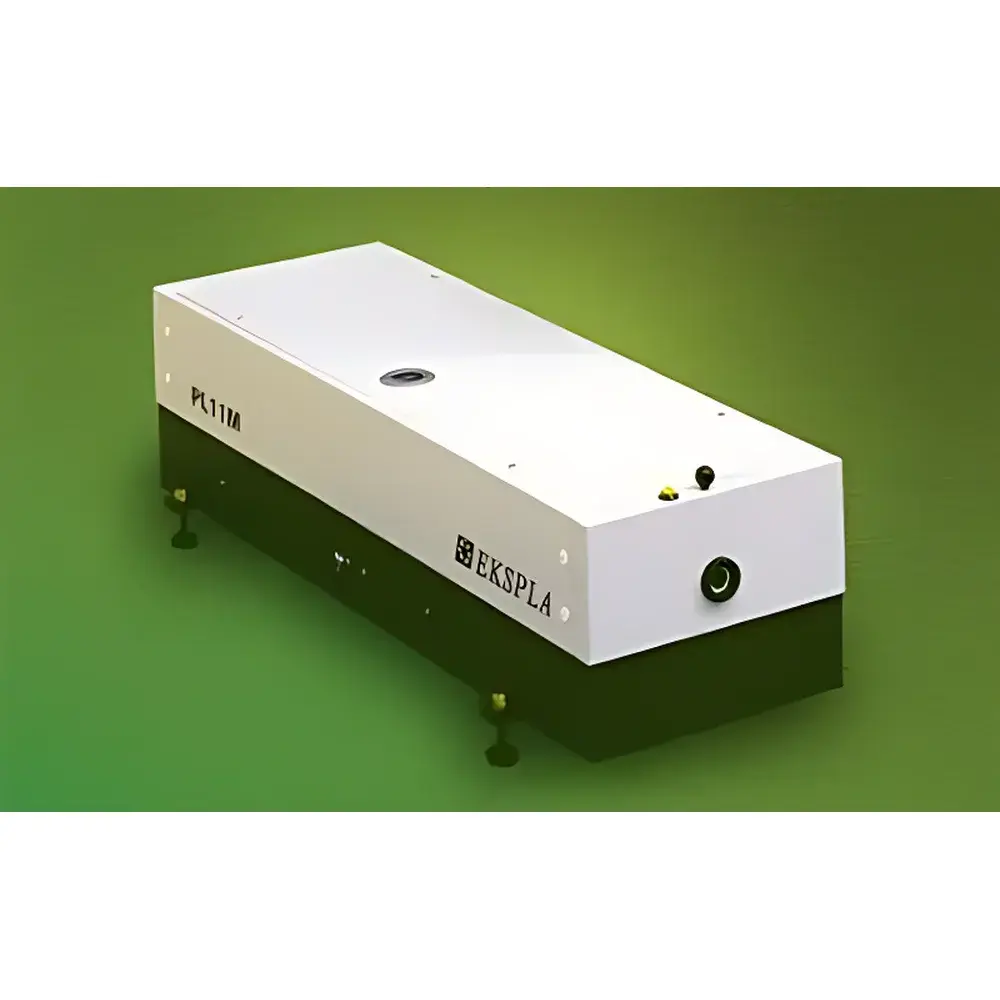
Ekspla PL11M Series Picosecond Diode-Pumped Solid-State Laser
| Brand | Ekspla |
|---|---|
| Origin | Lithuania |
| Manufacturer Type | OEM Manufacturer |
| Product Type | Diode-Pumped Solid-State (DPSS) Picosecond Laser |
| Model | PL11M |
| Output Wavelength | 1064 nm |
| Average Output Power | 1 W |
| Pulse Duration | ~10 ps |
| Repetition Rate | Up to 1 MHz |
| Beam Quality | M² < 1.5 |
| Control Interface | USB/RS-232 + Remote Keypad |
| Cooling | Air-Cooled |
| Power Supply | Single-Phase AC |
| Maintenance Requirement | Low |
Overview
The Ekspla PL11M Series is a compact, air-cooled, diode-pumped solid-state (DPSS) picosecond laser system engineered for high-repetition-rate time-resolved optical applications. Operating at the fundamental wavelength of 1064 nm, it delivers up to 1 W average output power with pulse durations of approximately 10 picoseconds and repetition rates scalable from single-shot mode up to 1 MHz. Its design leverages master oscillator–power amplifier (MOPA) architecture with passive Q-switching and nonlinear pulse compression stages to achieve stable, transform-limited pulses without requiring external chirp compensation. The system is optimized for integration into pump-probe spectroscopy, transient absorption setups, time-of-flight mass spectrometry (TOF-MS), and ultrafast fluorescence lifetime imaging—where precise temporal resolution, shot-to-shot stability, and long-term parameter reproducibility are critical.
Key Features
- High repetition rate operation up to 1 MHz enables statistically robust data acquisition in time-resolved experiments without compromising temporal resolution.
- Pulse duration of ~10 ps (FWHM) supports sub-100 fs time-domain resolution when used with appropriate autocorrelation or FROG diagnostics.
- Beam quality of M² < 1.5 ensures diffraction-limited focusing for high spatial intensity density and efficient coupling into single-mode fibers or nonlinear crystals.
- Air-cooled thermal management eliminates dependency on external chiller systems, reducing infrastructure complexity and operational overhead.
- Integrated USB 2.0 and RS-232 interfaces support full remote parameter control—including repetition rate, burst mode triggering, and pulse energy monitoring—via industry-standard SCPI commands.
- Front-panel keypad and status LED indicators enable local hands-free operation during alignment or maintenance procedures.
- Single-phase 100–240 VAC input simplifies deployment in standard laboratory environments without dedicated power conditioning.
Sample Compatibility & Compliance
The PL11M series is compatible with standard optical tables, kinematic mounts, and common ultrafast optics (e.g., broadband dielectric mirrors, pellicle beam splitters, and BBO/LBO crystals for harmonic generation). Its Class 4 laser classification requires adherence to IEC 60825-1:2014 and ANSI Z136.1-2022 safety standards; integrated interlock connectors support integration with lab-wide access control systems. While not certified for medical or industrial process control use, the system meets CE marking requirements for electromagnetic compatibility (EMC Directive 2014/30/EU) and low-voltage safety (LVD Directive 2014/35/EU). Its stable pulse-to-pulse energy variation (< ±1.5% RMS over 8 hours) supports GLP-compliant spectroscopic calibration workflows where traceable repeatability is mandated.
Software & Data Management
Ekspla provides the LaserControl software suite (Windows-based, 64-bit) for comprehensive device configuration, real-time monitoring, and automated sequence scripting. The software logs timestamped operational parameters—including internal cavity temperature, diode current, and pulse energy estimates—into CSV-formatted files compatible with MATLAB, Python (NumPy/Pandas), and LabVIEW. Audit trail functionality records all user-initiated changes with timestamps and operator IDs, satisfying basic FDA 21 CFR Part 11 requirements for electronic records in regulated R&D environments. Third-party integration is supported via TCP/IP socket communication and dynamic link libraries (DLLs) for custom application development.
Applications
- Time-resolved absorption and emission spectroscopy (e.g., femtosecond transient absorption, pump-probe kinetics)
- Multi-photon excitation in fluorescence lifetime imaging microscopy (FLIM) and time-correlated single photon counting (TCSPC)
- Optical parametric amplification (OPA) seeding in broadband IR/UV generation systems
- Laser-induced breakdown spectroscopy (LIBS) with gated detection for elemental analysis
- Ultrafast photoelectron spectroscopy and time-of-flight mass spectrometry (TOF-MS) ionization sources
- Nonlinear optical characterization of 2D materials and perovskite thin films
FAQ
Is the PL11M compatible with harmonic generation modules?
Yes—the 1064 nm fundamental output is optimized for efficient frequency doubling (532 nm), tripling (355 nm), and quadrupling (266 nm) using commercially available harmonic generators with appropriate phase-matching conditions.
What is the typical pulse energy at 1 MHz repetition rate?
At full 1 W average power and 1 MHz repetition rate, the pulse energy is approximately 1 µJ per pulse, assuming consistent 10 ps pulse width and Gaussian temporal profile.
Does the system require water cooling or external chillers?
No—PL11M is fully air-cooled and designed for continuous operation under ambient laboratory conditions (15–30 °C, non-condensing humidity).






