
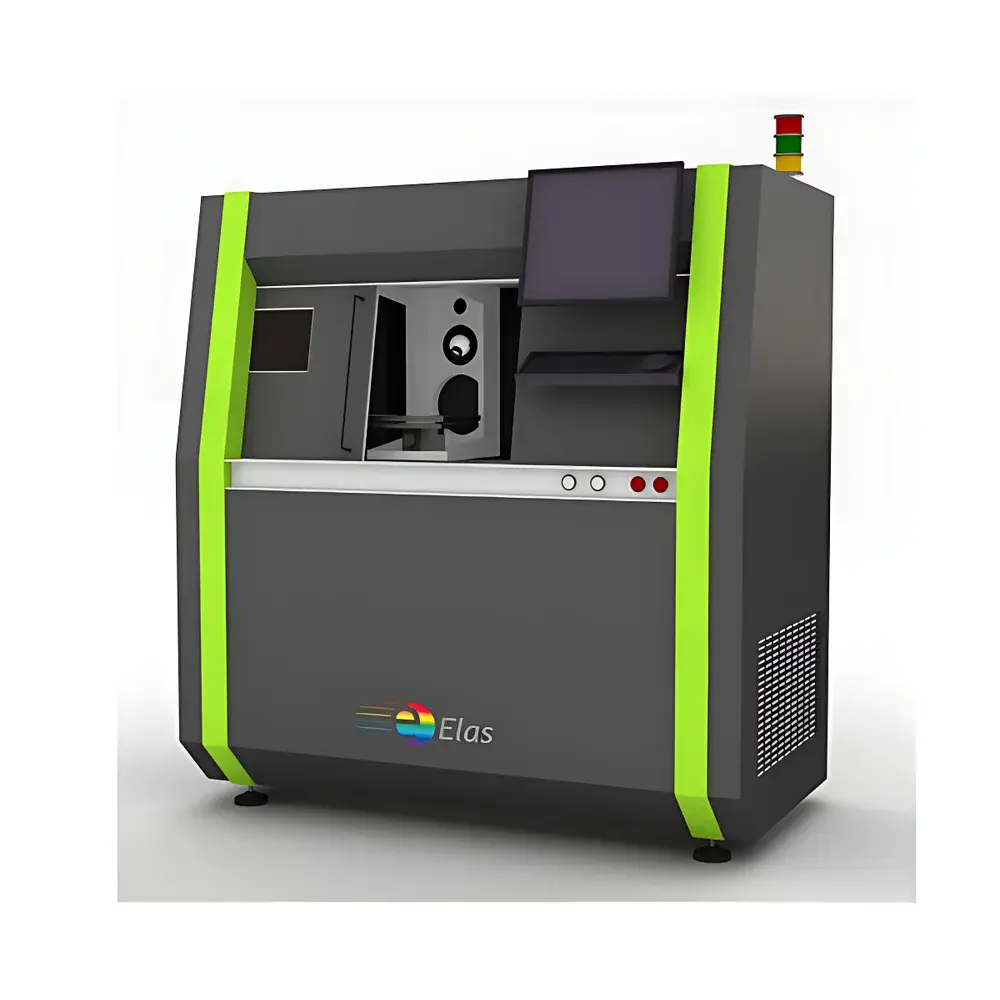
ELAS Mini MASTER Ultrafast Laser Micro Machining Workstation
| Brand | ELAS |
|---|---|
| Origin | Imported |
| Manufacturer Type | Authorized Distributor |
| Model | Mini MASTER |
| Core Component | Semiconductor-Based Ultrafast Laser System |
| Laser Types | Nanosecond, Picosecond, and Custom Wavelength Options (1064 nm / 532 nm / 355 nm) |
| Scanning Field | 100 × 100 mm |
| f-Theta Lens Focal Length | 160 mm |
| Max Marking Speed | 3.5 m/s |
| Max Positioning Speed | 15.0 m/s |
| Minimum Achievable Spot Size | ≤ 3 µm |
| Laser Pulse Synchronization | Yes |
| Beam Quality (M²) | < 1.3 (ns), < 1.5 (ps) |
| Power Requirement | Up to 2000 W |
| Dimensions (W×D×H) | 1110 × 760 × 1440 mm |
| Safety Class | IEC 60825-1 Class 1 Enclosed System |
| Software Platform | SCA Laser Micro Machining Suite (Windows OS) |
Overview
The ELAS Mini MASTER is a compact, Class 1 enclosed ultrafast laser micro machining workstation engineered for precision material processing in R&D laboratories and low-volume production environments. Based on the proven architecture of the full-scale MASTER platform, the Mini MASTER integrates semiconductor-pumped ultrafast laser sources—nanosecond, picosecond, and optionally femtosecond—with high-speed galvanometric scanning optics and real-time motion-laser synchronization. Its core measurement and control principle relies on time-resolved pulsed energy delivery: ultrashort pulses (≤10 ps) minimize thermal diffusion into surrounding material, enabling cold ablation with sub-micrometer spatial resolution and negligible heat-affected zones (HAZ). This makes the system particularly suitable for structuring thermally sensitive, brittle, or highly reflective substrates—including sapphire, fused silica, tungsten carbide, thin-film photovoltaics, and polymer-based microfluidic chips.
Key Features
- Class 1 laser-safe enclosure compliant with IEC 60825-1 and ISO 11553-1, certified for cleanroom integration (ISO Class 5–7 compatible).
- Modular ultrafast laser engine supporting three fundamental wavelengths (1064 nm, 532 nm, 355 nm) with automatic harmonic switching and pulse energy stabilization.
- High-fidelity galvo scanning system with 100 × 100 mm field-of-view, 160 mm f-theta lens, and ≤3 µm spot size (wavelength- and optics-dependent).
- Real-time laser-pulse-to-scanner synchronization ensuring deterministic feature placement at repetition rates up to 500 kHz.
- Industrial-grade control computer running Windows OS with integrated LCD interface, keyboard, and dedicated SCA software suite.
- Configurable sample handling options including motorized Z-axis and tilt adjustment, vacuum chucks, and integrated dust/fume extraction.
Sample Compatibility & Compliance
The Mini MASTER processes a broad spectrum of materials without requiring pre- or post-treatment: conductive (copper, gold, ITO), dielectric (glass, quartz, sapphire), ceramic (Al₂O₃, SiC), and polymeric substrates (PI, PET, PMMA, SU-8). Its process repeatability meets ASTM F2792 (Standard Terminology for Additive Manufacturing) and ISO 13485-aligned documentation protocols for medical device prototyping. For regulated environments, the SCA software supports audit-trail logging, user access levels, and electronic signature capability—facilitating alignment with FDA 21 CFR Part 11 and GLP/GMP quality systems when deployed in QC/QA or preclinical manufacturing workflows.
Software & Data Management
The SCA (Smart Control Architecture) software provides a unified interface for pattern design, import (DXF, SVG, G-code), parametric simulation, and real-time process monitoring. It includes built-in calibration routines for scanner self-alignment, dynamic focus compensation, and multi-layer depth profiling. All machining parameters—including pulse energy, scan velocity, hatch spacing, layer count, and beam overlap—are stored with timestamped metadata. Export formats include CSV (for statistical process control), TIFF (for overlay metrology), and XML (for traceable batch records). Optional API integration enables connection to MES or LIMS platforms via TCP/IP or OPC UA.
Applications
- Ablation: High-aspect-ratio micromold fabrication (e.g., Ni electroforming masters), microchannel patterning for lab-on-chip devices, and thin-film electrode structuring for flexible electronics.
- Cutting & Drilling: Precision scribing of solar cells, via drilling in ceramic substrates, injector nozzle fabrication, and optical filter arrays with aspect ratios >20:1.
- Marking: Surface and subsurface marking of transparent materials (e.g., glass ID tags), tamper-evident serialization, and biocompatible UID engraving on implantable components.
- Surface Structuring: Controlled wettability modification (hydrophobic/hydrophilic patterning), anti-reflective moth-eye textures on optical lenses, and micro-dimpled tribological surfaces for MEMS bearings.
FAQ
Is the Mini MASTER suitable for ISO 13485-certified medical device prototyping?
Yes—when configured with SCA software audit trail, user role management, and electronic signature modules, it supports documented process validation and traceability required under ISO 13485:2016 Clause 7.5.2.
Can the system be integrated into an automated production line?
Yes—via Ethernet/IP or Modbus TCP interfaces, the workstation accepts external start/stop commands, reports status codes, and exports machining logs for upstream MES synchronization.
What maintenance intervals are recommended for the galvo scanner and laser source?
Galvo mirrors require no scheduled maintenance; laser diode pumps are rated for >20,000 hours. Annual optical alignment verification and quarterly cleaning of beam path optics are advised per ELAS Service Bulletin SB-MINI-03.
Does the system support multi-material processing within a single job?
Yes—SCA software allows z-height mapping, dynamic focal shift, and wavelength switching between layers, enabling hybrid structuring (e.g., metal + polymer stacks) without manual intervention.




