
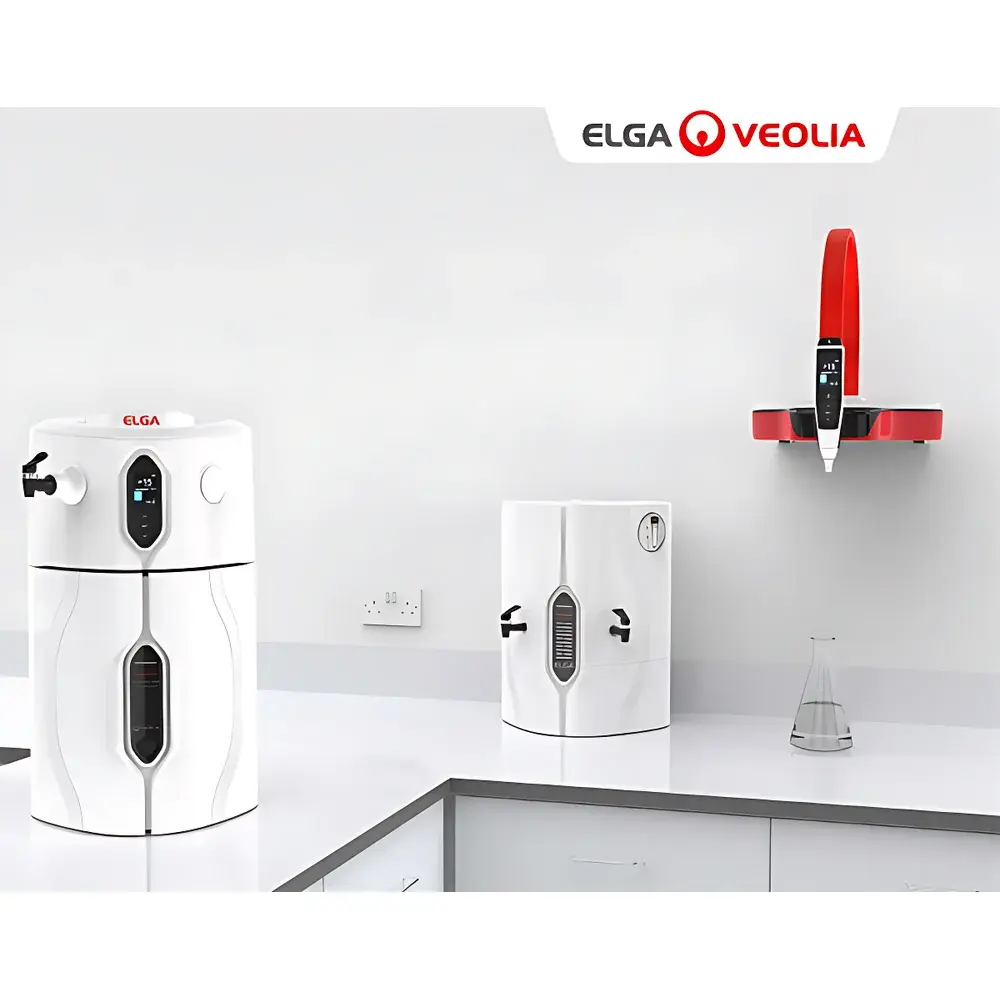
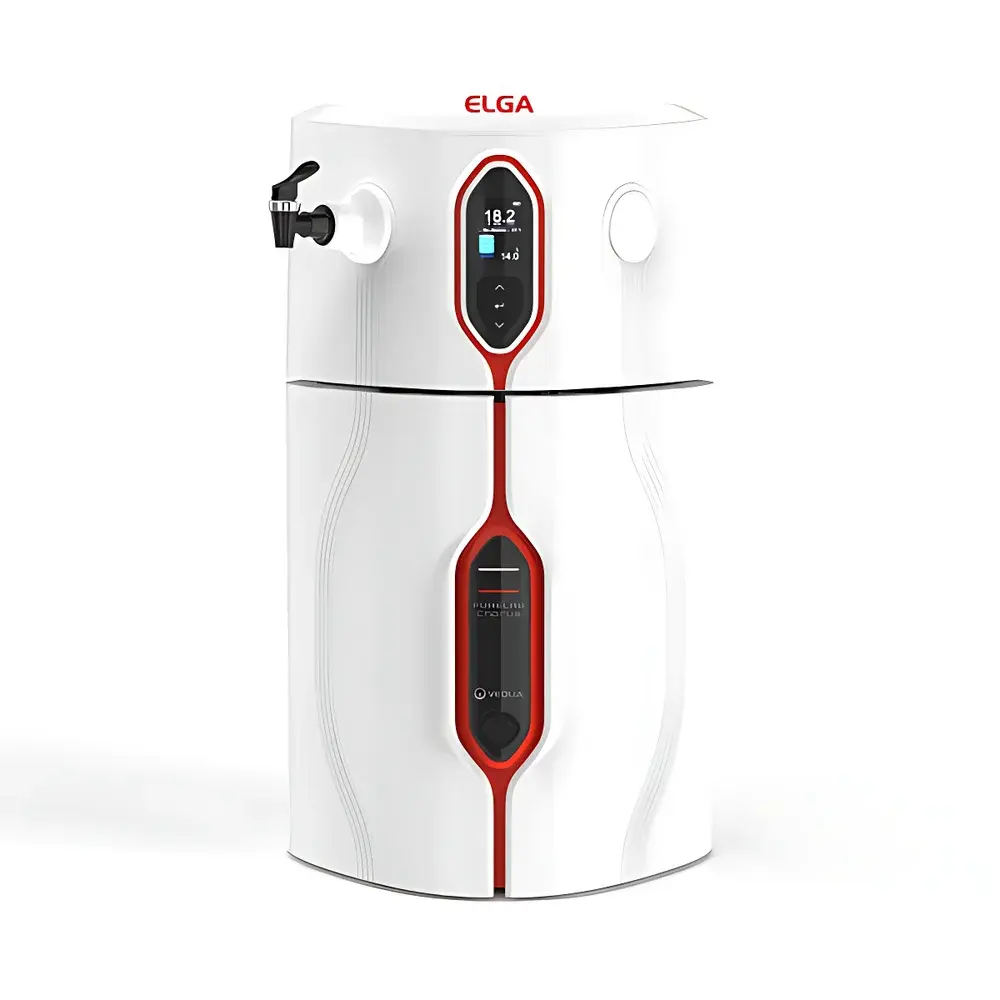
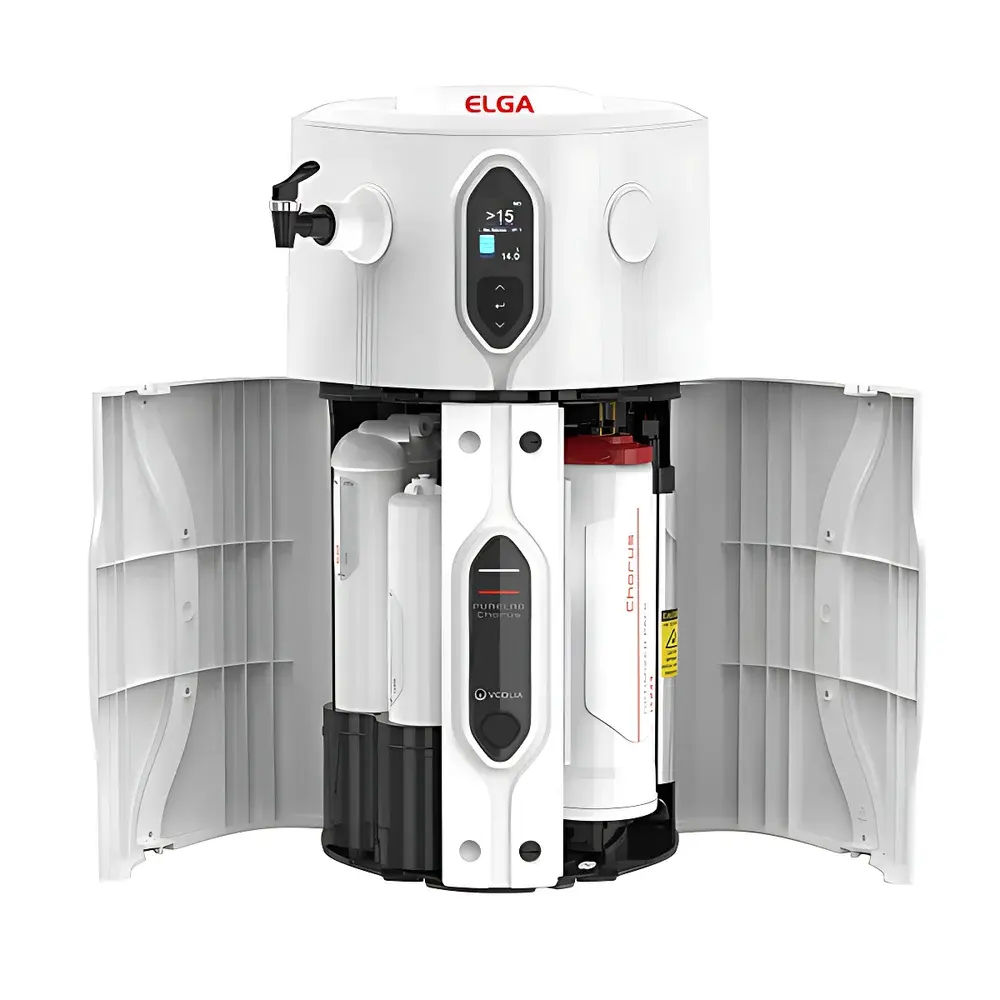
ELGA PURELAB Chorus 1 Complete and Chorus 2+ Ultra-Pure Water Systems
| Brand | ELGA (Veolia) |
|---|---|
| Origin | United Kingdom |
| Manufacturer Type | Original Equipment Manufacturer (OEM) |
| Import Status | Imported |
| Model | Chorus 1 Complete / Chorus 2+ |
| Pure Water Grade | Type I (Ultra-Pure) |
| Resistivity | 18.2 MΩ·cm at 25 °C |
| Heavy Metals & Soluble Silica | <0.1 ppb |
| Total Organic Carbon (TOC) | <5 ppb |
| Microbial Count / Endotoxins | <0.001 EU/mL |
| Particulates (>0.1 µm) | ≤0.2 particles/mL |
Overview
The ELGA PURELAB Chorus 1 Complete and Chorus 2+ are integrated, modular ultra-pure and high-purity water systems engineered for laboratories requiring consistent, on-demand production of Type I (ultra-pure) and Type II+ (high-purity) water per ISO 3696, ASTM D1193, and CLSI EP23 guidelines. Both systems employ a multi-stage purification architecture—combining reverse osmosis (RO), electrodeionization (EDI), dual-wavelength UV oxidation (185/254 nm), and final 0.1 µm filtration—to achieve and sustain resistivity ≥18.2 MΩ·cm (Chorus 1 Complete) or ≥15 MΩ·cm (Chorus 2+) with sub-ppb contaminant control. The Chorus 1 Complete delivers ultra-pure water directly from the main unit or via optional Halo dispensers, while the Chorus 2+ utilizes ELGA’s proprietary full-recirculation EDI technology—unique in commercial laboratory water systems—to maintain stable ion removal performance without resin exhaustion or chemical regeneration. This architecture eliminates batch variability and supports continuous, low-maintenance operation across diverse analytical, life science, and clinical applications.
Key Features
- Full-recirculation EDI loop (Chorus 2+) ensures constant conductivity suppression and >15 MΩ·cm stability without resin replacement or downtime.
- Dual-wavelength UV photooxidation (185 nm + 254 nm) reduces TOC to 99.9% of microorganisms in recirculating loops.
- Modular Halo dispenser ecosystem: supports up to four independent dispensers—including fixed-position Halo Basic/Advanced and handheld Halo Flex—with programmable flow rates (0.01–2 L/min), volumetric dispensing (50 mL–60 L), and user-defined presets.
- Circulating storage tanks (15, 30, 60, or 100 L) equipped with CO₂-removing and sterile-grade vent filters to prevent atmospheric recontamination.
- Real-time, point-of-use resistivity, TOC, and temperature monitoring with audible/visual alarms and data logging compliant with FDA 21 CFR Part 11 audit trail requirements.
- CE-marked and certified to IEC/EN 61010-1 and UL 61010-1 for electrical safety; RoHS and WEEE compliant; manufactured under ISO 9001:2008 and ISO 14001:2004 certified quality management systems.
Sample Compatibility & Compliance
These systems produce water meeting or exceeding specifications for critical laboratory applications including atomic absorption spectroscopy (AAS), flame AAS (FAAS), electrophysiology, ELISA, RIA, HPLC mobile phase preparation, cell culture media formulation, and buffer/pH standard calibration. All output water complies with ISO 3696:1987 (Grade 1), ASTM D1193-20 (Type I), and CLSI EP23-Ed1 for trace metal analysis. Endotoxin levels (<0.001 EU/mL) and microbial counts (<1 CFU/100 mL) satisfy USP and EP 2.2.47 requirements for sterile pharmaceutical water preparation support. System design conforms to GLP and GMP operational expectations, with full traceability of calibration, maintenance, and alarm events.
Software & Data Management
Integrated touchscreen interface provides real-time system status, historical trend graphs (resistivity, TOC, UV intensity, pressure differentials), and event logs exportable via USB or Ethernet. Optional ELGA Connect™ software enables remote monitoring, predictive maintenance alerts, and secure cloud-based data backup. Audit trails record all operator actions, parameter changes, and alarm acknowledgements with user authentication and timestamping—fully aligned with FDA 21 CFR Part 11 electronic records and signatures requirements. Calibration certificates and factory test reports are supplied with each unit, traceable to NIST standards.
Applications
- Analytical instrumentation: ICP-MS, GC-MS, LC-MS, AAS, FAAS, UV-Vis spectrophotometry
- Life sciences: mammalian cell culture, PCR/qPCR reagent preparation, electrophoresis, transfection media
- Clinical diagnostics: immunoassay diluents, hematology controls, histology staining solutions
- Pharmaceutical QA/QC: buffer preparation, reference standard dilution, cleaning validation rinses
- Materials science: nanomaterial synthesis, thin-film deposition, semiconductor wafer rinsing
- General lab use: glassware rinsing, autoclave feed, pH meter calibration, reagent grade water replacement
FAQ
What distinguishes Chorus 2+’s EDI technology from conventional EDI systems?
Chorus 2+ employs ELGA’s patented full-recirculation EDI configuration—where the entire product stream continuously passes through the EDI module—ensuring uninterrupted ion removal efficiency and eliminating concentration polarization. This differs fundamentally from single-pass EDI designs that degrade over time and require periodic resin replacement.
Can Chorus 1 Complete and Chorus 2+ be installed in non-traditional locations?
Yes. The compact footprint and flexible Halo dispenser architecture allow benchtop, under-bench, or wall-mounted installation. Halo units operate independently via dedicated tubing runs, enabling decentralized water access without compromising purity.
Is TOC monitoring performed at the point of use?
Yes. Integrated TOC sensors are located downstream of the final filter and UV chamber, providing real-time measurement at every Halo dispenser outlet—not just at the main unit.
How does the system ensure endotoxin control?
Endotoxin reduction is achieved through sequential barriers: 0.1 µm final filtration, 254 nm UV irradiation (disrupting LPS aggregates), and recirculation through a dedicated ultrafiltration loop (optional on Chorus 2+ configurations).
Are service intervals and consumables tracked automatically?
Yes. The onboard controller monitors usage hours, pressure drops, UV lamp intensity decay, and EDI current draw to predict optimal replacement timing for cartridges, UV lamps, and vent filters—generating maintenance reminders with part numbers and procedures.



