
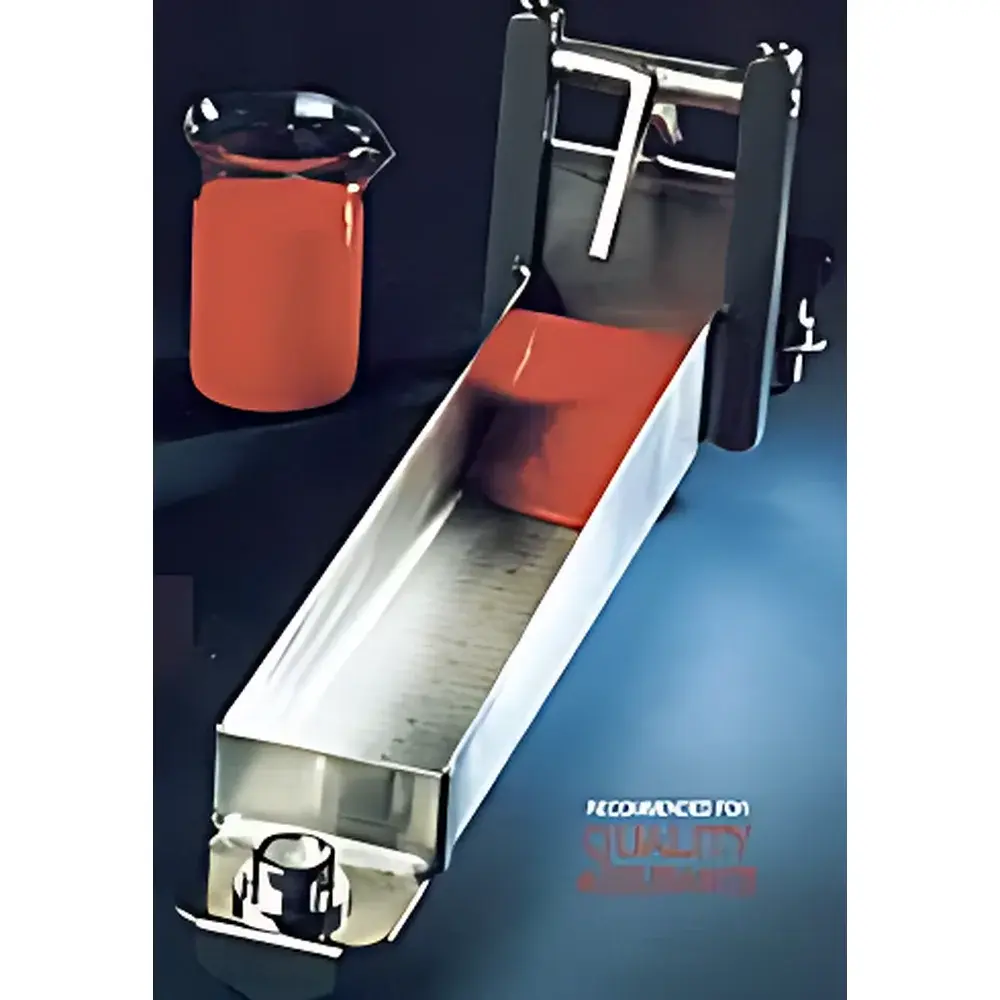
Endecotts Bostwick Consistometer
| Brand | Endecotts |
|---|---|
| Origin | United Kingdom |
| Model | Bostwick |
| Instrument Type | Fixed-Geometry Flow Consistometer |
| Sample Volume | 75 mL |
| Dimensions (L×W×H) | 14 in × 3.5 in × 5.5 in |
| Construction | Electropolished 2 mm stainless steel plate |
| Graduation Scale | 0.5 cm increments |
| Leveling | Dual leveling screws + bubble level |
| Flow Gate | Spring-loaded instantaneous release gate |
| Operating Environment | Ambient temperature |
| Compliance | Designed for routine QC per ASTM D1984, ISO 10664, and USP <911> guidelines |
| Application Domain | Food, dairy, sauces, pastes, cosmetics, coatings |
Overview
The Endecotts Bostwick Consistometer is a fixed-geometry, gravity-driven flow instrument engineered for rapid, repeatable assessment of consistency, flow behavior, and structural yield characteristics of semi-solid and highly viscous non-Newtonian materials. Unlike rotational viscometers that quantify shear stress versus shear rate, the Bostwick operates on the principle of controlled gravitational flow under standardized geometry—making it especially suited for quality control applications where simplicity, speed, and inter-laboratory reproducibility are critical. It measures the distance (in cm) a sample flows under its own weight over a defined time interval—typically 30 seconds—along a precisely machined stainless steel channel inclined at a fixed angle. This empirical yet standardized metric correlates strongly with sensory texture perception and processing performance in food, dairy, cosmetic, and coating formulations.
Key Features
- Robust electropolished 2 mm stainless steel construction ensures long-term corrosion resistance and compliance with hygienic design requirements for food-grade environments.
- Spring-loaded gate mechanism delivers instantaneous, consistent sample release—eliminating operator-induced variability in initiation timing.
- Dual precision leveling screws and integrated bubble level enable accurate horizontal alignment prior to each test, directly impacting measurement fidelity.
- Calibrated scale engraved at 0.5 cm intervals along the flow channel provides high-resolution visual readout without requiring external instrumentation or software.
- Compact footprint (14″ × 3.5″ × 5.5″) allows deployment on limited bench space in both R&D labs and production-floor QC stations.
- Validated for use with only 75 mL of sample—minimizing material consumption while maintaining statistical relevance for batch release testing.
Sample Compatibility & Compliance
The Bostwick Consistometer is widely applied across industries handling structured fluids exhibiting yield stress behavior—including tomato paste, yogurt, fruit spreads, mayonnaise, pharmaceutical gels, paint bases, and cosmetic creams. Its methodology aligns with internationally recognized standards including ASTM D1984 (Standard Test Method for Consistency of Tomato Products), ISO 10664 (Foodstuffs — Determination of consistency of fruit and vegetable products), and USP (Rheological Measurements for Pharmaceutical Dosage Forms). The instrument’s mechanical design supports GLP-compliant documentation when paired with standardized SOPs and manual log entries; though not electronically audit-trail enabled, its physical traceability satisfies basic regulatory expectations for routine process monitoring in GMP-aligned facilities.
Software & Data Management
The Bostwick Consistometer functions as a standalone mechanical device with no embedded electronics or proprietary software. All measurements are recorded manually using stopwatch timing and direct scale reading. This analog architecture eliminates calibration drift associated with sensors and avoids validation complexities related to electronic data capture systems. Users maintain traceability through paper-based or LIMS-integrated recordkeeping—recording sample ID, ambient temperature, flow distance (cm), elapsed time (s), and operator initials. For laboratories operating under FDA 21 CFR Part 11 requirements, supplementary documentation controls (e.g., controlled forms, reviewer sign-offs, retention protocols) ensure data integrity without compromising the instrument’s operational simplicity.
Applications
- Food manufacturing: Routine QC of ketchup, salsa, jam, and sour cream consistency against internal specifications or customer-defined flow thresholds.
- Dairy processing: Monitoring structural breakdown during fermentation or heat treatment of yogurts and cultured creams.
- Cosmetic formulation: Screening thickener efficacy and batch-to-batch uniformity in lotion, gel, and mask bases.
- Coatings & inks: Assessing sag resistance and leveling behavior of high-solids dispersions prior to spray application.
- R&D screening: Rapid comparative evaluation of ingredient substitutions (e.g., hydrocolloid blends) without requiring full rheological profiling.
FAQ
What is the difference between a Bostwick Consistometer and a rotational viscometer?
The Bostwick measures flow distance under gravity over time—a single-point, macroscopic consistency index—while rotational viscometers apply controlled shear to determine viscosity profiles across shear rates. The Bostwick is faster and more operator-friendly for pass/fail QC; rotational devices provide deeper rheological insight for formulation development.
Can the Bostwick be used for Newtonian liquids?
It is not recommended for low-viscosity Newtonian fluids (e.g., water, ethanol), as they flow beyond the scale or exhibit negligible yield behavior. It is optimized for structured, yield-stress materials with measurable flow resistance.
How often does the instrument require calibration verification?
Endecotts recommends annual verification using certified reference standards (e.g., NIST-traceable silicone gels) or inter-instrument comparison protocols. Physical geometry remains stable; primary maintenance involves cleaning and visual inspection of the gate and scale.
Is temperature control possible with this model?
No—the standard Bostwick operates at ambient conditions only. For temperature-dependent testing, users must precondition samples and conduct tests in climate-controlled rooms per ASTM D1984 Annex A1.
Does Endecotts provide method validation support?
Yes—Endecotts supplies application notes, SOP templates, and technical bulletins aligned with ISO/IEC 17025 principles to assist laboratories in establishing measurement uncertainty budgets and method transfer protocols.



