
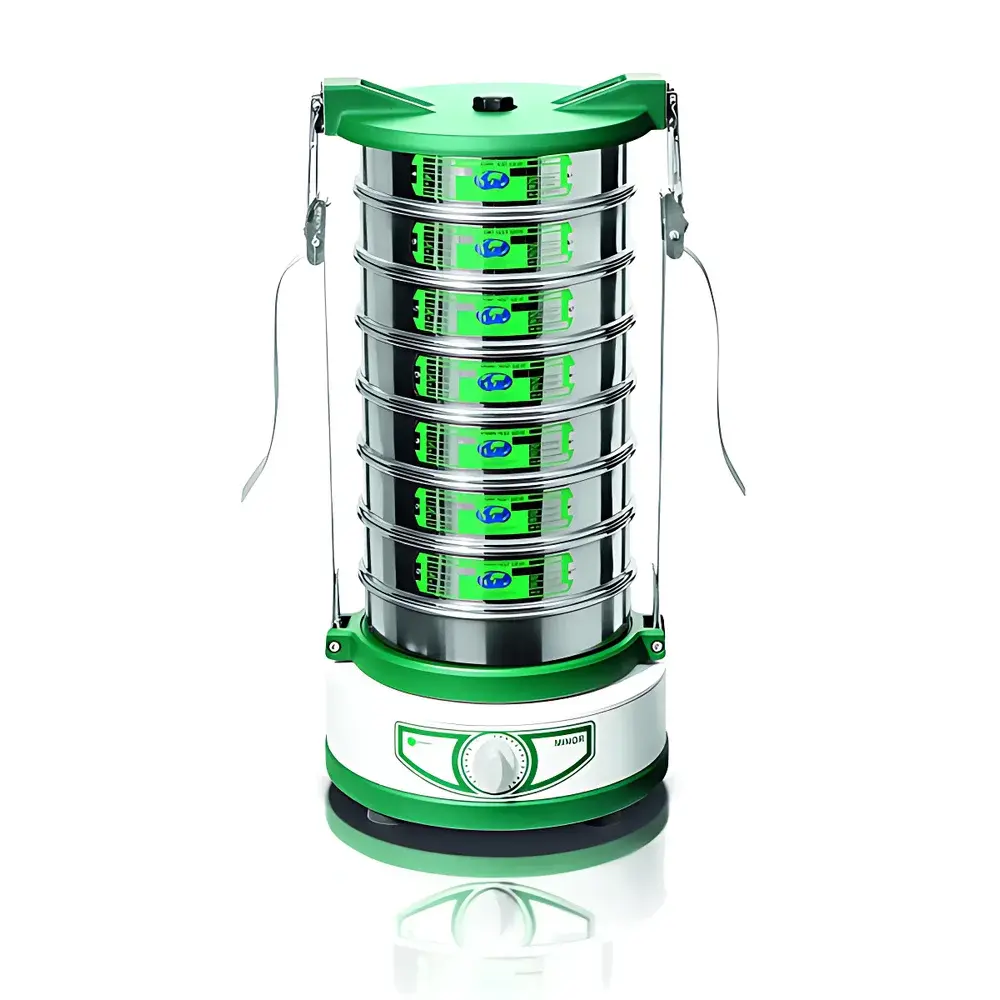
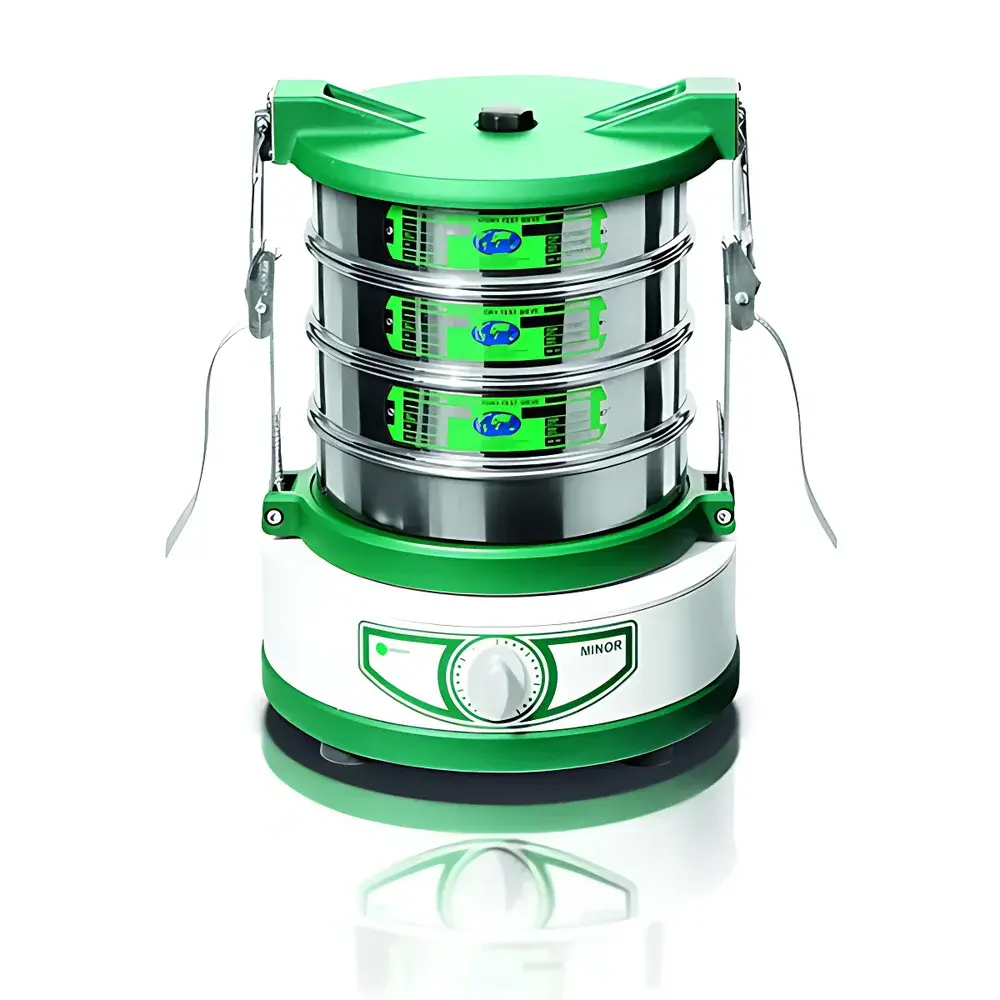
Endecotts Minor 200 Electromagnetic Sieve Shaker
| Brand | Endecotts |
|---|---|
| Origin | United Kingdom |
| Model | Minor 200 |
| Drive Type | Electromagnetic |
| Max Sample Capacity | 4 kg |
| Sieve Diameter Compatibility | 100 mm, 200 mm, 8 inch |
| Max Sieves per Stack | 8 (full-height) or 16 (half-height) |
| Vibration Amplitude | 1.6 mm (fixed) |
| Vibration Frequency | 3000 cycles/min @ 50 Hz |
| Timer Range | 0–60 min (mechanical dial) or continuous mode ("I") |
| Power Supply | 230 V, 50 Hz / 115 V, 60 Hz, 300 VA |
| Dimensions (W×H×D) | 315 × 126 × 287 mm |
| Net Weight | 17 kg |
| Ingress Protection | IP54 |
| Compliance | CE |
| Enclosure Type | Benchtop |
| Fixation Method | Polymeric tension belt |
| Base Stability | Anti-vibration rubber feet |
| Particle Size Range | 38 µm – 125 mm |
Overview
The Endecotts Minor 200 Electromagnetic Sieve Shaker is a precision-engineered benchtop instrument designed for standardized dry particle size analysis in accordance with ISO 9048, ASTM E11, and BS 410. Unlike rotary or mechanical shakers, the Minor 200 employs a controlled electromagnetic drive system that delivers consistent, repeatable vertical oscillation—eliminating rotational torque, gear wear, and mechanical backlash. This principle ensures high reproducibility across repeated sieving runs, particularly critical for QC laboratories operating under GLP or ISO/IEC 17025 frameworks. Its compact footprint (315 × 126 × 287 mm) and low mass (17 kg) make it suitable for space-constrained environments—including cleanrooms, production line labs, and mobile quality control units—without compromising structural rigidity or vibration isolation performance.
Key Features
- Electromagnetic drive mechanism delivering fixed 1.6 mm amplitude and 3000 cycles/min frequency at 50 Hz (or equivalent at 60 Hz), ensuring stable energy transfer to the sieve stack independent of load mass.
- Belt-based clamping system using reinforced polymeric tension straps—designed for rapid, tool-free assembly of full-height (8-sieve) or half-height (16-sieve) stacks with 100 mm, 200 mm, or 8-inch diameter sieves.
- Mechanical timer with 0–60 minute range and continuous (“I”) mode; no digital electronics or firmware dependencies—enhancing long-term reliability and minimizing calibration drift risks.
- IP54-rated enclosure with sealed electromagnetic actuator and dust-resistant housing, meeting environmental protection requirements for industrial laboratory settings.
- Anti-vibration rubber feet provide passive damping and prevent transmission of oscillatory energy to adjacent instrumentation or work surfaces.
- No rotating parts, lubrication points, or consumable drive components—resulting in zero scheduled maintenance and extended mean time between failures (MTBF).
Sample Compatibility & Compliance
The Minor 200 is validated exclusively for dry sieving applications involving free-flowing, non-cohesive powders and granular solids. It supports sieve meshes ranging from 38 µm (400 mesh) up to 125 mm (coarse aggregate classification), fully covering specifications outlined in ISO 3310-1 and ASTM E11. The device accommodates standard test sieves conforming to EN 933-1, USP , and Ph. Eur. 2.9.31. While not rated for wet sieving or abrasive slurries, its rigid base and belt-tensioned stack design minimize lateral displacement during high-frequency excitation—ensuring minimal sieve edge wear and consistent aperture exposure over thousands of operational cycles. CE marking confirms conformity with EU Machinery Directive 2006/42/EC and Low Voltage Directive 2014/35/EU.
Software & Data Management
The Minor 200 operates as a standalone electromechanical instrument without embedded software, network interfaces, or data logging capabilities. This architecture aligns with laboratories prioritizing auditability, deterministic operation, and regulatory simplicity—particularly those subject to FDA 21 CFR Part 11 requirements where electronic records must be validated. Users record sieve residue masses manually or integrate results into LIMS via external balance interfaces. The absence of firmware eliminates cybersecurity vulnerabilities, firmware update dependencies, or timestamp synchronization issues common in connected instruments. All operational parameters—including timing, amplitude, and frequency—are factory-set and mechanically invariant, supporting traceable method validation per ISO/IEC 17025 clause 7.2.2.
Applications
This shaker serves core functions across pharmaceutical excipient release testing, mineral processing QC, construction materials grading (e.g., sand, gravel, cement), food ingredient particle distribution verification, and ceramic raw material screening. Its repeatability supports routine pass/fail testing against specification limits (e.g., USP for particle size distribution of inhalation powders), batch homogeneity assessment in API manufacturing, and sieve analysis of catalyst supports in petrochemical R&D. Due to its portability and low power demand (300 VA), it is frequently deployed in field laboratories conducting on-site aggregate compliance checks per ASTM D6913 or EN 13242.
FAQ
Is the Minor 200 suitable for wet sieving?
No. It is engineered exclusively for dry sieving applications. Wet sieving requires sealed motor housings, corrosion-resistant components, and fluid containment systems not present in this model.
Can I use non-Endecotts brand sieves?
Yes—provided they comply with ISO 3310-1 dimensional tolerances and are manufactured to 200 mm or 8-inch outer diameter standards with compatible frame height and rim geometry.
Does the unit require periodic calibration?
While no formal calibration certificate is issued, users should verify timer accuracy annually using a certified stopwatch and confirm mechanical integrity of tension belts and mounting surfaces per internal SOPs.
What is the expected service life under typical lab usage?
With proper handling and avoidance of overloading (>4 kg), the electromagnetic actuator and structural frame are rated for ≥10 years of daily operation at 2–3 cycles per hour.
Is the Minor 200 compliant with GMP documentation requirements?
Yes—its deterministic mechanical design, lack of configurable software, and CE-certified safety architecture support straightforward inclusion in equipment qualification protocols (IQ/OQ/PQ) under EU Annex 15 and FDA guidance.



