
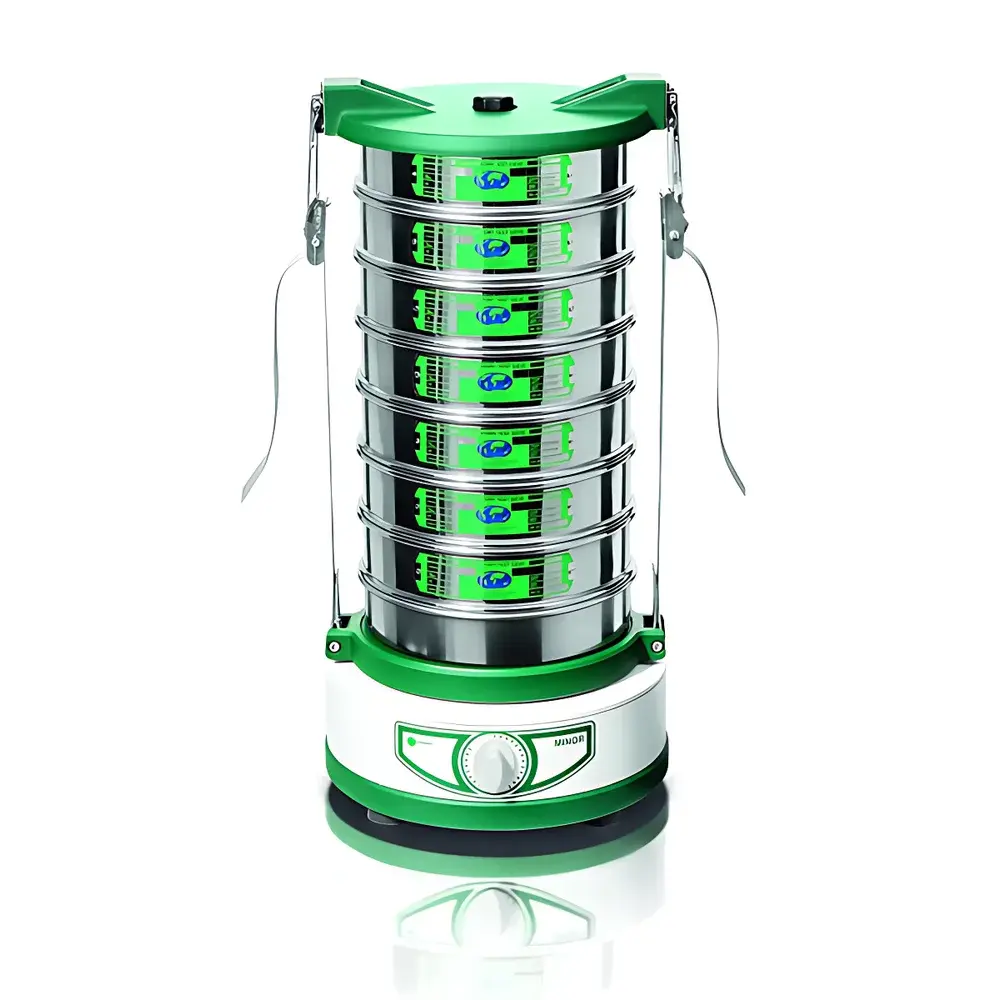
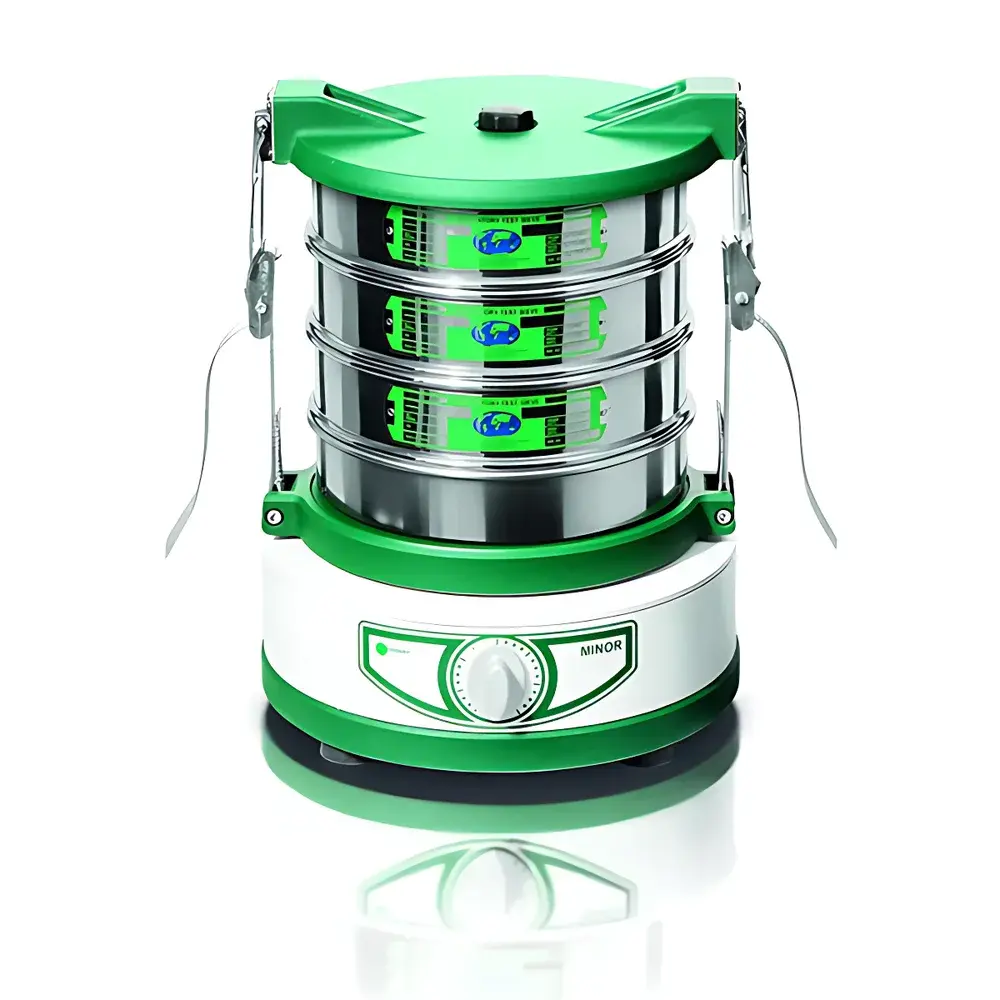
Endecotts Minor 200 Lightweight Vibratory Sieve Shaker
| Brand | Endecotts |
|---|---|
| Origin | United Kingdom |
| Model | MINOR |
| Drive Type | Electromagnetic |
| Max Sample Capacity | 4 kg |
| Sieve Diameter Compatibility | 100 mm, 200 mm, 8 inch |
| Max Number of Sieves | 8 (full-height) or 16 (half-height) |
| Vibration Amplitude | 1.6 mm (fixed) |
| Vibration Frequency | 3000 rpm @ 50 Hz |
| Timer Range | 0–60 min (mechanical dial) or continuous mode ("I") |
| Operating Mode | Dry sieving only |
| Enclosure Rating | IP54 |
| Power Supply | 230 V, 50 Hz / 115 V, 60 Hz, 300 VA |
| Dimensions (W×H×D) | 315 × 126 × 287 mm |
| Net Weight | 17 kg |
| Compliance | CE-marked |
| Sieve Fixation | Polymeric tension belt system |
| Footing | Vibration-damping rubber feet |
| Height Clearance Requirement | ≤200 mm |
Overview
The Endecotts Minor 200 Lightweight Vibratory Sieve Shaker is an electromagnetically driven, benchtop particle size analyzer engineered for precise, reproducible dry sieve analysis in quality control, R&D, and routine production environments. Unlike rotary or mechanical shakers, the Minor 200 employs a fixed-amplitude, high-frequency electromagnetic excitation system (3000 rpm at 50 Hz) to induce controlled vertical oscillation—minimizing lateral shear forces and preserving particle integrity during separation. Its compact footprint (315 × 287 mm base), low profile (126 mm height), and 17 kg net weight enable seamless integration into constrained laboratory workspaces or mobile QC stations. Designed in accordance with ISO 2591-1, ISO 9276-2, and ASTM E11 standards for test sieve specifications and sieving methodology, the Minor 200 delivers consistent performance across the full analytical range—from coarse granules (125 mm) down to fine powders (38 µm)—without requiring lubrication, belt replacement, or motor alignment.
Key Features
- Electromagnetic drive mechanism ensures silent operation (<65 dB(A)) and zero rotating parts—eliminating wear-related calibration drift and scheduled maintenance.
- Polymeric tension belt clamping system securely holds stacked sieves (up to 8 full-height or 16 half-height units) without distortion, accommodating standard 100 mm, 200 mm, and 8-inch diameter test sieves per ISO 3310-1 and ASTM E11.
- Vibration-damping rubber feet provide stable operation on non-reinforced lab benches; device operates reliably within ≤200 mm vertical clearance—ideal for fume hoods or under-shelf installations.
- Mechanical timer with 0–60 minute range and continuous (“I”) mode enables unattended operation while maintaining traceable process parameters for GLP-compliant documentation.
- IP54-rated enclosure protects internal electronics from dust ingress and incidental splashing—suitable for shared lab environments where powder handling occurs adjacent to instrumentation.
- Universal dual-voltage power supply (115 V / 230 V, 50/60 Hz) ensures global deployment without transformer dependency; 300 VA draw supports sustained duty cycles without thermal throttling.
Sample Compatibility & Compliance
The Minor 200 is validated exclusively for dry sieving applications involving free-flowing, non-agglomerating particulates—including metal powders, pharmaceutical granules, mineral ores, catalysts, and polymer beads. It is not rated for wet sieving, sticky, hygroscopic, or electrostatically charged materials. All mechanical interfaces comply with ISO 2591-1:2022 for sieving procedure validation and ISO 9276-2:2019 for particle size distribution reporting conventions. The unit carries CE marking per the EU Machinery Directive 2006/42/EC and Low Voltage Directive 2014/35/EU, confirming conformity with essential health and safety requirements. While the instrument itself does not embed electronic audit trails, its deterministic mechanical timer and fixed vibration profile support manual SOP adherence in GMP-regulated settings (e.g., USP , EP 2.9.32).
Software & Data Management
The Minor 200 operates as a standalone hardware platform with no embedded microprocessor, firmware, or digital interface. All operational parameters—including time, amplitude, and frequency—are mechanically fixed or manually selected via analog controls. This architecture eliminates software validation requirements under FDA 21 CFR Part 11 and simplifies qualification protocols (IQ/OQ/PQ) for regulated industries. Users record results manually or integrate output into LIMS via external balance data capture (e.g., weight loss per sieve fraction). Documentation packages include full mechanical schematics, CE declaration of conformity, and ISO-standardized test sieve compatibility matrices—enabling straightforward traceability in audit scenarios.
Applications
- Pharmaceutical solid dosage development: Granule size distribution verification prior to compression or capsule filling per USP .
- Mineral processing QA: On-site screening of crushed ore fractions to verify compliance with mill discharge specifications.
- Advanced ceramics manufacturing: Classification of spray-dried zirconia or alumina powders to ensure green body density uniformity.
- Food ingredient QC: Validation of flour, sugar, or spice particle fineness against Codex Alimentarius sieve specifications.
- Abrasive media grading: Verification of grit size consistency for coated abrasives and blasting media per FEPA standards.
- Academic research: Teaching laboratories use the Minor 200 to demonstrate fundamental principles of particle segregation mechanics and Stokes’ law limitations.
FAQ
Is the Minor 200 suitable for wet sieving?
No. The unit lacks liquid containment features, sealed drive components, or corrosion-resistant materials required for aqueous or solvent-based sieving.
Can I use non-Endecotts brand sieves?
Yes—provided they conform to ISO 3310-1 or ASTM E11 dimensional tolerances and are available in 100 mm, 200 mm, or 8-inch diameters with compatible frame heights.
Does the device require periodic recalibration?
No. The electromagnetic actuator’s fixed 1.6 mm amplitude and 3000 rpm frequency are factory-set and inherently stable; only mechanical integrity (belt tension, foot adhesion) requires visual inspection.
What is the maximum allowable stack height when using half-height sieves?
The total assembled height—including top lid, sieve stack, and receiver pan—must not exceed 200 mm to ensure stable operation and full travel clearance.
Is the Minor 200 compliant with FDA 21 CFR Part 11?
Not applicable—no electronic records or signatures are generated. Its mechanical design satisfies ALCOA+ principles for attributable, legible, contemporaneous, original, accurate, and complete manual data recording.



