
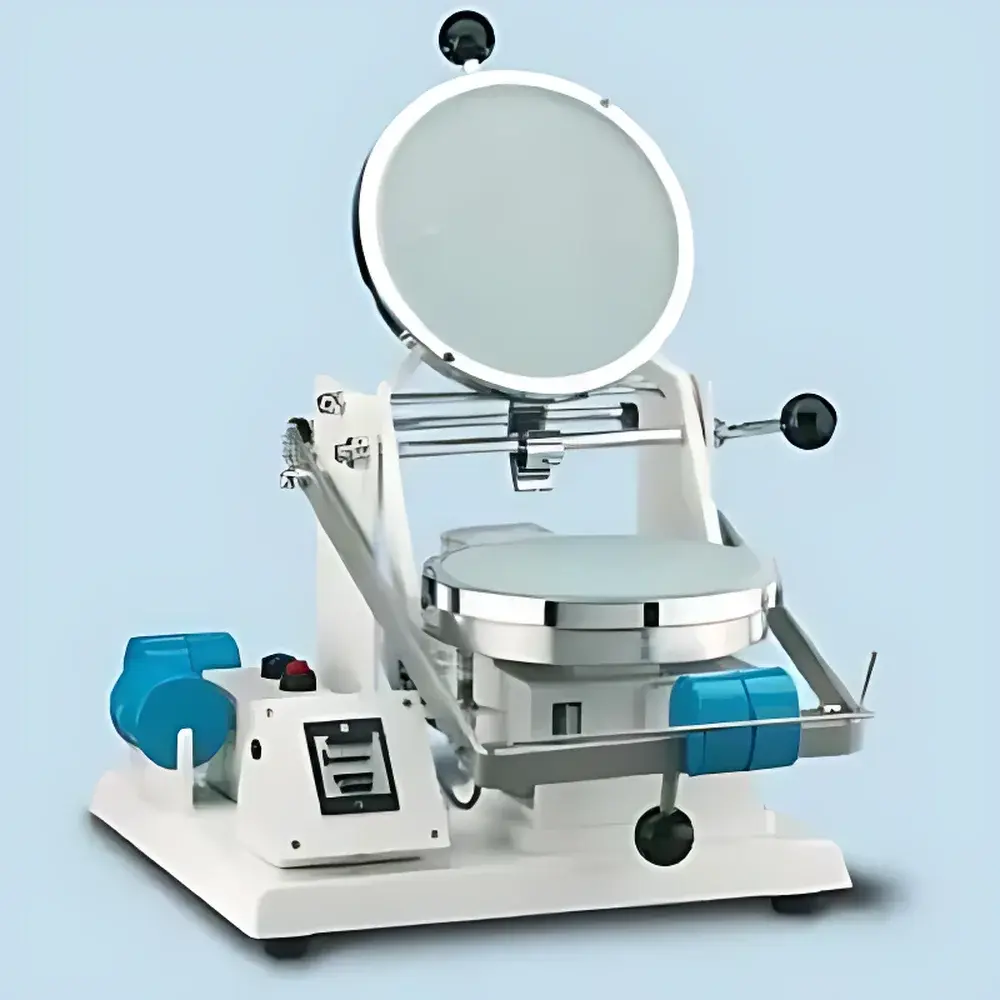
Engelsmann JEL 25/53 Automatic Flat Grinding Mill
| Brand | Engelsmann |
|---|---|
| Origin | Germany |
| Model | JEL 25/53 |
| Motor Power | 0.37 kW |
| Rotational Speed | 72 rpm |
| Dimensions (L×W×H) | 600 × 480 × 400 mm |
| Net Weight | ~80 kg |
| Grinding Plate Diameter | 250 mm |
| Load Weights Available | 8.5, 25, 37.5, 50, 62.5, 75, 87.5, 100 kg |
| Counter | 5-digit digital |
| Grinding Media | Replaceable flat tempered glass plates |
| Optional | Circulating water-cooled grinding plates |
Overview
The Engelsmann JEL 25/53 Automatic Flat Grinding Mill is a precision-engineered laboratory instrument designed for standardized particle size reduction and dispersion evaluation in pigment and coating formulation workflows. Operating on the principle of controlled parallel-plate grinding—where sample material is subjected to uniform compressive force and rotational shear between two precisely aligned flat glass plates—the JEL 25/53 delivers reproducible mechanical treatment under defined load, speed, and time parameters. Its fixed rotational speed of 72 rpm ensures consistent energy input per unit time, while the rigid cast-iron frame and low-noise integrated motor (0.37 kW) provide mechanical stability critical for inter-laboratory comparability. Unlike oscillating or ball-mill systems, this flat-grinding geometry enables direct assessment of relative tinting strength and dilution hue—key quality attributes governed by ISO 787-24 (Pigments—Determination of relative tinting strength) and ASTM D4499 (Standard Test Method for Relative Tinting Strength of White Pigments). The system’s compact footprint (600 × 480 × 400 mm) and modular glass plate design support integration into regulated QC laboratories where spatial efficiency and maintenance traceability are essential.
Key Features
- Integrated 0.37 kW motor with fixed 72 rpm output—engineered for torque consistency and minimal speed drift across extended operation cycles
- Eight calibrated load weights (8.5–100 kg in 12.5 kg increments) enabling precise application of normal force per ISO 787-24 Annex A
- Tempered flat glass grinding plates (Ø250 mm), easily removable and replaceable without tools—minimizing downtime and cross-contamination risk
- 5-digit digital counter with non-volatile memory for batch-level grinding cycle tracking and audit-ready documentation
- Optional water-jacketed grinding plates with external circulating chiller interface—maintains thermal stability during prolonged dispersion trials (e.g., carbon black or organic pigment slurries)
- Robust cast-alloy housing and vibration-damped base—designed for continuous use in ISO 17025-accredited testing environments
- Ergonomic manual lever actuation for rapid plate separation and sample loading—eliminates pneumatic or hydraulic subsystems that require calibration or service intervals
Sample Compatibility & Compliance
The JEL 25/53 accommodates paste-like, high-viscosity dispersions typical of organic pigments, inorganic oxides (e.g., TiO₂, Fe₂O₃), carbon blacks, and functional fillers used in paints, inks, and plastics masterbatches. Sample volumes range from 0.5 g to 5 g per test—compatible with ASTM D4499 and ISO 787-24 specimen mass requirements. All contact surfaces are chemically inert borosilicate glass; no metal-to-sample interaction occurs. The instrument meets CE marking requirements for machinery safety (2006/42/EC) and electromagnetic compatibility (2014/30/EU). When operated with documented SOPs—including weight calibration logs, plate replacement records, and counter reset protocols—it supports GLP-compliant data generation and satisfies FDA 21 CFR Part 11 expectations for electronic record integrity when paired with validated LIMS interfaces.
Software & Data Management
The JEL 25/53 operates as a stand-alone electromechanical system with no embedded firmware or proprietary software—ensuring long-term operational continuity and eliminating cybersecurity vulnerabilities associated with networked lab instruments. All process parameters (load selection, cycle count, operator ID) are recorded manually or via external digital logbooks. For laboratories requiring automated data capture, the 5-digit counter output can be interfaced with programmable logic controllers (PLCs) or industrial I/O modules using standard 0–10 V analog or TTL pulse signals (available upon request). This architecture aligns with ISA-88 and ISA-95 frameworks for hybrid manual/automated sample prep workflows and facilitates integration into enterprise-wide quality management systems (QMS) without vendor lock-in.
Applications
- Relative tinting strength determination of white and colored pigments per ISO 787-24 and ASTM D4499
- Evaluation of dispersion efficiency in aqueous and solvent-based pigment pastes
- Preparation of standardized grind gauges for Hegman fineness testing
- Controlled attrition studies of agglomerated nanomaterials (e.g., SiO₂, ZnO) prior to rheological or spectroscopic analysis
- Batch-to-batch consistency verification in pigment manufacturing QA/QC labs
- Method development for regulatory submissions requiring documented mechanical dispersion protocols (e.g., REACH, TSCA)
FAQ
What standards does the JEL 25/53 comply with for pigment testing?
It is explicitly referenced in ISO 787-24 and ASTM D4499 for relative tinting strength and dilution hue measurements.
Can the grinding plates be cooled during operation?
Yes—optional water-jacketed plates support connection to external chillers for temperature-sensitive formulations.
Is operator training required for routine use?
No formal certification is needed; however, users must follow documented SOPs covering weight selection, plate cleaning, and counter logging to ensure data validity.
How often do the glass grinding plates require replacement?
Under normal use with non-abrasive pigments, plates last ≥500 cycles; wear is visually inspectable and tracked via the counter log.
Does Engelsmann provide calibration services?
Yes—traceable load calibration (certified to DIN EN ISO/IEC 17025) and mechanical alignment verification are available through authorized service partners in EMEA and North America.



