
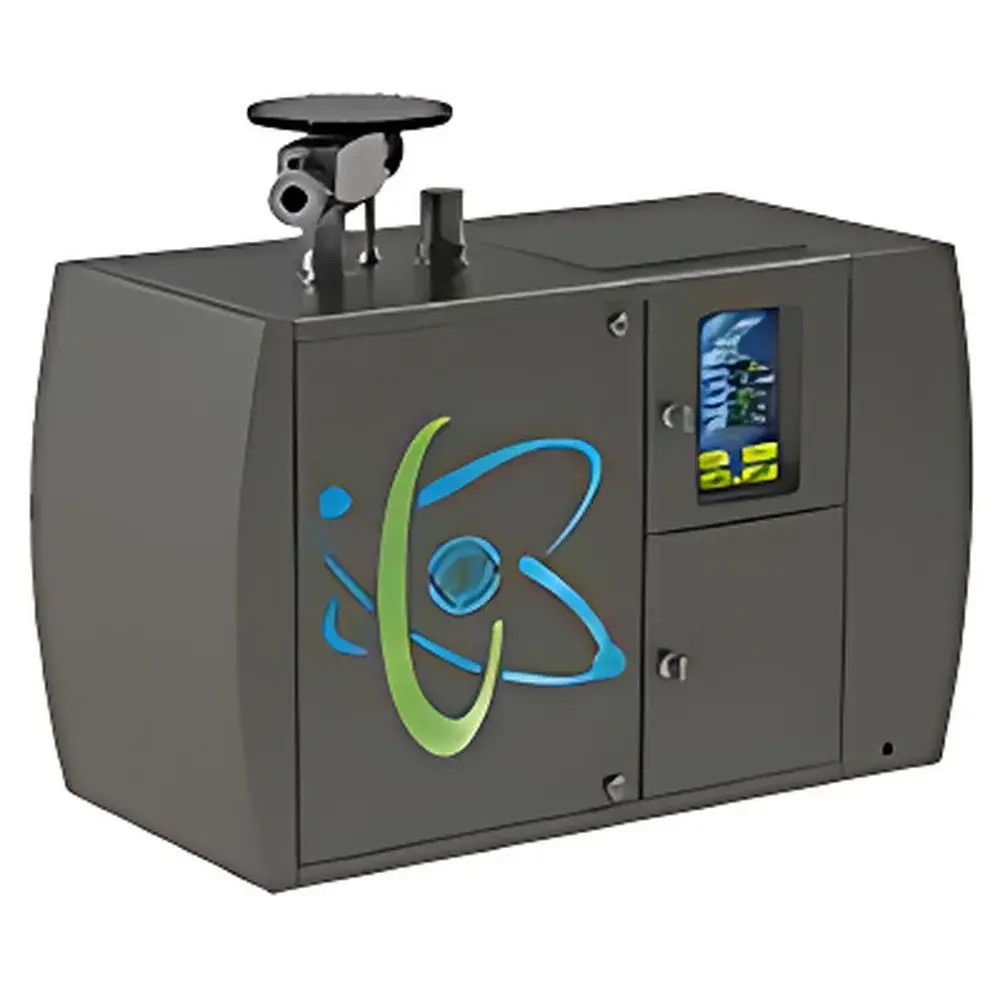
NC Technologies ECS 8060 Nitrogen and Protein Analyzer
| Brand | NC Technologies |
|---|---|
| Origin | Italy |
| Model | ECS 8060 |
| Analysis Method | Dumas Combustion |
| Detected Elements | Nitrogen (N) |
| Protein Calculation | Based on N × Conversion Factor (e.g., 6.25 for food) |
| Analysis Time | 2–8 min per sample |
| Sample Mass Range | 0.1–400 mg (up to 1000 mg for low-carbon samples) |
| Detection Limit (LOQ) | 5 µg N |
| Detector | Self-Calibrating High-Sensitivity TCD |
| Carrier Gas | Helium (99.999%, 3–5 bar) |
| Oxidant Gas | Oxygen (99.999%, 3–5 bar) |
| Auxiliary Gas | Oil-free compressed air |
| Sample Types | Solid and liquid organic matrices |
| Automation | Fully automated oxygen dosing, leak check, flow optimization, catalyst monitoring |
| Interface | Touchscreen HMI |
| Isotope Compatibility | Yes — direct coupling to IRMS systems (e.g., Thermo Fisher, Elementar, Sercon) |
| Compliance | Designed for GLP/GMP environments |
Overview
The NC Technologies ECS 8060 Nitrogen and Protein Analyzer is a high-precision, fully automated Dumas combustion-based elemental analyzer engineered specifically for quantitative nitrogen determination and subsequent protein content calculation in organic samples. Unlike Kjeldahl-based methods, the ECS 8060 employs flash combustion at temperatures up to 1,150 °C in a pure oxygen atmosphere, followed by catalytic reduction and gas chromatographic separation of combustion products (CO₂, H₂O, NOₓ, SO₂, N₂) through a thermostatically controlled GC column. The evolved nitrogen gas is quantified using a self-calibrating thermal conductivity detector (TCD), eliminating the need for reference gases and ensuring long-term baseline stability. This method conforms to internationally recognized standards including AOAC 992.15, ISO 14891, and ASTM D515–19 for nitrogen analysis in food, feed, and agricultural materials. The instrument’s architecture integrates real-time oxygen consumption monitoring, intelligent catalyst health diagnostics, and adaptive flow control—enabling reproducible results across heterogeneous sample types while minimizing consumable usage and operator intervention.
Key Features
- Fully automated Dumas combustion platform with integrated pneumatic autosampler (60-position carousel standard)
- Self-calibrating high-sensitivity TCD detector (LOQ: 5 µg N) with drift-compensated electronics and no requirement for reference gas calibration
- Intelligent oxygen dosing system that dynamically adjusts O₂ volume per sample based on mass and expected nitrogen content—reducing oxidant consumption by up to 40% versus fixed-dose systems
- Real-time catalyst activity monitoring via thermal profiling and pressure drop analytics across the reduction and purification zones
- Touchscreen HMI with intuitive workflow navigation, method templating, and embedded diagnostic logs for preventive maintenance scheduling
- Modular reaction tube design supporting three interchangeable configurations: standard quartz, high-capacity (for >500 mg samples), and low-adsorption (for volatile or sulfur-rich matrices)
- Seamless IRMS interface via standardized 1/8″ Swagelok fittings and analog/digital signal output (0–10 V, RS-232, Ethernet) for offline or online stable isotope ratio analysis (¹⁵N/¹⁴N)
Sample Compatibility & Compliance
The ECS 8060 accommodates a broad spectrum of organic sample formats without derivatization: homogeneous solids (flour, meat powder, soil), viscous liquids (milk, plant extracts), and slurries (algal biomass, fermentation broths). Sample mass ranges from 0.1 mg to 400 mg (extendable to 1,000 mg for low-carbon, high-nitrogen matrices such as urea or ammonium salts). Its gas handling system meets ISO 8573-1 Class 1 requirements for compressed air purity, and helium/oxygen supply lines incorporate dual-stage filtration (0.01 µm particulate + hydrocarbon scrubbers) to prevent detector contamination. The analyzer is designed for operation within GLP-compliant laboratories and supports full 21 CFR Part 11 compliance when deployed with NC Technologies’ optional validated software suite—including electronic signatures, audit trail logging, user role management, and data integrity verification.
Software & Data Management
Instrument control, data acquisition, and reporting are managed via NC Analyze™ v5.2 software—a Windows-based application compliant with ICH M10 and FDA guidance on bioanalytical method validation. Key capabilities include: multi-point calibration curve generation with weighting options (1/x, 1/x²), automatic blank subtraction, internal standard correction (e.g., acetanilide, caffeine), and batch-wise statistical evaluation (RSD%, recovery %, LOD/LOQ estimation). Raw chromatograms and TCD voltage traces are stored in vendor-neutral .csv and .tdf formats. Export modules support LIMS integration via ASTM E1394 and HL7 v2.x protocols. All processing parameters—including combustion temperature ramp profiles, GC oven dwell times, and detector gain settings—are version-controlled and exportable as method files for cross-instrument reproducibility.
Applications
Primary use cases center on regulatory and quality control testing in food and feed industries: crude protein quantification in cereals, dairy products, pet food, and plant-based alternatives per AOAC Official Methods 984.13 and 992.15. Additional applications include nitrogen balance studies in clinical nutrition research, protein content verification in dietary supplements, and nitrogen recovery assessment in wastewater treatment sludge. The ECS 8060 also serves as a front-end preparation module for compound-specific isotope analysis (CSIA) workflows—delivering purified N₂ streams to IRMS instruments for δ¹⁵N fingerprinting in authenticity testing (e.g., honey adulteration, organic certification, geographical origin tracing).
FAQ
What is the difference between the ECS 8060 and the ECS 8080?
The ECS 8060 is a dedicated nitrogen/protein analyzer optimized for speed, precision, and operational economy in routine food testing labs. The ECS 8080 is a full CHNS/O configuration combining dual-furnace combustion architecture with independent CN and CHNS measurement modes—offering broader elemental coverage but requiring more complex method development and higher consumable throughput.
Can the ECS 8060 analyze total Kjeldahl nitrogen (TKN)?
No—it performs only Dumas-combustion nitrogen. TKN requires acid digestion and is measured separately; however, Dumas N correlates strongly with TKN in most food matrices (r² > 0.995) and is accepted by Codex Alimentarius and EU Regulation No. 1169/2011 as an equivalent method.
Is method validation support available?
Yes—NC Technologies provides IQ/OQ/PQ documentation templates, system suitability test protocols, and on-site qualification assistance aligned with ISO/IEC 17025 and USP guidelines.
What maintenance intervals are recommended?
Catalyst replacement every 10,000 injections (typical), GC column regeneration every 6 months, and TCD filament inspection annually—guided by built-in usage counters and predictive alerts in the HMI.
Does the system require external cooling water?
No—all thermal management is air-cooled via variable-speed fans and heat-pipe-assisted dissipation; ambient operating range is 15–30 °C with ≤70% non-condensing humidity.





