
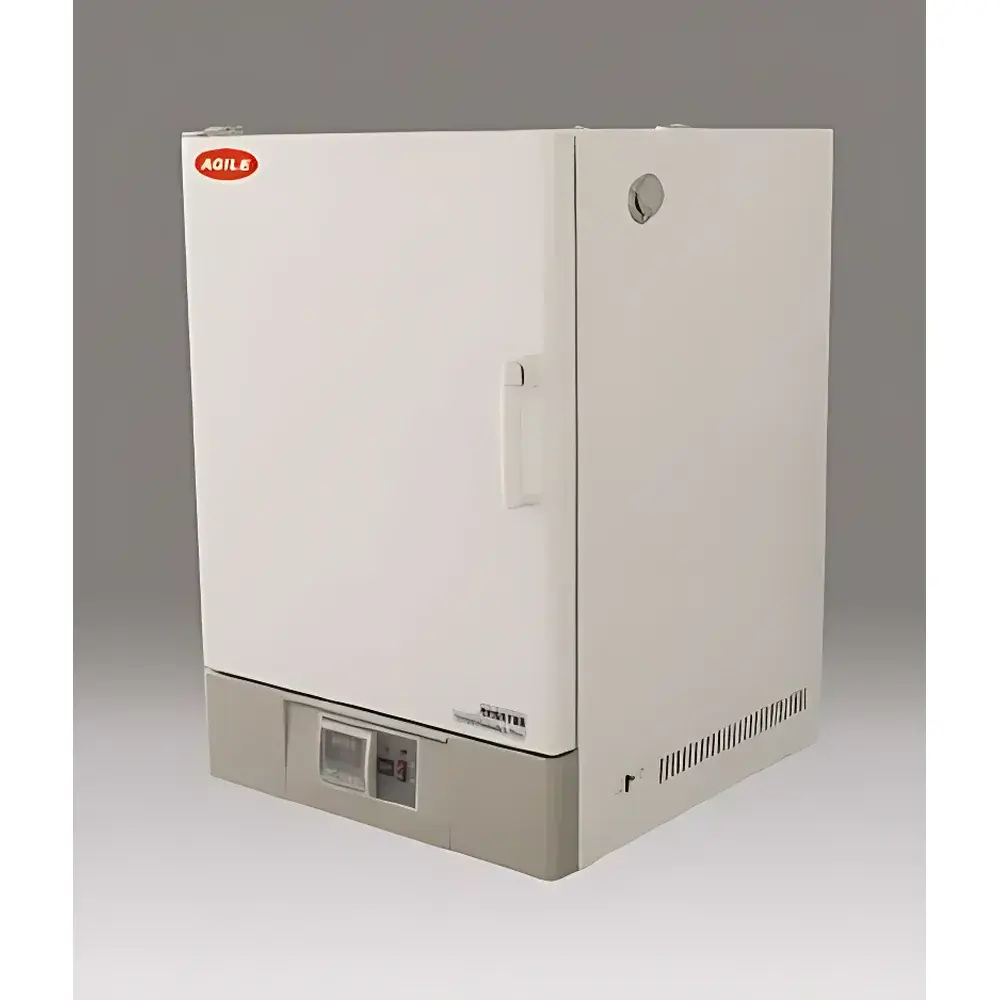
English Product Name
| Origin | China |
|---|---|
| Manufacturer Type | Authorized Distributor |
| Model | SD101-3GB / SD101-2GB / SD101-1GB / SD101-005GB / SD101-003GB |
| External Dimensions (D×W×H) | 75×71×102 cm |
| Chamber Dimensions (D×W×H) | 60×60×65 cm |
| Chamber Volume | 234 L |
| Temperature Range | Ambient +20 °C to 200 °C |
| Temperature Uniformity | ±2.5% |
| Temperature Fluctuation | ±0.5 °C |
| Heating Power | 1.8 kW |
| Control System | PID Digital Temperature Controller |
| Safety Features | Independent Over-Temperature Protection, Short-Circuit Protection |
| Compliance | JB/T 5520–1991, CE Certified |
| Construction | Vertical Configuration with Stainless Steel Interior Chamber |
Overview
The SD101-3GB Forced-Convection Electric Hot-Air Drying Oven is a precision-engineered laboratory thermal processing instrument designed for reliable, repeatable drying, baking, heat treatment, sterilization, and temperature-stability testing across R&D and production environments. Utilizing a robust forced-air circulation architecture—comprising a rear-mounted centrifugal blower and optimized ducted airflow channels—the oven ensures rapid thermal equilibration and high spatial uniformity within the stainless steel working chamber. Its operational range extends from ambient +20 °C to 200 °C, with digital PID control delivering stable setpoint maintenance (±0.5 °C fluctuation) and verified temperature uniformity of ±2.5% across the full chamber volume. The unit conforms to JB/T 5520–1991 “Technical Specifications for Drying Ovens” and carries CE marking, affirming compliance with essential EU health, safety, and environmental protection requirements for laboratory equipment.
Key Features
- Forced convection system with adjustable air velocity and directional flow optimization for consistent thermal distribution
- Digital PID temperature controller with intuitive LED display, programmable ramp/soak profiles, and real-time deviation monitoring
- Stainless steel interior chamber (AISI 304 grade) resistant to oxidation, corrosion, and thermal fatigue—suitable for repeated exposure to organic solvents and humidified samples
- Dual independent safety circuits: primary temperature controller + secondary mechanical over-temperature cutoff (adjustable up to 250 °C), plus short-circuit and ground-fault protection
- Modular panel construction with powder-coated steel exterior, ergonomic door handle, and reinforced double-glazed observation window with silicone gasket seal
- Vertical cabinet design maximizing floor-space efficiency while supporting stable stacking and integration into modular lab furniture systems
Sample Compatibility & Compliance
The SD101 series accommodates a broad spectrum of sample types—including polymer films, pharmaceutical tablets, ceramic precursors, metal coatings, biological tissue sections, and electronic components—without cross-contamination risk, thanks to its seamless stainless steel chamber and absence of internal insulation fibers. It supports routine validation protocols under ISO/IEC 17025-accredited laboratories and aligns with key regulatory frameworks: ASTM E145–22 (Standard Specification for Gravity-Convection and Forced-Ventilation Ovens), USP (Sterilization and Sterility Assurance), and ICH Q5C (Stability Testing of Biotechnological/Biological Products). While not inherently GLP/GMP-certified, its documented temperature stability, traceable calibration points, and audit-ready operational logs make it suitable for use in environments requiring 21 CFR Part 11–compliant data integrity when paired with validated external data acquisition software.
Software & Data Management
The SD101-3GB operates via embedded firmware without proprietary software dependency. All temperature setpoints, dwell times, and alarm thresholds are configured directly on the front-panel interface. For extended data logging or remote supervision, optional RS485/Modbus RTU output enables integration with third-party SCADA platforms (e.g., LabVIEW, Ignition, or Siemens Desigo CC). Calibration certificates—traceable to NIST or CNAS-accredited reference standards—are provided upon request. Users may perform periodic verification using Class A platinum resistance thermometers (Pt100) per ISO/IEC 17025 clause 6.4.3, with documented procedures supporting IQ/OQ/PQ execution during equipment qualification.
Applications
- Moisture content determination (per ASTM D2298 and ISO 62) in polymers, composites, and adhesives
- Pre- and post-weighing desiccation of filter papers, crucibles, and gravimetric analysis vessels
- Thermal aging studies of elastomers and insulating materials per IEC 60216
- Baking of printed circuit board (PCB) solder masks and conformal coatings prior to electrical testing
- Low-temperature sterilization of glassware and stainless steel tools in non-sterile research labs
- Conditioning of hygroscopic reference standards (e.g., potassium hydrogen phthalate) before titration
FAQ
What is the maximum allowable load mass for uniform heating in the SD101-3GB chamber?
The chamber supports static loads up to 30 kg distributed evenly on the standard two-shelf configuration; exceeding this may impede airflow and degrade temperature uniformity beyond ±2.5%.
Can the oven be used for sterilization at 160 °C for 2 hours?
Yes—this cycle complies with dry-heat sterilization guidelines for glassware and metal instruments per USP , provided chamber loading does not obstruct airflow and temperature mapping confirms ≥160 °C throughout the load.
Is the stainless steel interior electropolished or passivated?
The chamber features mechanically polished AISI 304 stainless steel with standard acid passivation per ASTM A967, ensuring low particle shedding and compatibility with cleanroom-adjacent applications.
Does the unit include a calibration certificate with initial delivery?
A factory calibration report (covering three-point verification at 50 °C, 100 °C, and 150 °C using traceable Pt100 probes) is included; full ISO/IEC 17025 calibration requires third-party service.
What maintenance intervals are recommended for optimal performance?
Blower motor lubrication every 12 months, door gasket inspection quarterly, and annual verification of over-temperature cutoff functionality using calibrated external thermocouple monitoring.



