
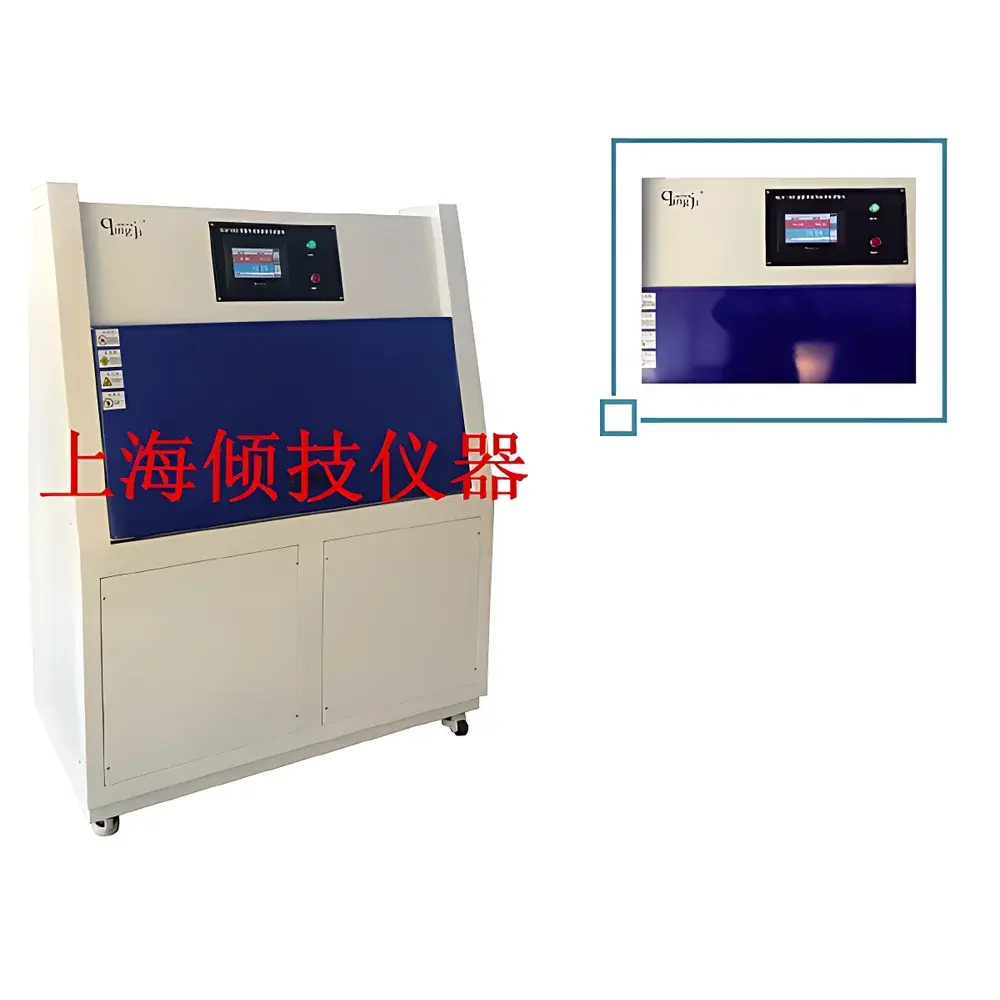
English Product Name
| Origin | Shanghai, China |
|---|---|
| Manufacturer Type | Authorized Distributor |
| Regional Classification | Domestic (PRC) |
| Model | QUV1003 (Spray-Enabled) |
| Instrument Type | Electronic Universal Testing Machine for Accelerated Aging |
| Temperature Range | RT+10°C to 70°C |
| Temperature Uniformity | ±3°C |
| Humidity During Condensation | ≥75% RH |
| Standard Irradiation Temperature Options | 50°C, 60°C (recommended), or 70°C (±3°C tolerance) |
| Condensation Temperature | 50°C (±3°C) |
| Cycle Options | 4h UV / 4h Condensation or 8h UV / 4h Condensation |
| UV Lamp Center-to-Center Spacing | 65–70 mm |
| Specimen-to-Lamp Distance | 55 mm |
| UV Spectrum | UV-B (280–315 nm) |
| Standard Specimen Size | 75 × 150 mm |
| Water Requirement | Deionized or Distilled Water, ~8 L/day |
| Internal Chamber Dimensions (D×W×H) | 450 × 1165 × 500 mm |
| Overall Dimensions (D×W×H) | 600 × 1325 × 1480 mm |
Overview
The QUV1003 UV Accelerated Weathering Tester is an electronically controlled, benchtop-scale environmental simulation system engineered for quantitative assessment of material degradation under controlled ultraviolet (UV) radiation, thermal cycling, and moisture exposure. It operates on the principle of accelerated photochemical aging—employing fluorescent UV-B lamps (280–315 nm) to replicate the most damaging portion of solar UV spectrum, combined with precisely regulated condensation and optional water spray cycles to simulate dew formation and surface wetting. This methodology aligns with ASTM G154, ISO 4892-3, and GB/T 14522–1993 for artificial weathering of plastics, coatings, elastomers, and composite materials. Unlike static mechanical testers, the QUV1003 does not apply tensile or compressive loads; rather, it subjects specimens to time-accelerated environmental stress to induce and quantify surface and bulk deterioration—including chalking, gloss loss, color shift, microcracking, delamination, and embrittlement—enabling predictive lifetime modeling and comparative formulation screening.
Key Features
- UV-B fluorescent lamp array delivering spectrally stable irradiance in the 280–315 nm range, calibrated per ISO 4892-3 Annex B
- Dual-mode exposure control: programmable UV irradiation followed by either condensation-only or condensation-plus-spray cycles
- Precise black-panel temperature regulation (±3°C uniformity) across all operational setpoints (50°C, 60°C, or 70°C during UV phase; 50°C during condensation)
- Integrated humidity control system maintaining ≥75% RH during condensation phase via saturated air chamber design
- Standard specimen rack accommodating up to 48 pieces of 75 × 150 mm test coupons, positioned at fixed 55 mm distance from lamp centers
- Robust stainless-steel interior chamber (450 × 1165 × 500 mm) resistant to UV-induced corrosion and moisture accumulation
- Compliance-ready architecture supporting audit trails, user access levels, and calibration logging for GLP/GMP-aligned laboratories
Sample Compatibility & Compliance
The QUV1003 accommodates flat, rigid, or semi-flexible specimens up to 3 mm thickness and 75 × 150 mm footprint—including injection-molded thermoplastics, powder-coated metal panels, automotive sealants, rubber gaskets, and fiber-reinforced composites. Specimens must be non-volatile and thermally stable below 70°C. The system supports multi-specimen parallel testing without cross-contamination. Regulatory alignment includes full traceability to GB/T 14522–1993, ASTM G154 Class I & II, ISO 4892-3 Method A, and JIS D 0205. While not a medical device or pharmaceutical testing instrument, its data output meets documentation requirements for ISO 9001 quality systems and supports submissions under FDA 21 CFR Part 11 when paired with compliant software (see Software & Data Management section).
Software & Data Management
The QUV1003 operates via an embedded industrial-grade controller with LCD interface, enabling direct programming of exposure profiles (e.g., 4h UV/4h condensation), temperature setpoints, and cycle counts. Optional PC-based software (sold separately) provides real-time monitoring, automated data logging (temperature, irradiance, cycle stage), CSV export, and customizable reporting templates. All logged parameters include timestamps, operator ID, and version-stamped firmware identifiers—supporting audit readiness for ISO/IEC 17025 accredited labs. Calibration certificates for UV irradiance sensors and temperature probes are issued annually and archived digitally per laboratory SOPs.
Applications
This tester serves R&D, QC, and regulatory departments in automotive OEMs (e.g., radiator end-tank polymer durability), coating manufacturers (intercoat adhesion after UV exposure), aerospace suppliers (sealant UV resistance), and consumer electronics (housing material fade resistance). Typical use cases include: evaluating UV stabilizer efficacy in polypropylene blends; benchmarking acrylic vs. polyester topcoats under cyclic UV/moisture; validating shelf-life claims for outdoor signage films; and qualifying new elastomer formulations for under-hood applications per SAE J2527. Results correlate statistically with 2–5 years of real-world exposure, reducing validation timelines from years to weeks.
FAQ
Does the QUV1003 meet ASTM G154 requirements?
Yes—the system implements Class I (UV-B only) and Class II (UV-B with condensation) exposure protocols as defined in ASTM G154-22.
Can I use tap water for the spray function?
No—only deionized or distilled water is permitted to prevent mineral deposits on lamps and specimens.
Is third-party calibration available?
Yes—certified irradiance and temperature calibration services are offered annually by ISO/IEC 17025-accredited providers.
What maintenance intervals are recommended?
Lamp replacement every 1,600 hours; chamber cleaning every 3 months; sensor verification quarterly.
Is remote monitoring supported?
Basic Ethernet connectivity is available for status polling; full SCADA integration requires optional software module and IT infrastructure review.



