
English Product Name
| Brand | ViALUX |
|---|---|
| Origin | Germany |
| Model | V-650L02 NIR |
| Resolution | 1280 × 800 |
| Spectral Range | 800–2500 nm |
| Continuous Wave Damage Threshold | 160 W |
| Onboard Memory | 32 GB DDR4 SDRAM (256 Gbit) |
| Full-Frame 1-bit Refresh Rate | 10,752 Hz |
| Interface | PCIe x4 Gen3 + USB 3.0 |
| Controller Software | ALP-5.0 |
| Supported DLP Chipsets | All High-Performance TI DLP® Micromirror Devices |
| Direct Link Sensor (DLS) Ready | Yes |
Overview
The ViALUX V-650L02 NIR UltraSpeed PCIe DMD Spatial Light Modulator is a high-performance optical modulation platform engineered for demanding scientific and industrial applications requiring real-time, high-fidelity control of near-infrared (NIR) light fields. Based on Texas Instruments’ Digital Micromirror Device (DMD) architecture, the system leverages microelectromechanical systems (MEMS) technology to achieve pixel-level spatial modulation with sub-microsecond switching fidelity. Unlike conventional DLP-based projectors optimized for visual display, this module is purpose-built for coherent optical processing — including structured illumination, computational imaging, adaptive optics, hyperspectral encoding, and ultrafast laser pulse shaping in the 800–2500 nm spectral window. Its core innovation lies in eliminating traditional data bottlenecks: the PCIe x4 Gen3 interface enables sustained bidirectional data throughput exceeding 61 Gbit/s — surpassing the native bandwidth of TI’s DLPCx10 controller chipset — thereby allowing continuous streaming of full-resolution frames directly from host PC memory (including SSD-backed virtual memory), without onboard frame buffering constraints.
Key Features
- Real-time PCIe x4 Gen3 + USB 3.0 dual-interface architecture for deterministic low-latency data ingestion and synchronized control signaling
- Native support for 1280 × 800 resolution DMD arrays with full 1-bit binary modulation at up to 10,752 Hz (full-frame, no subsampling)
- Optimized optical path for high-power NIR operation: CW damage threshold of 160 W across 800–2000 nm; extended spectral usability to 2500 nm with calibrated efficiency trade-offs
- 32 GB onboard DDR4 SDRAM (256 Gbit) enabling local pattern storage for autonomous operation or high-speed looped sequences
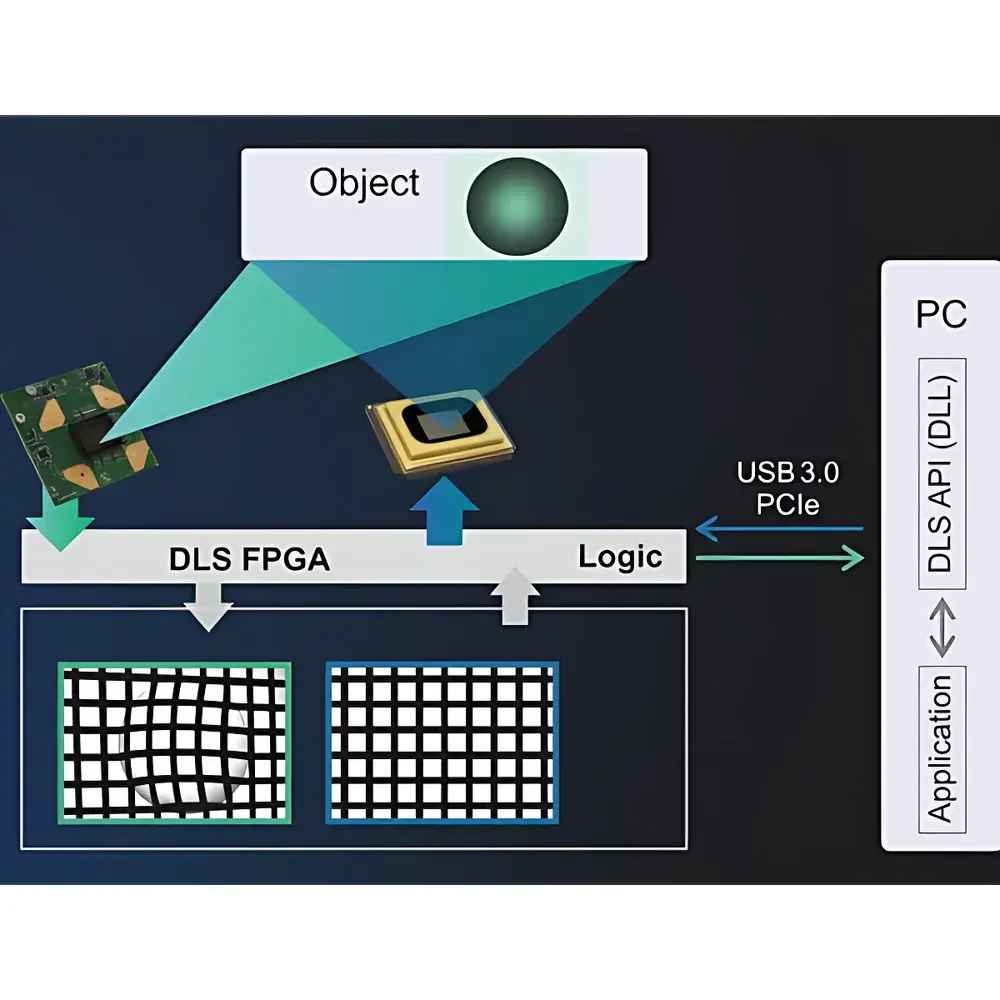
- Integrated FPGA logic supporting ViALUX’s Direct Link Sensor (DLS) concept — enabling hardware-synchronized projection and image capture within a single timing domain
- ALP-5.0 controller suite with comprehensive C/C++/Python/.NET APIs, compliant with Windows and Linux environments, and validated for GLP-aligned experimental workflows
- Modular mechanical design compatible with standard 30 mm and 60 mm optical rail systems, featuring kinematic mounting interfaces and integrated thermal management for stable long-duration operation
Sample Compatibility & Compliance
The V-650L02 NIR is designed for integration into optomechanical assemblies where precise spatial light control is required under non-ideal thermal or vibration conditions. Its sealed DMD package and thermally compensated drive electronics ensure stable modulation contrast (>1000:1) across ambient temperatures from 15 °C to 35 °C. The device complies with IEC 61000-6-2 (immunity) and IEC 61000-6-4 (emissions) standards for laboratory-grade electronic instrumentation. While not certified as medical or industrial safety equipment per se, its optical output characteristics align with ANSI Z136.1 (2022) Class 4 laser system interlock requirements when used in conjunction with appropriate beam containment and shuttering subsystems. Firmware and ALP-5.0 software support audit trails and configuration versioning — features essential for ISO/IEC 17025-accredited metrology labs and FDA-regulated R&D environments requiring traceable instrument control logs.
Software & Data Management
The ALP-5.0 software development kit provides deterministic frame scheduling, multi-threaded buffer management, and hardware-timed trigger synchronization via TTL, LVDS, or optical fiber inputs. It supports both static pattern loading and dynamic streaming modes — the latter enabling seamless transfer of >100 kfps equivalent binary sequences using memory-mapped I/O and zero-copy DMA pipelines. All API calls are thread-safe and expose fine-grained access to DMD mirror addressing, bit-plane sequencing, and exposure timing parameters. Integration with third-party platforms such as MATLAB, LabVIEW, and Python-based scientific stacks (NumPy, OpenCV, PyTorch) is documented and tested. For regulated environments, ALP-5.0 can be configured to generate immutable execution logs compliant with 21 CFR Part 11 requirements when deployed with qualified timestamping services and role-based access controls.
Applications
- Quantitative phase imaging and Fourier ptychography using programmable illumination apertures
- Time-resolved spectroscopy with wavelength-encoded spatial multiplexing
- Laser material processing with dynamically reconfigurable beam profiles (e.g., multi-spot ablation, Bessel beam generation)
- Neurophotonics: two-photon holographic stimulation in scattering tissue using wavefront shaping algorithms
- Gas sensing and molecular fingerprinting in the SWIR band (1000–2500 nm) via Hadamard-transform spectroscopy
- Industrial machine vision: high-speed defect classification using structured-light encoding and real-time CNN inference pipelines
FAQ
What is the maximum sustained data rate achievable over the PCIe interface?
The V-650L02 NIR achieves sustained unidirectional payload throughput of ≥5.5 GB/s (44 Gbit/s) over PCIe x4 Gen3, verified under continuous 1280×800 1-bit streaming with host-side memory-mapped buffers.
Can the module operate without a host PC after initial configuration?
Yes — patterns stored in onboard DDR4 memory can be executed autonomously via external TTL triggers or internal sequencer logic, independent of host connectivity.
Is ALP-5.0 compatible with real-time operating systems (RTOS) such as QNX or VxWorks?
ALP-5.0 is officially supported on Windows 10/11 and Ubuntu LTS (20.04+). RTOS porting requires custom driver development and is available under NDA-based engineering engagement.
How is thermal stability maintained during extended NIR illumination?
The module incorporates passive heat spreading and convection-cooled aluminum housing; optional active cooling kits (with PID-controlled fan modules) are available for >10 W average optical load scenarios.
Does ViALUX provide calibration certificates for reflectance uniformity or timing jitter?
Factory calibration reports covering mirror actuation latency (±12 ns RMS), spatial nonuniformity (< ±2.3% PV), and spectral responsivity (800–2000 nm) are supplied with each unit; NIST-traceable calibration is available as an add-on service.




