
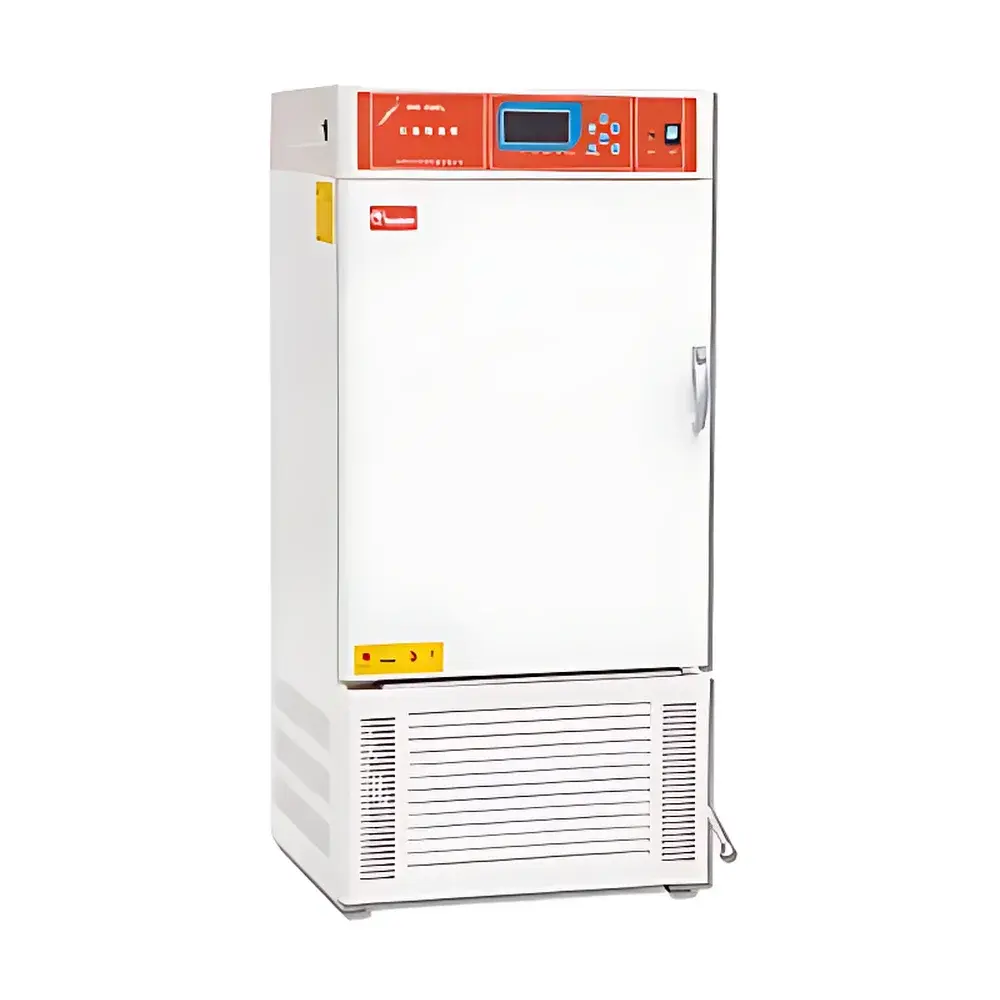
English Product Name
| Brand | Jihepu |
|---|---|
| Origin | Shandong, China |
| Model | LHS150CL |
| Temperature Range (with humidification) | −10 °C to 85 °C |
| Temperature Uniformity | ±0.3 °C |
| Humidity Range | 45–95 % RH |
| Chamber Capacity | 150 L |
| Power Supply | 220 V, 50 Hz |
| Input Power | 1400 W |
| Interior Dimensions (W×D×H) | 500 × 505 × 600 mm |
| Exterior Dimensions (W×D×H) | 630 × 705 × 1150 mm |
| Standard Shelving | 3 adjustable stainless steel shelves |
| Timer Range | 1–9999 minutes |
| Temperature Resolution | 0.1 °C |
| Temperature Accuracy | ±0.3 °C |
| Humidity Accuracy | ±3 % RH |
Overview
The Jihepu LHS150CL Temperature and Humidity Controlled Incubator is an engineered environmental simulation system designed for precise, long-term maintenance of stable thermal and hygroscopic conditions within a sealed chamber. Based on forced-air convection with dual independent control loops—one for refrigeration/heating and one for humidification/dehumidification—the unit operates on the principle of PID-regulated feedback control to maintain setpoint fidelity across its full operational range. Its architecture supports continuous operation under GLP-compliant workflows and meets fundamental requirements for stability testing per ICH Q1A(R2), USP , and ISO 14644-1 Class 8 cleanroom-adjacent environments. The LHS150CL serves as a foundational platform for pharmaceutical stability studies, biopolymer aging assessments, textile conditioning, food packaging validation, and microbiological culture support where reproducible ambient replication—not merely static temperature—is critical.
Key Features
- Stainless steel interior chamber (SUS304) with seamless, radius-rounded corners for ease of cleaning and resistance to corrosion under high-humidity exposure.
- Dual-sensor monitoring system: high-accuracy capacitive humidity sensor (calibrated traceable to NIST standards) and PT100-grade temperature probe, both rated for continuous operation at ≥95 % RH.
- Environmentally optimized refrigeration circuit using R134a refrigerant—CFC- and HCFC-free—with variable-speed compressor and microchannel condenser for energy-efficient thermal management.
- Large-format backlit LCD controller with intuitive menu navigation; supports real-time display of chamber setpoints, actual values, deviation alerts, and historical trend logging (via optional USB export).
- 25 mm-diameter access port on left side wall, fitted with silicone gasket and removable plug, enabling integration with external sensors, data loggers, or gas supply lines without compromising chamber integrity.
- Three-tier adjustable stainless steel shelving system, load-rated to 15 kg per shelf, with reinforced support brackets and non-slip surface finish.
Sample Compatibility & Compliance
The LHS150CL accommodates standard laboratory vessels including Petri dishes, multi-well plates, glass vials, aluminum foil-wrapped samples, and sealed polymer containers. Its chamber geometry permits uniform airflow distribution validated per ASTM E2876-13 (Standard Practice for Performance Testing of Environmental Chambers). The unit complies with CE marking requirements for electrical safety (EN 61000-6-3, EN 61000-6-4) and electromagnetic compatibility. While not certified for GMP manufacturing use out-of-the-box, it supports audit-ready documentation when paired with validated calibration procedures (e.g., IQ/OQ protocols), traceable thermohygrometer verification, and electronic record retention per FDA 21 CFR Part 11 guidelines (when used with compliant third-party software).
Software & Data Management
The embedded controller records time-stamped temperature and humidity values at user-defined intervals (default: 1 min), storing up to 30 days of continuous data internally. Data export is supported via USB flash drive in CSV format for post-processing in Excel, MATLAB, or statistical process control (SPC) platforms. Optional RS485 communication interface enables integration into centralized building management systems (BMS) or LIMS environments using Modbus RTU protocol. Firmware updates are performed locally via USB; no cloud dependency or vendor-hosted infrastructure is required—ensuring data sovereignty and uninterrupted operation in regulated settings.
Applications
- ICH-guided accelerated and real-time stability testing of active pharmaceutical ingredients (APIs) and finished dosage forms.
- Conditioning of textile specimens prior to tensile strength, colorfastness, or shrinkage analysis per AATCC TM16 and ISO 139.
- Accelerated aging of polymer-based medical device packaging per ASTM F1980.
- Controlled incubation of fungal cultures, plant tissue explants, and insect rearing colonies requiring sustained high-RH environments.
- Validation of moisture barrier performance in flexible packaging materials under defined temperature/humidity stress profiles.
FAQ
What is the minimum operating temperature with active humidification enabled?
The LHS150CL maintains humidity control down to −10 °C; below this point, condensation risk increases significantly and humidification is automatically disabled to protect internal components.
Can the unit operate continuously at 95 % RH and 40 °C for extended periods?
Yes—its corrosion-resistant construction, high-capacity humidifier reservoir, and redundant condensate drainage design support uninterrupted operation at maximum RH/temperature combinations for ≥30 days.
Is calibration certificate included with shipment?
A factory-issued calibration report (covering temperature and humidity at three points: 25 °C/50 % RH, 40 °C/75 % RH, and 60 °C/95 % RH) is provided; full ISO/IEC 17025-accredited calibration requires separate service engagement.
Does the controller support multi-step programmable profiles?
The base LHS150CL model features fixed-setpoint control only; programmable ramp-soak cycles require the LHS150CLY variant equipped with the Y-series controller.
What maintenance intervals are recommended for optimal performance?
Humidifier tank cleaning every 7 days under continuous use; condenser coil inspection quarterly; temperature/humidity sensor verification semiannually using NIST-traceable references.




