
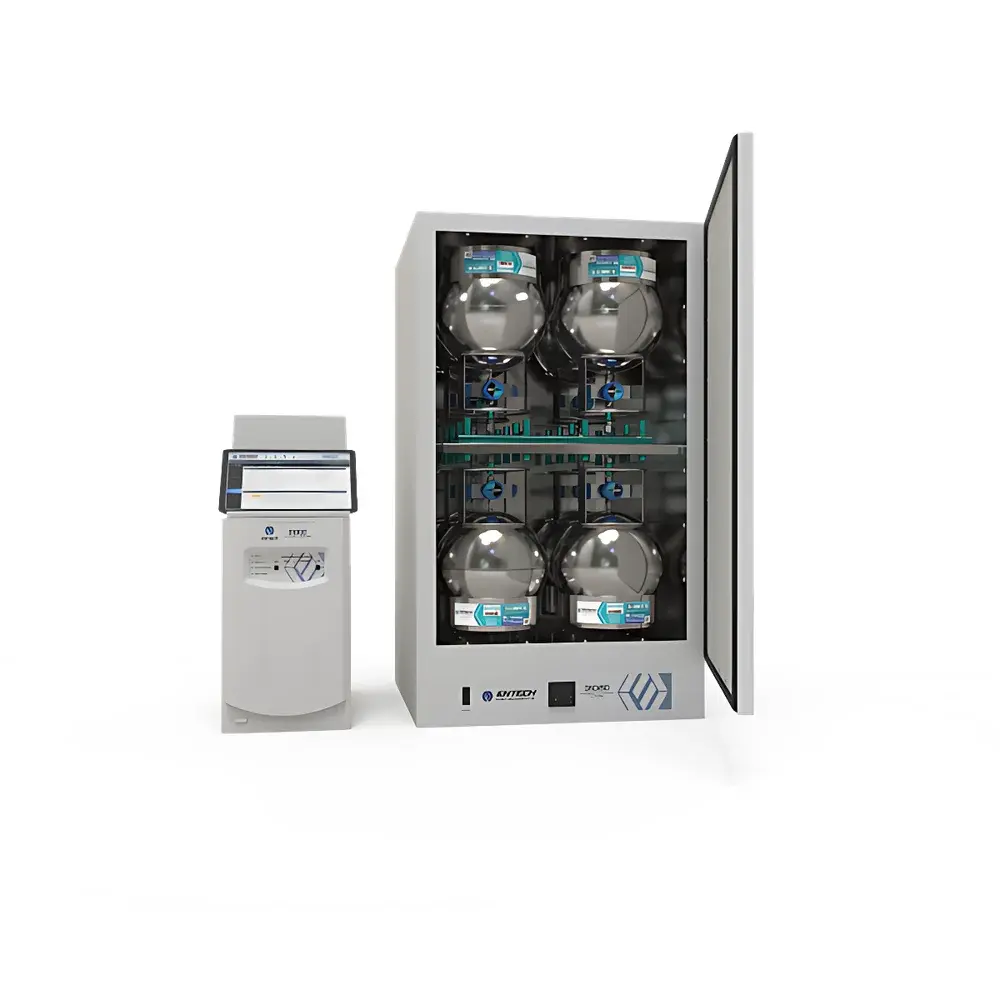
Entech 3100D Automated Canister Cleaning System
| Brand | Entech |
|---|---|
| Origin | Imported |
| Manufacturer Type | Authorized Distributor |
| Model | Entech 3100D |
| Pricing | Upon Request |
Overview
The Entech 3100D Automated Canister Cleaning System is an engineered solution for the rigorous decontamination and reconditioning of electropolished stainless-steel SUMMA® canisters used in ambient air, occupational health, and emission monitoring programs. Designed to meet the stringent requirements of EPA Methods TO-14A, TO-15, and ASTM D6196, the system employs a dual-stage vacuum architecture—comprising an external oil-free diaphragm pump and an internal high-vacuum turbomolecular pump—to achieve deep cleaning through sequential evacuation, inert gas (nitrogen or zero-air) purging, and controlled thermal conditioning. Unlike batch-style ovens or manual flushing protocols, the 3100D delivers reproducible, trace-level cleanliness by integrating real-time pressure feedback, adaptive molecular pump control, and uniform canister heating—ensuring residual VOC and SVOC levels remain below method detection limits (MDLs) across repeated cycles.
Key Features
- Dual-pump architecture: External long-life oil-free diaphragm pump for rough vacuum and primary purge, paired with an internal turbomolecular pump for high-vacuum bake-out (≤1×10⁻⁶ Torr achievable)
- Independent fill and evacuation pathways: Prevents cross-contamination between cleaning cycles; eliminates carryover risk during multi-canister processing
- Integrated heated oven: Uniform temperature distribution (up to 120 °C) across canister body and valve assembly, maximizing desorption of semi-volatile compounds (e.g., naphthalene, phenanthrene)
- Silonite™-coated fluidic path: Ultra-inert surface treatment minimizes analyte adsorption and catalytic degradation—critical for reactive species (e.g., aldehydes, terpenes, halogenated VOCs)
- Adaptive turbomolecular pump control: Real-time pressure feedback modulates rotor speed and cooling to extend pump lifetime and maintain optimal pumping efficiency across varying load conditions
- Optional humidified purge mode: Introduces precisely metered moisture during purge cycles to enhance removal of polar, hydrogen-bonding compounds (e.g., methanol, acetaldehyde, formic acid)
- Micro-QT™ quick-connect mounting bracket: Enables rapid, tool-free canister loading/unloading while maintaining leak-tight integrity per ASTM E260/E1510 specifications
Sample Compatibility & Compliance
The 3100D supports standard 6-L, 3-L, and 1-L SUMMA®-type canisters equipped with stainless-steel valves (e.g., Swagelok® SS-4H series). All wetted surfaces—including transfer lines, manifolds, and purge chambers—are Silonite™-treated to ensure compatibility with EPA TO-15 target analytes (C₂–C₁₂ hydrocarbons, oxygenates, halocarbons, sulfur compounds) and extended SVOC lists (e.g., PAHs, phthalates, flame retardants). The system meets GLP-compliant operational prerequisites for environmental laboratories accredited under ISO/IEC 17025:2017 and supports audit-ready documentation via optional electronic logbook integration (21 CFR Part 11–ready when paired with validated LIMS interfaces).
Software & Data Management
Operation is managed through a dedicated touchscreen HMI with pre-programmed cleaning protocols (EPA TO-15 Clean, High-Sensitivity SVOC Clean, Humidified Polar Clean), each storing full cycle metadata: start/end timestamps, peak vacuum achieved, total purge volume, final residual pressure, and thermal profile. Cycle logs are exportable as CSV or PDF for QA/QC review. Optional Ethernet connectivity enables remote monitoring, alarm notification via SNMP, and synchronization with laboratory information management systems (LIMS) supporting ASTM E1578 and ISO 22093 data exchange schemas.
Applications
- Ambient air monitoring networks requiring daily re-use of canisters under EPA Contract Laboratory Program (CLP) guidelines
- Industrial hygiene surveys where repeated sampling at fixed locations demands consistent canister blank integrity
- Method validation studies assessing canister carryover, breakthrough, and storage stability per ASTM D5466
- Calibration lab operations performing canister-based primary standard preparation and verification
- Research applications involving low-concentration VOC/SVOC speciation in urban, rural, and indoor environments
FAQ
What vacuum level does the 3100D achieve during bake-out?
The integrated turbomolecular pump achieves base pressures ≤1×10⁻⁶ Torr under clean, dry conditions—verified using a calibrated Bayard-Alpert gauge.
Can the system clean canisters with PTFE-coated valves?
Yes—Silonite™-compatible thermal and pressure profiles prevent degradation of fluoropolymer seals; however, maximum temperature is limited to 100 °C for PTFE components.
Is humidified cleaning compatible with all TO-15 analytes?
Humidified purge is validated for polar VOCs; non-polar compounds (e.g., BTEX, CFCs) show no performance loss when humidity is limited to ≤200 ppmv and followed by extended high-vacuum hold.
How is system performance verified between runs?
Built-in automated blank verification uses a certified zero-air source and GC-MS to quantify residual contaminants; pass/fail criteria align with EPA Method TO-15 Appendix A acceptance thresholds.
Does the 3100D support unattended overnight operation?
Yes—fully autonomous cycle execution, thermal ramping, and safety interlocks (over-temperature cutoff, vacuum loss shutdown) enable unattended multi-cycle processing with email/SNMP alerts on completion or fault.



