
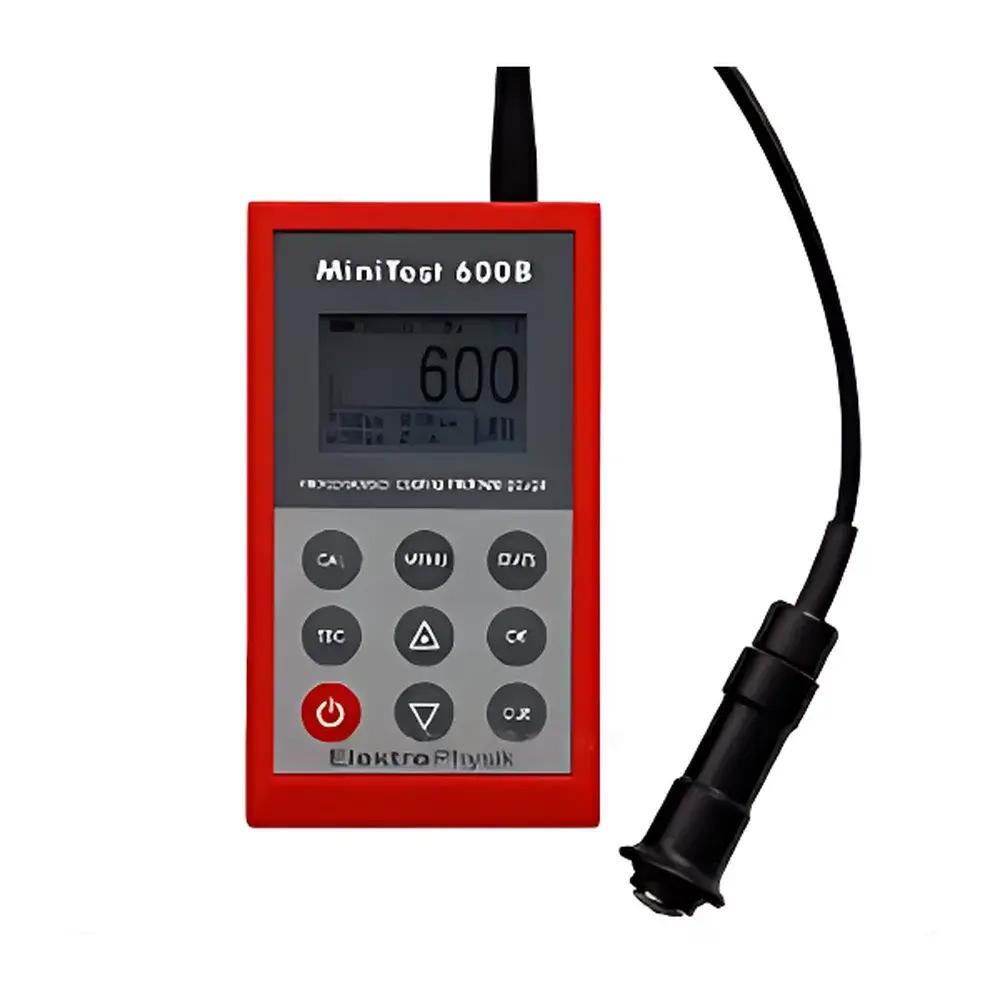
EPK MiniTest 600 BN Electromagnetic Eddy Current Coating Thickness Gauge
| Brand | EPK |
|---|---|
| Origin | Germany |
| Model | MiniTest 600 BN |
| Measurement Principle | Electromagnetic Eddy Current |
| Application | Non-ferrous metal substrates (Al, Cu, Zn, brass, austenitic stainless steel) with insulating coatings |
| Measurement Range | 0–2000 µm |
| Accuracy | ±(2% of reading + 2 µm) |
| Minimum Substrate Thickness | 50 µm |
| Minimum Curvature Radius | 5 mm (convex), 25 mm (concave) |
| Minimum Measuring Area | Ø20 mm |
| Display | 128×64 backlit LCD |
| Power Supply | 2×AA batteries |
| Interface | USB |
| Compliance | ISO 2178, ISO 2360, DIN 50981, ASTM B244, ASTM D7091 |
Overview
The EPK MiniTest 600 BN is a precision-engineered, handheld electromagnetic eddy current coating thickness gauge designed exclusively for non-ferrous metallic substrates—such as aluminum, copper, zinc, brass, and austenitic stainless steel—coated with electrically insulating layers. Unlike magnetic induction instruments (e.g., F-type probes), the BN variant operates on the principle of high-frequency eddy current generation and impedance analysis within the conductive base material. When the probe’s coil emits an alternating magnetic field, eddy currents form in the underlying non-ferrous substrate; their magnitude and phase shift are modulated by the thickness and dielectric properties of the overlying non-conductive coating (e.g., anodized oxide, paint, enamel, ceramic, or polymer films). This physical relationship enables traceable, non-destructive, and repeatable thickness quantification without substrate damage or surface preparation. The instrument conforms to internationally recognized metrological standards—including ISO 2178 (for magnetic substrates, referenced for comparative calibration rigor), ISO 2360 (eddy current method), DIN 50981, ASTM B244 (standard test method for thickness of anodic coatings), and ASTM D7091 (non-magnetic coatings on non-ferrous metals)—ensuring data integrity across quality control, R&D, and third-party verification workflows.
Key Features
- True dual-mode eddy current architecture optimized for non-ferrous substrates—no manual mode switching required
- Robust probe tip fabricated from sapphire-reinforced ceramic, delivering >100,000 measurement cycles under industrial abrasion conditions
- Integrated real-time statistical engine: calculates mean, min/max, standard deviation, and count per batch (up to 10 user-defined batches, 1000 readings each)
- Configurable block statistics for secondary analysis—enabling subgroup evaluation per production lot, shift, or operator
- Backlit 128×64 monochrome LCD with adjustable contrast; supports both metric (µm/mm) and imperial (mil/thou) units
- Time-stamped measurement logging via built-in real-time clock; programmable auto-power-off (1–30 min)
- USB 2.0 interface compliant with Windows OS (XP through 11); includes EPK DataTransfer software for raw data export, histogram generation, and GLP-compliant report templates
- Compact ergonomic housing (64 × 115 × 25 mm), total mass 270 g including batteries—designed for one-handed operation in confined or overhead locations
Sample Compatibility & Compliance
The MiniTest 600 BN is validated for use on non-ferromagnetic conductive substrates ≥50 µm thick, including wrought and cast aluminum alloys (e.g., 6061, 7075), copper and copper-nickel alloys, zinc die-castings, brass, and fully austenitic stainless steels (e.g., AISI 304, 316). It measures insulating coatings ranging from thin anodized films (≥0.5 µm) to thick polymeric systems (up to 2000 µm), provided the coating exhibits resistivity >10⁴ Ω·cm. Critical geometric constraints include minimum convex curvature radius of 5 mm and concave radius of 25 mm; minimum flat-area diameter is Ø20 mm. Calibration is performed using certified foil standards traceable to NIST or PTB. Instrument firmware supports single-point zero calibration and two-point linear calibration—essential for maintaining accuracy across wide dynamic ranges. All measurements satisfy ISO/IEC 17025 documentation requirements when used with EPK’s accredited calibration services.
Software & Data Management
The included EPK DataTransfer v4.x software provides full bidirectional communication via USB. Raw measurement files (.mtf) store timestamp, probe ID, substrate type flag, temperature-compensated values, and statistical metadata. Export options include CSV (for Excel or Minitab integration), PDF reports with embedded histograms and control charts, and XML for LIMS ingestion. Audit trail functionality records all configuration changes, calibration events, and user logins—meeting FDA 21 CFR Part 11 electronic record requirements when deployed with Windows domain authentication. Batch-level summaries support SPC charting (X̄/R, Cpk), while custom filters allow sorting by date range, operator ID, or tolerance band deviation. No cloud dependency: all processing occurs locally, preserving data sovereignty in regulated environments.
Applications
This gauge is routinely deployed in automotive OEM finishing lines for verifying anodized layer thickness on aluminum body panels and wheels; in aerospace maintenance depots for inspecting thermal barrier coatings on turbine housings; in architectural aluminum extrusion plants for QA of powder-coated façade profiles; and in electronics manufacturing for measuring conformal coatings on PCB edge connectors. Its portability and battery autonomy (≥25 hours continuous use) make it ideal for field inspections of marine hulls, offshore platform cladding, and infrastructure bridges where access is constrained. In laboratory settings, it serves as a reference tool for validating destructive cross-sectioning results per ASTM E376.
FAQ
Can the MiniTest 600 BN measure coatings on galvanized steel?
No—galvanized steel is ferromagnetic; use the MiniTest 600 F or FN model instead.
Does temperature affect measurement accuracy?
Yes—probe operating range is –10 °C to +70 °C; readings outside this range require thermal stabilization per ISO 2360 Annex B.
Is probe replacement possible in the field?
Yes—the integrated probe uses a standardized LEMO 00 connector; EPK supplies calibrated replacement probes with individual certificate of conformity.
How is traceability maintained during calibration?
Each unit ships with a factory calibration certificate referencing PTB-traceable standards; annual recalibration is recommended per ISO/IEC 17025.
Can statistical data be exported directly to SAP QM modules?
Via CSV export with configurable field mapping; EPK offers optional middleware integration kits for SAP, Oracle Quality, and Siemens Opcenter.



