
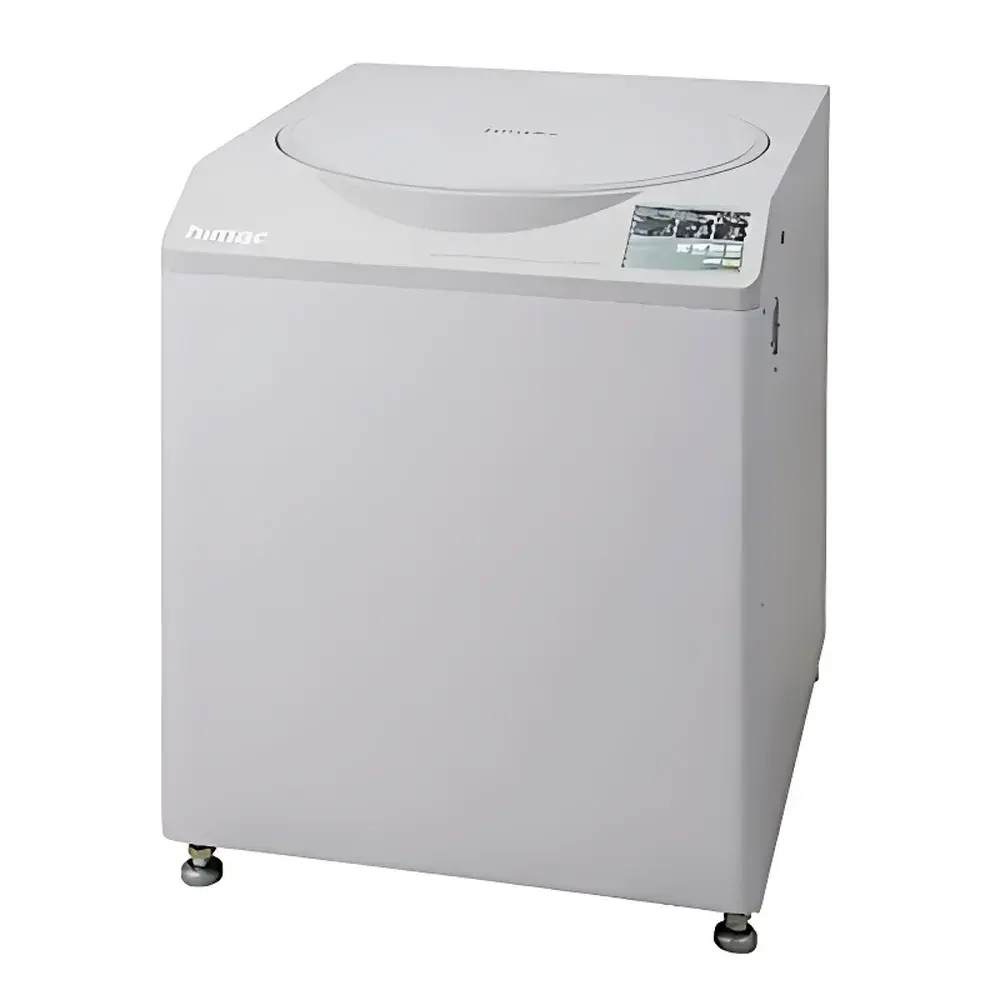
Eppendorf CR30NX High-Capacity Refrigerated Floor-Standing Ultracentrifuge (Himac)
| Brand | Eppendorf |
|---|---|
| Origin | Japan |
| Manufacturer | Hitachi High-Technologies Corporation (Himac) |
| Type | Floor-standing refrigerated ultracentrifuge |
| Speed Range | 300–30,000 rpm |
| Max RCF | 110,000 × g |
| Max Capacity | 6 × 1,000 mL or 4 × 1,500 mL |
| Noise Level | < 56 dBA |
| Dimensions (W×D×H) | 708 × 892 × 866 mm |
| Weight | 310 kg |
| Temperature Control Accuracy | ±2 °C |
| Refrigerant | R410A |
| Power Supply | AC 220 V, 50/60 Hz, 1500 W max |
| Interface | 1× USB, 1× LAN |
| Program Storage | 1,000 protocols |
| Timer Range | 1 s–9 min 59 s (1-s increment) or 1 min–99 h 59 min (1-min increment), with hold function |
| Acceleration Profiles | 11 modes |
| Deceleration Profiles | 10 modes (incl. 2 variable slope) |
| Safety Features | Interlocked door, overspeed detection, imbalance sensing, rotor lid detection, overtemperature protection |
| Sterilization Compatibility | Autoclavable rotors (121 °C, 20 min) for R30AT, R10A3, R5S4 |
| Drive System | Inverter-controlled induction motor |
| Cooling System | Variable-speed rotary compressor |
Overview
The Eppendorf CR30NX High-Capacity Refrigerated Floor-Standing Ultracentrifuge—engineered and manufactured by Hitachi High-Technologies under the Himac platform—is a precision-engineered instrument designed for high-throughput, high-g-force separation of biological and nanoscale samples in demanding research and bioprocessing environments. Operating on the principle of sedimentation equilibrium and rate-zonal centrifugation, the CR30NX delivers reproducible, scalable separations across a broad dynamic range—from intact cells and microbial pellets to exosomes, viral vectors, subcellular organelles, and engineered nanoparticles. Its dual-capability architecture supports both high-speed preparative runs (up to 30,000 rpm) and ultra-high-resolution analytical workflows (RCF up to 110,000 × g), making it suitable for applications requiring strict thermal stability, mechanical robustness, and regulatory traceability.
Key Features
- Ultra-low acoustic signature (< 56 dBA at full speed), achieved via optimized rotor dynamics, asymmetric vibration damping, and precision-balanced drive assembly—enabling operation in shared laboratory spaces without acoustic interference.
- Patented rotor auto-locking mechanism ensures secure engagement and alignment prior to acceleration, eliminating manual torque verification and reducing operator error during high-throughput workflows.
- Multi-sensor safety architecture includes real-time monitoring of rotational imbalance, chamber temperature deviation, rotor overspeed, lid integrity, and refrigerant pressure—each triggering immediate deceleration and system lockout per IEC 61010-2-020 compliance requirements.
- Intuitive GUI-driven 7-inch capacitive touchscreen interface with contextual icons, multi-language support (EN/DE/FR/JP/CN), and responsive haptic feedback enables rapid protocol navigation and parameter adjustment without training overhead.
- Energy-efficient variable-speed compressor system using R410A refrigerant maintains precise temperature control (−20 °C to +40 °C) across all speeds and loads, with thermal accuracy of ±2 °C at rotor interface—critical for preserving labile biomolecules during extended runs.
- Modular rotor ecosystem includes fixed-angle (R30AT, R20A2, R10A3), swinging-bucket (R25ST), and microplate-compatible (R5S4) configurations—all certified for autoclaving (121 °C, 20 min) except R25ST, which supports validated chemical sterilization protocols per ISO 14937.
Sample Compatibility & Compliance
The CR30NX accommodates diverse sample formats—from 50 µL microtubes to 1,500 mL centrifuge bottles—without compromising g-force uniformity or thermal homogeneity. Its large-diameter chamber and reinforced rotor housing meet ASTM F1842-22 standards for structural integrity under sustained 110,000 × g loading. All rotors are CE-marked and comply with ISO 21501-4 for particle size distribution validation when used with calibrated density gradients. The system supports GLP/GMP-aligned operation through integrated audit trail logging (user ID, timestamp, parameter set, run history), electronic signature capability, and 21 CFR Part 11–compatible data export via encrypted USB or LAN. Temperature calibration is traceable to NIST-certified references, and routine performance verification follows ISO/IEC 17025–accredited procedures.
Software & Data Management
The onboard firmware supports 1,000 user-defined protocols with granular control over acceleration/deceleration profiles, hold conditions, and stepwise ramping. All run metadata—including real-time RCF, temperature, current draw, and vibration amplitude—are time-stamped and stored internally with SHA-256 hashing for data integrity. Export options include CSV, PDF summary reports, and XML-formatted raw logs compatible with LIMS integration (e.g., LabWare, STARLIMS). Remote monitoring and firmware updates are enabled via secure HTTPS-over-LAN; no cloud dependency or external telemetry is active by default. Audit log entries persist across power cycles and retain tamper-proof timestamps synchronized to internal RTC with battery backup.
Applications
- Isolation of extracellular vesicles (exosomes, microvesicles) from plasma, serum, or conditioned media using iodixanol or sucrose density gradients.
- Large-scale purification of AAV, lentiviral, and adenoviral vectors for gene therapy process development and QC release testing.
- Subcellular fractionation of mitochondria, lysosomes, and synaptic vesicles from tissue homogenates under cryo-stabilized conditions.
- Preparative separation of synthetic nanoparticles (liposomes, polymeric micelles, metallic colloids) for DLS, TEM, and functional characterization.
- High-yield pelleting of bacterial and yeast cultures (e.g., E. coli, S. cerevisiae) for protein expression workflows and downstream lysis optimization.
- Clarification of clarified lysates and cell culture supernatants prior to chromatographic purification or filtration steps in biomanufacturing suites.
FAQ
What is the maximum allowable imbalance tolerance for the CR30NX?
The system detects imbalances ≥2 g·cm and halts acceleration automatically; rotor-specific tolerances are preloaded into firmware and enforced per ISO 15881-2.
Can the CR30NX be integrated into a centralized lab automation network?
Yes—via its native LAN port supporting Modbus TCP and HTTP REST API endpoints for status polling, remote start/stop, and log retrieval.
Is rotor lifetime tracking supported?
Yes—each rotor contains an embedded RFID tag storing serial number, manufacturing date, sterilization count, and cumulative run hours; this data is read and logged automatically at every cycle.
Does the CR30NX support vacuum operation?
No—the system operates at ambient pressure; vacuum compatibility is not required for standard ultracentrifugation workflows and is excluded to enhance thermal stability and reduce maintenance complexity.
How is temperature uniformity verified across the rotor chamber?
Hitachi performs spatial mapping using 12 calibrated thermocouples during factory acceptance testing (FAT); results are documented in the Certificate of Conformance and available upon request.



