
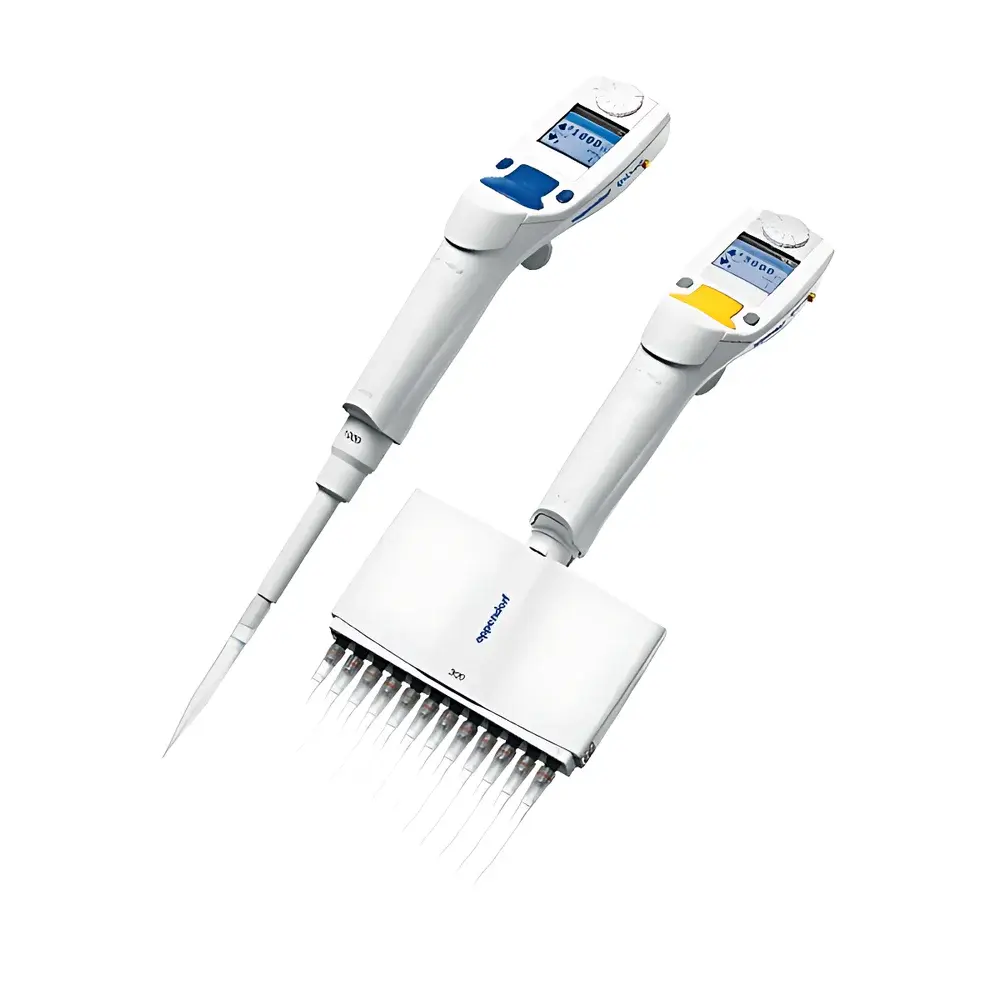
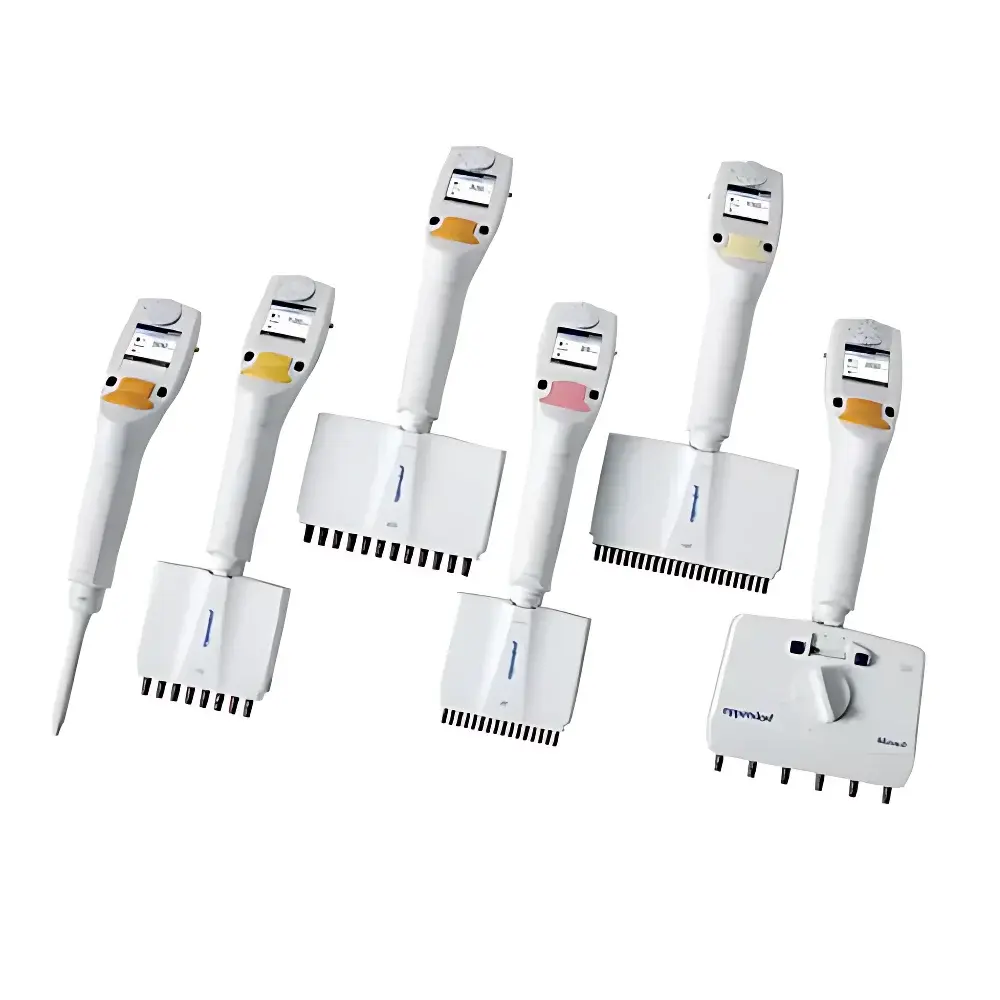
Eppendorf Xplorer and Xplorer plus Electric Pipettes
| Brand | Eppendorf |
|---|---|
| Origin | Germany |
| Manufacturer Type | Original Equipment Manufacturer (OEM) |
| Product Origin | Imported |
| Model Series | Xplorer / Xplorer plus |
| Instrument Type | Multi-channel Electric Pipette |
| Automation Level | Motorized |
| Channel Options | 1, 8, 12, 16, or 24 channels |
| Volume Range | 0.5 µL – 1200 µL |
| Maximum Capacity | 1200 µL |
| Accuracy | ±0.6 % |
Overview
The Eppendorf Xplorer and Xplorer plus electric pipettes are precision-engineered motorized liquid handling instruments designed for high-reproducibility volumetric transfer in demanding laboratory environments. Based on a brushless DC motor-driven piston system, these pipettes deliver consistent aspiration and dispensing across the full volume range (0.5–1200 µL), eliminating operator-induced variability associated with manual pipetting. The core architecture integrates closed-loop feedback control to dynamically compensate for fluid density, viscosity, and environmental factors—including altitude and ambient temperature—ensuring metrological traceability per ISO 8655-2:2022. Designed specifically for compliance-critical workflows, the Xplorer plus variant extends functionality with programmable multi-step protocols and adaptive calibration profiles for specialized tip geometries (e.g., epT.I.P.S.® Long) and non-aqueous solvents (e.g., ethanol, glycerol). Both platforms meet IEC 61000-4 electromagnetic compatibility standards and are validated for use in GLP- and GMP-regulated settings where audit-ready documentation is required.
Key Features
- Motorized piston actuation with real-time force feedback ensures consistent plunger movement regardless of user fatigue or technique variation.
- Center-balanced ergonomic design reduces wrist extension and forearm torque—validated by DIN EN ISO 11228-3 biomechanical assessment for repetitive tasks.
- SOFTeject technology reduces ejection force by 50% compared to conventional mechanisms; outer tips release first in multi-channel configurations, minimizing plate deformation and cross-contamination risk.
- Modular lower-body assembly enables full autoclaving at 121°C/20 min (EN 285 compliant); UV-resistant housing withstands >1000 cycles of 254 nm irradiation without performance degradation.
- Dual-mode operation: intuitive rotary dial interface for rapid parameter selection (volume, mode, speed) and tactile button feedback for hands-on control during critical transfers.
- Xplorer plus exclusive capabilities include 10-step programmable sequences, on-device history logging (last 10 dispense configurations), and solvent-specific calibration offsets stored in non-volatile memory.
Sample Compatibility & Compliance
The Xplorer series supports universal compatibility with Eppendorf epT.I.P.S.® sterile, low-retention, and 384-well optimized tips—including 4.5 mm pitch variants for direct 384-well plate filling. It accommodates viscous (up to 1000 mPa·s), volatile (e.g., acetone, DMSO), and surfactant-laden solutions via adjustable aspiration/dispense speeds and reverse pipetting algorithms. Regulatory alignment includes adherence to ISO 8655 (volumetric accuracy verification), ASTM E2758 (liquid handler qualification), and FDA 21 CFR Part 11 requirements when paired with Eppendorf’s certified software suite. All models ship with a factory-issued calibration certificate traceable to PTB (Physikalisch-Technische Bundesanstalt) standards.
Software & Data Management
While standalone operation requires no PC connection, the Xplorer plus integrates seamlessly with Eppendorf’s free VisioNize Lab Suite for remote configuration, firmware updates, and electronic logbook generation. Audit trails record timestamped events—including volume changes, mode selections, tip ejection counts, and calibration adjustments—with SHA-256 hashing for data integrity. Export formats comply with ALCOA+ principles (Attributable, Legible, Contemporaneous, Original, Accurate) and support CSV/Excel ingestion into LIMS or ELN systems. Optional RFID-enabled tip rack recognition allows automatic protocol loading based on consumable type.
Applications
These pipettes serve as primary liquid handlers in molecular biology (qPCR setup, NGS library prep), clinical diagnostics (serum dilution series, ELISA plate filling), cell culture (media exchange in 384-well assays), and quality control laboratories performing USP analytical instrument qualification. The 16-/24-channel configurations significantly accelerate high-density screening—enabling full-row/column dispensing into 384-well plates without repositioning, thereby reducing procedural steps by 50% versus sequential 96-well processing. Reverse pipetting mode supports accurate delivery of protein solutions, glycerol stocks, and detergent-containing buffers where surface tension effects dominate.
FAQ
What regulatory standards does the Xplorer plus support for audit readiness?
It meets ISO 8655-2:2022 for volumetric performance, includes built-in calibration traceability to PTB, and generates Part 11-compliant electronic records when used with VisioNize Lab Suite.
Can the Xplorer plus be calibrated for non-aqueous solvents like ethanol or glycerol?
Yes—the device stores up to three solvent-specific offset profiles that adjust aspiration/dispense timing and speed based on published density and vapor pressure data.
Is autoclaving supported for all channel configurations?
All single- and multi-channel models permit full lower-body autoclaving at 121°C/20 min; however, the upper electronics module must remain unsterilized and is rated IP54 for splash resistance.
How does SOFTeject reduce mechanical stress during tip ejection?
By sequencing tip release from outer to inner positions and limiting peak ejection force to ≤0.8 N per tip, it prevents well-to-well bending in thin-wall microplates and maintains seal integrity in PCR strip tubes.
What is the maximum number of programmable steps in Xplorer plus protocols?
Up to four discrete steps can be defined per protocol—including volume, mode (Pip/Man/P-M/Dis/Ads), speed, and pause duration—with persistent storage across power cycles.
Related Products



