
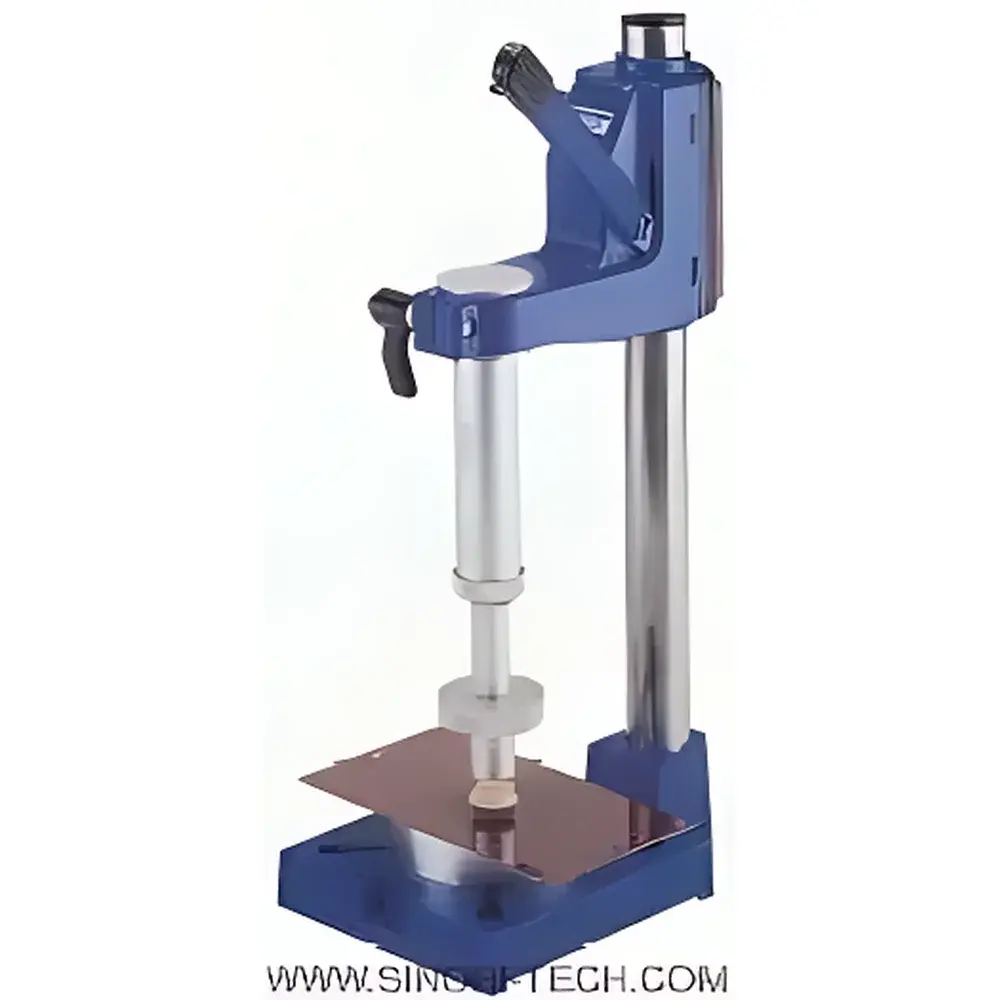
Erichsen #415 Drying Time Tester
| Origin | Germany |
|---|---|
| Manufacturer Type | Authorized Distributor |
| Origin Category | Imported |
| Model | #415 |
| Pricing | Available Upon Request |
Overview
The Erichsen #415 Drying Time Tester is a precision mechanical instrument engineered for objective, standardized assessment of surface drying behavior in liquid coatings—including paints, varnishes, lacquers, and industrial finishes—according to DIN 53150 (equivalent to ISO 9117-3). It operates on the principle of controlled mechanical indentation and adhesion evaluation: a calibrated vertical load is applied via lever-actuated impact force to a coated test panel, followed by qualitative assessment of substrate–film interaction under defined pressure, dwell time, and contact geometry. This method quantifies progressive film formation stages—from initial tack-free state (Stage 1) through full through-dry (Stage 7)—by evaluating resistance to deformation, transfer adhesion, and surface integrity. Unlike optical or thermal methods, the #415 delivers repeatable, operator-independent results rooted in physical contact mechanics, making it indispensable for QC laboratories requiring compliance with automotive OEM specifications, architectural coating standards, and regulatory documentation under ISO/IEC 17025-accredited testing protocols.
Key Features
- Compliance-certified design aligned with DIN 53150, ISO 9117-3, and ASTM D1640 (for comparative drying evaluation)
- Robust aluminum column structure with integrated high-reproducibility compression spring delivering up to 250 N nominal impact force
- Precision lever mechanism ensuring strictly perpendicular, zero-slip load application—eliminating lateral shear artifacts during testing
- Interchangeable loading configurations: 20 g / 200 g dead-weight loads for early-stage tack assessment; 2 kg and 20 kg lever-amplified loads for later-stage hardness and coalescence evaluation
- Included standardized elastomeric contact elements: two cylindrical rubber discs (Ø22 mm × 5 ± 0.5 mm; Shore A 50 ± 0.5 IRHD per ISO 48) ensuring uniform pressure distribution and consistent interface compliance
- Integrated height-adjustable lever frame enabling precise positioning relative to test panel thickness (accommodating standard 0.2–3.0 mm coated metal/glass panels)
- Compact footprint (150 × 300 × 440 mm) and lightweight construction (~4.5 kg) suitable for benchtop deployment in ISO Class 7 cleanrooms or production-line QC stations
Sample Compatibility & Compliance
The #415 supports universal compatibility with standard test substrates including steel, aluminum, glass, and plastic panels prepared per ISO 1514 and ISO 2808. Its methodology satisfies requirements for documentation in GMP-regulated environments where drying kinetics influence batch release decisions—particularly for pharmaceutical coating processes (e.g., tablet film coating validation per USP ) and aerospace primer qualification (SAE AMS-C-83231). All supplied consumables meet traceable metrological criteria: paper discs (Ø26 mm) conform to DIN EN ISO 1517-compliant glass beads (50 g, 125–250 µm); rubber discs are certified per ISO 48; weights are calibrated to OIML R111 Class E2 tolerances. The system requires no electrical supply or software calibration—ensuring long-term stability without drift, supporting audit readiness for FDA 21 CFR Part 11–aligned recordkeeping when paired with laboratory notebooks or LIMS-integrated reporting.
Software & Data Management
As a fully manual, analog mechanical tester, the #415 does not incorporate embedded electronics or digital interfaces. Data acquisition follows paper-based GLP-compliant workflows: operators record load type, dwell duration (60 s ± 2 s), observed adhesion response, and assigned drying stage directly into standardized test forms referencing DIN 53150 Annex A evaluation tables. For digital integration, laboratories may link results to validated LIMS platforms (e.g., LabWare, Thermo Fisher SampleManager) via structured CSV upload templates. Audit trails—including operator ID, environmental conditions (recorded separately per ISO 15184), and equipment verification logs—are maintained externally per ISO/IEC 17025 clause 7.7. No firmware updates, cybersecurity patches, or electronic signature modules apply—reducing validation burden in regulated settings.
Applications
- Quality control of solvent-borne, water-borne, UV-curable, and high-solids industrial coatings
- Formulation development for fast-dry automotive clearcoats and coil coatings
- Batch-to-batch consistency verification prior to packaging or shipment
- Technical service support for customer complaint investigations involving cure defects
- Educational use in polymer science and materials engineering curricula demonstrating film formation kinetics
- Third-party certification testing for CE marking (EN 71-3), RoHS, and REACH compliance documentation
FAQ
Does the #415 require annual recalibration?
No—its mechanical architecture contains no transducers, sensors, or adjustable torque mechanisms subject to drift. Annual verification against traceable reference weights and rubber hardness standards is recommended per ISO/IEC 17025 clause 6.5.2.
Can it be used for powder coatings?
Yes, provided the cured film is applied to a compliant substrate and cooled to ambient temperature before testing; DIN 53150 explicitly permits evaluation of thermoset powder coatings post-cure.
Is operator training required for ISO 9117-3 compliance?
Yes—users must complete documented competency assessment covering load selection logic, dwell timing accuracy, paper disc placement protocol, and Stage 4–7 visual interpretation per DIN 53150 Table 1.
What environmental conditions affect test repeatability?
Ambient temperature (23 ± 2 °C) and relative humidity (50 ± 5 % RH) per ISO 3270 are mandatory; deviations require correction factors documented in test reports.
Are replacement rubber discs available with NIST-traceable certificates?
Yes—Erichsen offers certified replacement sets (Order No. 0093.01.32) with individual IRHD test reports issued by DAkkS-accredited laboratories.



