
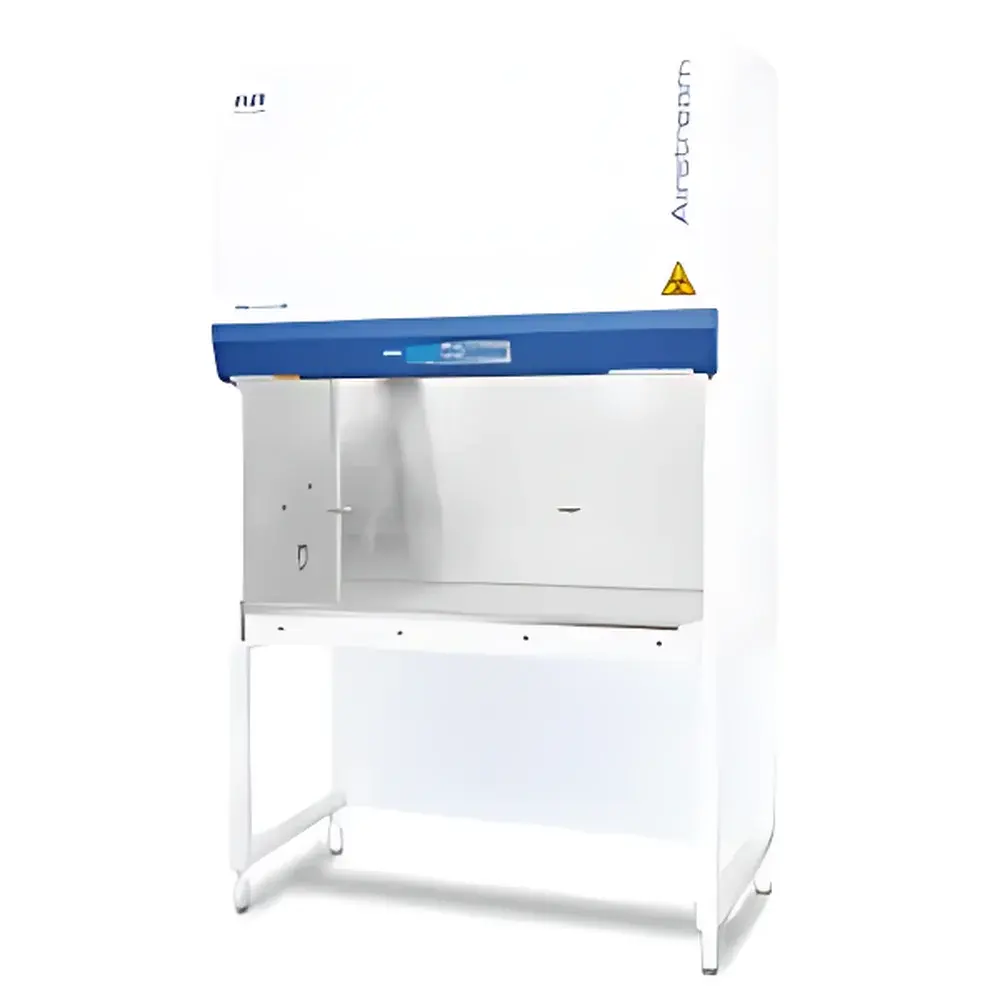
Esco Airstream® AC2-S Class II Type A2 Biological Safety Cabinet
| Brand | Esco |
|---|---|
| Origin | Singapore |
| Instrument Type | Class II Type A2 Biological Safety Cabinet |
| External Dimensions (L×W×H) | 1340 × 753 × 1400 mm |
| Internal Dimensions (L×W×H) | 1220 × 580 × 660 mm |
| Filter Efficiency | ≥99.999% for 0.1–0.3 µm particles |
Overview
The Esco Airstream® AC2-S is a certified Class II, Type A2 biological safety cabinet engineered to provide simultaneous protection for personnel, products, and the environment during microbiological and biomedical procedures. It operates on the principle of laminar airflow—drawing room air through a front intake grille, directing ~70% of total airflow downward over the work surface via a vertically recirculated stream (after passing through a ULPA filter), while exhausting ~30% externally via a dedicated ducted connection or thimble exhaust. This dual-path airflow architecture complies with internationally recognized performance standards including EN 12469:2000 and IEST-RP-CC001, ensuring reliable containment of low-to-moderate risk biological agents (BSL-1 to BSL-2). Designed for continuous operation in regulated laboratory environments, the AC2-S integrates energy-efficient DC ECM motor technology, delivering stable inflow and downflow velocities (0.45 m/s and 0.30 m/s respectively) across wide input voltage ranges (190–250 V AC), minimizing operational drift under variable power conditions.
Key Features
- ULPA filtration system with ≥99.999% efficiency against 0.1–0.3 µm particulates—exceeding HEPA H14 (EN 1822) and equivalent to ISO Class 5 cleanroom air quality within the work area.
- Sentinel Gold microprocessor-based control system featuring a large-format LCD display that presents real-time airflow metrics, alarm status, UV exposure time, and filter life estimation—all accessible without navigation menus.
- Integrated airflow sensors continuously monitor inflow and downflow velocity; automatic audible/visual alerts activate if deviations exceed ±10% of setpoints, supporting proactive maintenance and GLP-compliant documentation.
- ISOCIDE® antimicrobial coating applied to all exposed stainless steel surfaces inhibits microbial colonization on cabinet exteriors and interior panels, reducing cross-contamination risks during routine handling and cleaning cycles.
- One-piece seamless stainless steel work surface with shallow basin design prevents liquid pooling and facilitates complete decontamination—compatible with common disinfectants including 70% ethanol and sodium hypochlorite solutions.
- Ergonomic workstation configuration: full-length hand rest positioned 100 mm above the work surface minimizes arm fatigue and prevents inadvertent disruption of the protective air curtain at the sash opening.
- RS-232 serial interface enables integration with Building Management Systems (BMS) or centralized lab monitoring platforms for remote status reporting and audit trail generation.
Sample Compatibility & Compliance
The AC2-S accommodates standard laboratory workflows involving cell culture, molecular cloning, diagnostic sample processing, and pharmaceutical aseptic manipulations. Its airflow profile and containment integrity are validated for use with volatile organic compounds (VOCs) at concentrations ≤5% of their lower explosive limit (LEL), provided external exhaust ducting meets local fire and ventilation codes. The unit conforms to EN 12469:2000 for performance testing, NSF/ANSI 49 (2022) for North American market compliance, and ISO 14644-1 Class 5 requirements for particle concentration in the work area. All models undergo factory certification per IEST-RP-CC001 protocols—including smoke visualization, tracer gas containment, and filter leak testing—and include a Certificate of Conformance with batch-specific test data.
Software & Data Management
The Sentinel Gold controller logs operational parameters—including cumulative runtime, UV lamp usage hours, filter pressure differentials, and alarm events—with timestamped records stored internally for up to 12 months. Export functionality via RS-232 supports CSV-formatted data transfer to LIMS or electronic lab notebooks (ELN). Audit trail capabilities meet FDA 21 CFR Part 11 requirements when paired with user-access-controlled authentication (optional password-enabled administrator mode). Firmware updates are performed via secure USB interface, with version history and checksum verification embedded in each release.
Applications
- Aseptic preparation of mammalian and insect cell cultures under ISO Class 5 conditions.
- Handling of genetically modified organisms (GMOs) requiring BSL-2 containment per NIH Guidelines.
- Processing of clinical specimens—including blood, urine, and respiratory samples—in diagnostic microbiology laboratories.
- Compounding sterile preparations in hospital pharmacy cleanrooms compliant with USP and .
- Quality control testing of biologics and vaccines where environmental particulate control is mandated by regulatory submissions.
FAQ
What certifications does the AC2-S hold for international use?
The AC2-S carries EN 12469:2000 certification for European markets and is NSF/ANSI 49 listed for North America. It also satisfies ISO 14644-1 Class 5 airborne particle limits and IEST-RP-CC001 validation protocols.
Is external ducting mandatory for safe operation?
Yes—Type A2 cabinets require either hard-ducted exhaust to the outdoors or connection to a dedicated thimble exhaust system with balanced make-up air. Recirculation-only operation is not permitted due to potential accumulation of vapors and aerosols.
Can the AC2-S be integrated into a facility’s BMS network?
Yes—the built-in RS-232 port supports Modbus RTU protocol for bidirectional communication with building automation systems, enabling centralized monitoring of airflow status, alarms, and service intervals.
What maintenance intervals are recommended for ULPA filters?
Filter replacement is determined by pressure differential monitoring rather than fixed time intervals. Typical service life ranges from 3 to 5 years under normal use, depending on ambient particulate load and decontamination frequency.
Does the ISOCIDE® coating require special cleaning agents?
No—standard laboratory disinfectants compatible with stainless steel (e.g., 70% isopropyl alcohol, 10% bleach solutions) may be used without compromising coating integrity. Avoid abrasive pads or chlorinated solvents exceeding 5% concentration.
Related Products



