
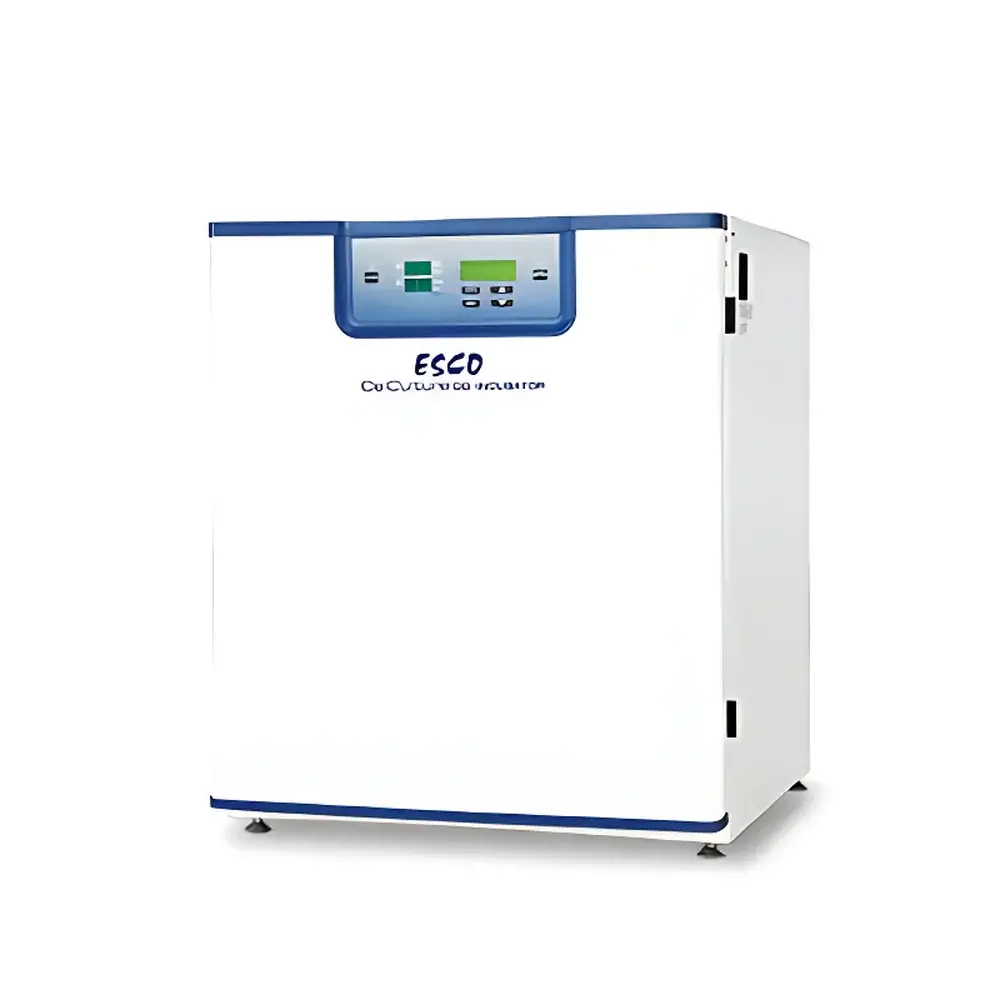
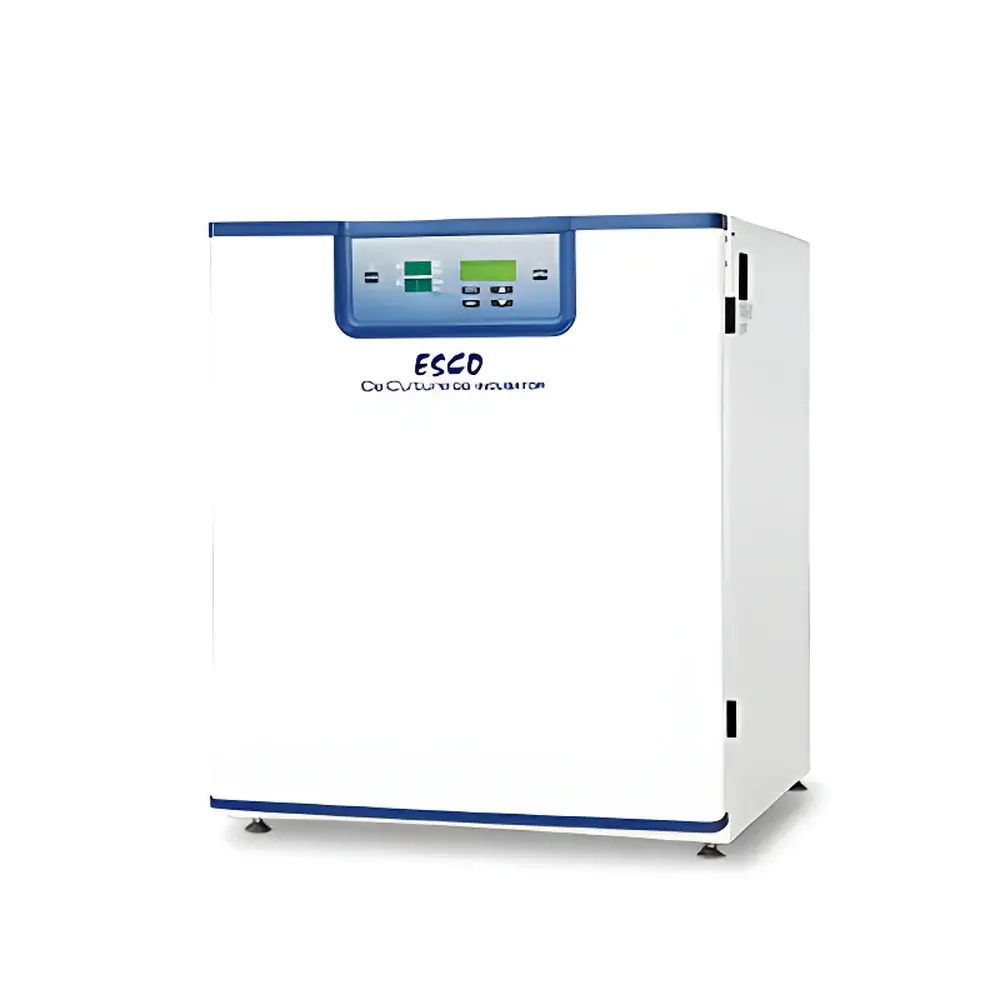
Esco CelCulture CCL Direct-Heat Air-Jacketed CO₂ Incubator
| Brand | Esco |
|---|---|
| Origin | Singapore |
| Manufacturer | Esco Lifesciences |
| Country of Origin | Imported |
| Instrument Type | Air-Jacketed CO₂ Incubator |
| Model | CCL |
Overview
The Esco CelCulture CCL is a precision-engineered, direct-heat air-jacketed CO₂ incubator designed for stringent mammalian cell culture applications in academic research laboratories, biopharmaceutical development facilities, and clinical IVF units. It operates on the principle of independent thermal regulation via an insulated air jacket surrounding the sample chamber—eliminating direct contact between heating elements and the interior cavity, thereby minimizing thermal overshoot and ensuring exceptional temperature stability (±0.1 °C uniformity across the chamber). The system maintains tightly controlled physiological conditions: 37 °C temperature, 5% CO₂ (±0.1%), and ≥95% relative humidity (RH), all continuously monitored and actively regulated. Its architecture integrates microbiological containment with process reliability—making it suitable for GLP-compliant workflows, ISO 13485-aligned cell therapy manufacturing environments, and USP –referenced primary cell expansion protocols.
Key Features
- Air-jacketed thermal design ensures rapid temperature recovery (<10 min after 30-sec door opening) and eliminates thermal shock or “overshoot” during setpoint transitions.
- Validated high-temperature decontamination cycle (180 °C for 3 hours), independently assessed by the UK Health Protection Agency (HPA), achieves ≥6-log reduction of bacterial endospores (e.g., Bacillus stearothermophilus), fungal conidia, and vegetative cells—meeting ISO 14644-1 Class 5 (formerly Class 100) air cleanliness requirements post-cycle.
- ISO 5-grade internal air quality maintained through continuous recirculation via a dual-stage filtration system: a pre-filter plus an ultra-low penetration air (ULPA) filter with ≥99.999% particle retention efficiency at 0.12 µm—surpassing standard HEPA specifications (EN 1822-1:2022).
- ISOCIDE™ antimicrobial coating—integrated into the external epoxy powder coat at the formulation stage—provides durable, non-leaching surface protection; validated to inhibit >99.9% of surface-adherent Staphylococcus aureus and Escherichia coli within 24 hours (ASTM E2149-20).
- Intelligent airflow management: fan suspension upon door opening prevents cross-contamination; laminar, low-velocity airflow (≤0.1 m/s) passes uniformly over the stainless-steel water pan to accelerate humidity equilibration without disturbing monolayer cultures.
- Chamber constructed from electropolished 304 stainless steel (Ra ≤ 0.8 µm); outer casing fabricated from electro-galvanized steel with ISOCIDE-coated finish—ensuring corrosion resistance and cleanability per ISO 14644-1 Annex B.
Sample Compatibility & Compliance
The CCL incubator supports long-term cultivation of sensitive primary cells, stem cell lines (e.g., hESCs, iPSCs), hybridomas, and co-culture systems requiring stable gas-phase composition and minimal shear stress. Its environmental control fidelity aligns with ASTM F2655-21 (Standard Guide for CO₂ Incubator Performance Verification), ISO 13408-2:2020 (Aseptic processing of health products—Part 2: Isolators), and EU GMP Annex 1 (2022) requirements for grade A/B environments. All sensor calibrations are traceable to NIST-certified references; CO₂ sensors utilize infrared (NDIR) technology with automatic span validation. The unit complies with IEC 61010-1:2010 for laboratory equipment safety and meets EMC directive 2014/30/EU.
Software & Data Management
Embedded CelAlert™ intelligent diagnostics log all operational parameters—including temperature, CO₂ concentration, RH, door status, alarm events, and maintenance intervals—in non-volatile flash memory (≥10-year data retention). Event timestamps adhere to ISO/IEC 17025:2017 audit-trail requirements, supporting 21 CFR Part 11-compliant electronic records when integrated with Esco’s optional LabManager™ remote monitoring platform (via Ethernet or Wi-Fi). Real-time graphing, configurable threshold alerts, and CSV export functionality enable trend analysis for preventive maintenance planning and regulatory submission packages.
Applications
- In vitro fertilization (IVF) embryo culture under time-lapse-compatible conditions
- Neural progenitor cell differentiation assays requiring uninterrupted O₂/CO₂ balance
- Tissue engineering scaffold seeding with shear-sensitive mesenchymal stromal cells (MSCs)
- Monoclonal antibody production using CHO-K1 suspension cultures
- Cancer spheroid formation and drug response screening in 3D models
- Regulatory-grade banking of clinical-grade dendritic cells (ISO 20387:2018)
FAQ
What validation documentation is supplied with the CCL incubator?
Factory-installed IQ/OQ documentation is provided, including as-built schematics, sensor calibration certificates (NIST-traceable), and HPA-validated decontamination cycle reports.
Can the CCL be integrated into a centralized building management system (BMS)?
Yes—via Modbus TCP or optional analog 4–20 mA outputs for temperature, CO₂, and RH signals.
Is the ULPA filter replaceable by the user?
Yes—filter replacement is tool-free and guided via the LCD interface; filter life is tracked automatically and reported in the event log.
Does the unit support humidity control without a water reservoir?
No—humidification is achieved exclusively via heated stainless-steel water pan evaporation; optional humidity sensor feedback enables closed-loop RH regulation.
How frequently must the CO₂ sensor be calibrated?
Automatic zero/span verification occurs daily; full NIST-traceable recalibration is recommended annually or after 2,000 operating hours, whichever comes first.




