
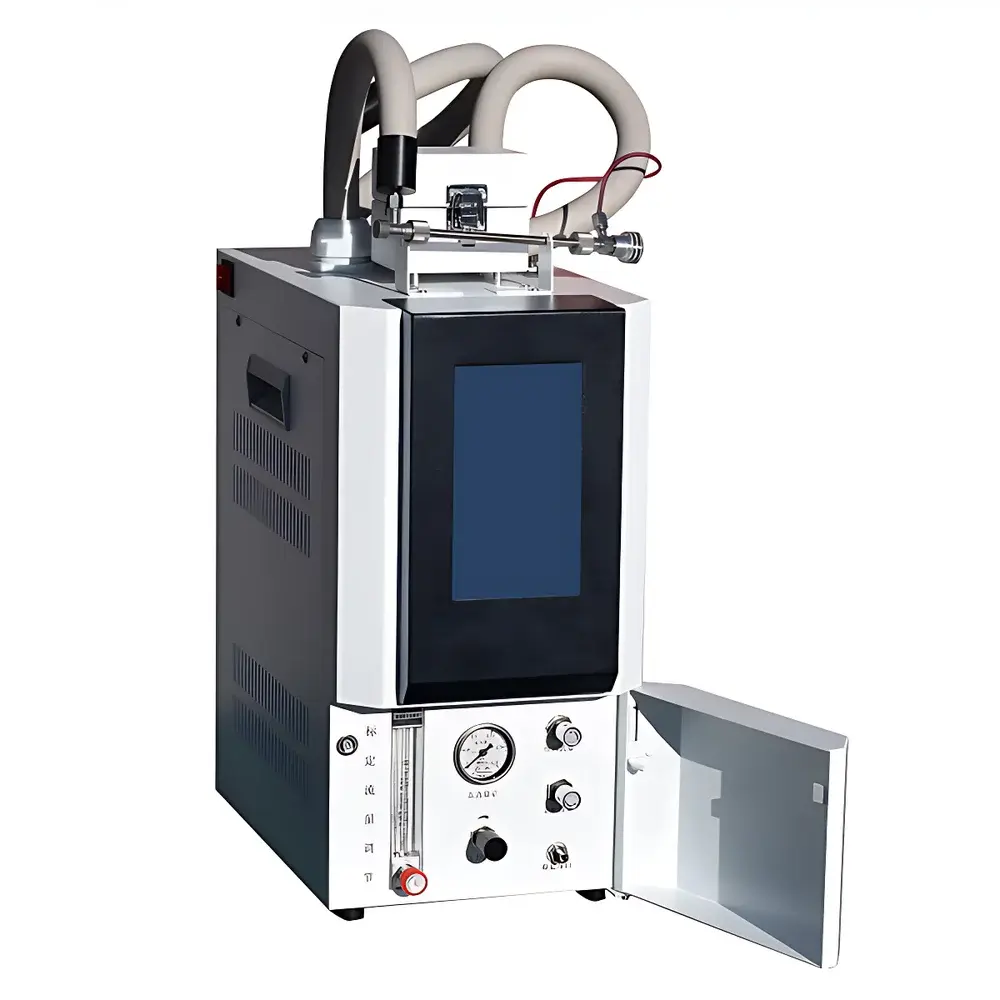
Beifen Sanpu SDAT-3430 Dual-Stage Thermal Desorber for GC Analysis
| Brand | Beifen Sanpu |
|---|---|
| Origin | Beijing, China |
| Manufacturer Type | Direct Manufacturer |
| Instrument Type | Dual-Stage Thermal Desorber |
| Desorption Temperature Range | Ambient to 450 °C |
| Cold Trap Temperature Range | −35 °C to Ambient |
| Desorption Recovery Rate | >99% (compound-dependent) |
| Sample Capacity | 1 adsorption tube per run |
Overview
The Beifen Sanpu SDAT-3430 is a dual-stage thermal desorber engineered for high-fidelity preconcentration and quantitative transfer of volatile organic compounds (VOCs) from sorbent tubes into gas chromatography (GC) systems. It operates on the principle of controlled thermal desorption—first stage desorption from the sample tube, followed by cryofocusing in a thermoelectrically cooled cold trap, and second-stage rapid flash desorption into the GC inlet. This two-step architecture minimizes analyte degradation, suppresses breakthrough, and ensures sharp, reproducible peaks—critical for compliance-driven TVOC analysis per GB 50325–2020 Annex E and ISO 16000–6. Designed specifically for integration with capillary GC-FID systems (e.g., GC-9860), the SDAT-3430 delivers robust performance in indoor air quality (IAQ) monitoring, environmental laboratory QA/QC, and building material emission testing.
Key Features
- Dual-stage thermal desorption architecture with independent temperature control for primary desorption oven and Peltier-cooled cold trap
- Precise desorption temperature regulation from ambient to 450 °C (±0.5 °C stability), enabling full elution of semi-volatiles including n-alkanes up to C24
- Cold trap operating range from −35 °C to ambient, ensuring efficient focusing of C2–C12 VOCs and minimizing band broadening
- Optimized carrier gas flow path with inert stainless-steel tubing and zero-dead-volume fittings to prevent memory effects or catalytic decomposition
- Single-tube configuration (1-position carousel) with programmable tube conditioning capability prior to analysis
- Integrated leak-check routine and real-time pressure monitoring for method validation and system integrity assurance
Sample Compatibility & Compliance
The SDAT-3430 supports standard 6 mm OD × 89 mm quartz or stainless-steel sorbent tubes packed with Tenax TA, Tenax GC, Carbopack B/C, or multi-bed media (e.g., Carbograph 1TD + Carboxen 1000). It is fully aligned with Chinese national standard GB 50325–2020 Annex E for TVOC determination in residential and commercial indoor air, as well as ISO 16000–6:2011 for VOC sampling and analysis in indoor environments. All thermal profiles, dwell times, and gas flows are programmable and auditable—supporting GLP-compliant documentation requirements. When paired with a GC system equipped with FID detection and validated chromatographic conditions (e.g., 50 m × 0.32 mm × 1.0 µm TVOC-specific column), the complete workflow meets linearity (R ≥ 0.999), repeatability (RSD 99% for target aldehydes, aromatics, and alkanes) criteria specified in regulatory protocols.
Software & Data Management
The SDAT-3430 communicates via RS-232 or USB interface with Beifen Sanpu’s GC-9860 Chromatography Workstation software. Method parameters—including desorption ramp rates, hold times, cold trap equilibration duration, and backflush sequences—are stored as editable templates. All instrument events (temperature setpoints, actual readings, valve actuation timestamps, pressure logs) are time-stamped and exported in CSV format for traceability. The software supports audit trail functionality compliant with basic data integrity principles; while not natively 21 CFR Part 11-certified, it enables manual electronic record retention suitable for internal QA audits and third-party accreditation (e.g., CNAS, CMA) under documented SOPs.
Applications
- Quantitative determination of TVOC in indoor air per GB 50325–2020, including formaldehyde, benzene, toluene, ethylbenzene, xylenes (BTEX), styrene, and C9–C12 alkylbenzenes
- Testing of VOC emissions from building materials (e.g., carpets, adhesives, particleboard) using small-chamber or micro-chamber methods
- Occupational hygiene monitoring for workplace exposure assessment (OSHA/NIOSH-aligned sampling strategies)
- Method development and validation studies requiring precise thermal desorption reproducibility and low blank contribution
- Support for EPA TO-17 compliant workflows when coupled with appropriate GC-MS instrumentation and calibration standards
FAQ
What sorbent tubes are compatible with the SDAT-3430?
Standard 6 mm OD × 89 mm sorbent tubes packed with Tenax TA, Tenax GC, or multi-bed media (e.g., Carbograph 1TD + Carboxen 1000) are supported. Tube conditioning and desorption parameters must be optimized per packing specification.
Does the SDAT-3430 support automated multi-tube analysis?
No—it is a single-position thermal desorber designed for method development, reference lab validation, or low-throughput regulatory testing where precision per sample is prioritized over batch throughput.
Can the cold trap temperature reach below −30 °C consistently?
Yes—the Peltier-based cooling system maintains −35 °C ±1 °C under standard lab conditions (25 °C ambient, <60% RH) without liquid nitrogen or mechanical refrigeration.
Is the SDAT-3430 validated for use with GC-MS systems?
While optimized for GC-FID applications per GB 50325–2020, the unit’s inert flow path and precise thermal control make it suitable for GC-MS coupling; users must validate sensitivity, spectral fidelity, and carryover performance per their specific MS interface and tuning protocol.
How is system performance verified during routine operation?
Performance checks include blank tube analysis (to confirm <0.5 ng background for key TVOC analytes), recovery testing using certified standard permeation tubes or spiked sorbent tubes, and retention time stability monitoring across ≥10 consecutive injections.
Related Products





