
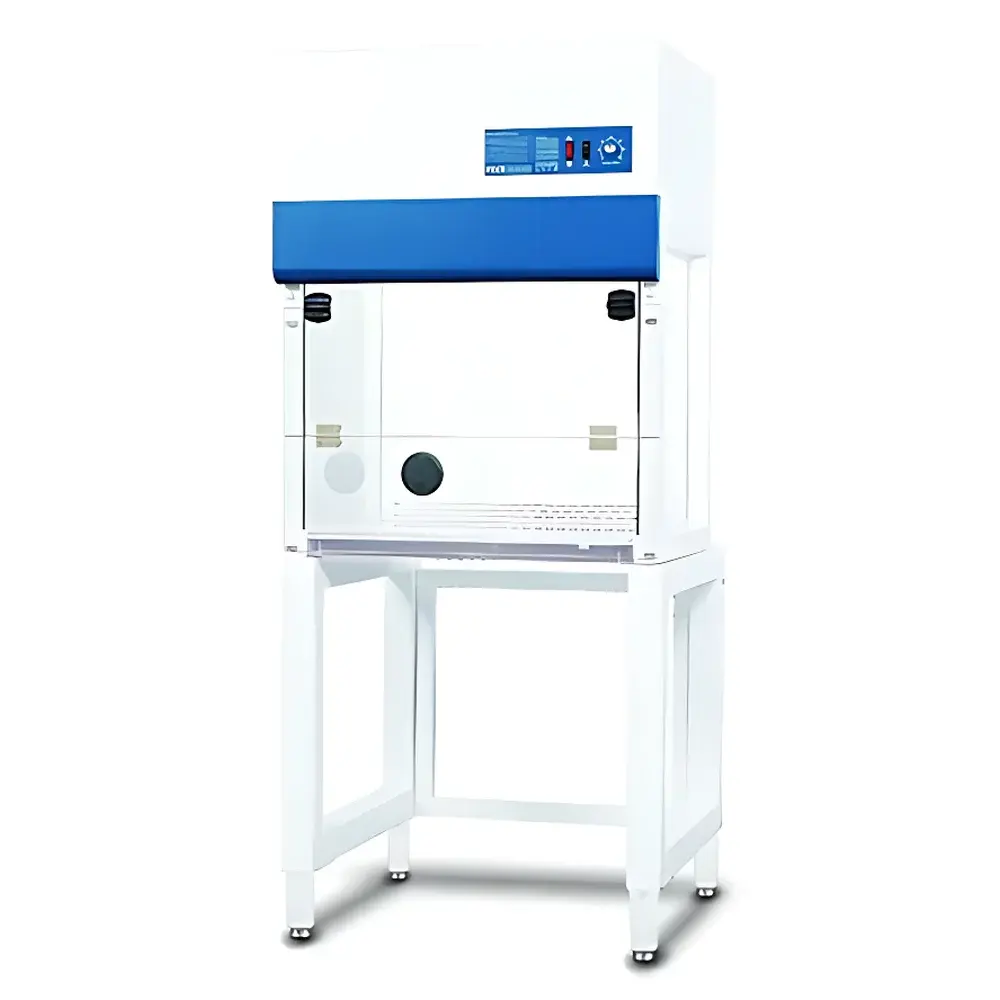
Esco SCR-2A1 PCR-Dedicated Vertical Laminar Flow Clean Bench
| Brand | Esco |
|---|---|
| Origin | Singapore |
| Manufacturer Type | Original Equipment Manufacturer (OEM) |
| Import Status | Imported |
| Model | SCR-2A1 |
| Instrument Category | Vertical Laminar Flow Clean Bench |
| Cleanliness Class | ISO Class 4 (≤352 particles/m³ @ ≥0.3 µm) |
| Noise Level | <63 dB(A) |
| User Capacity | Single-user, single-face configuration |
| Airflow Pattern | Vertical downward laminar flow |
Overview
The Esco SCR-2A1 PCR-Dedicated Vertical Laminar Flow Clean Bench is an engineered solution for molecular biology laboratories requiring stringent contamination control during polymerase chain reaction (PCR) setup and post-amplification handling. Designed specifically to mitigate amplicon carryover—a primary source of false-positive results—the SCR-2A1 employs unidirectional, HEPA-filtered vertical laminar airflow (VLF) to create a particle-free working environment compliant with ISO 14644-1 Class 4 (equivalent to Federal Standard 209E Class 10). Unlike horizontal-flow benches or general-purpose clean benches, the SCR-2A1 integrates structural, optical, and operational safeguards aligned with the three-zone PCR laboratory workflow: reagent preparation, sample processing, and amplification/analysis. Its airflow architecture ensures that airborne nucleic acid contaminants—whether from aerosolized amplicons or ambient particulates—are continuously swept away from the work surface and operator breathing zone, preserving assay integrity and reproducibility.
Key Features
- Vertical laminar airflow generated by a low-turbulence, brushless DC motor-driven blower system, delivering uniform velocity (0.3–0.5 m/s) across the full work surface (760 × 600 mm).
- Dual-stage filtration: pre-filter (polyurethane foam, 85% arrestance @ 5 µm) + certified H14 HEPA filter (EN 1822-1:2019), achieving ≥99.995% particle capture efficiency at 0.3 µm; typical service life exceeds 3 years under standard lab conditions (8 h/day, ISO Class 7 ambient air).
- Integrated 20 W germicidal UV-C lamp (253.7 nm), mounted behind the front panel to eliminate direct line-of-sight exposure; optimized reflector geometry eliminates shadow zones, ensuring full-surface irradiance ≥100 µW/cm² at 15 cm distance.
- Motorized, interlocked polycarbonate safety sash (5 mm thick, β-radiation resistant, UV-absorbing) with dual-position operation: fully open (spring-assisted) for routine work; fully closed (auto-locking) for UV decontamination cycles.
- Programmable UV timer (0–60 min, 1-min increments) with audible end-cycle alert and automatic lamp shutoff; safety interlock prevents UV activation unless sash is fully sealed.
- Warm-white LED lighting (5000 K CCT, >80 CRI) integrated into the airflow path to minimize turbulence while delivering ≥500 lux uniform illumination across the work area—reducing visual fatigue during extended pipetting sessions.
Sample Compatibility & Compliance
The SCR-2A1 supports all standard PCR consumables—including 0.2 mL tube strips, 96-well plates, and master mix vials—without airflow disruption. Its ISO Class 4 performance is validated per ISO 14644-3:2019 (particle counting), ISO 14644-4:2022 (installation testing), and EN 12464-1:2021 (lighting requirements). The unit complies with IEC 61010-1:2012 (safety of electrical equipment) and IEC 60335-1:2012 (UV radiation safety). It meets GLP/GMP environmental control expectations for nucleic acid-based diagnostics and is routinely deployed in laboratories adhering to CLIA, CAP, and ISO/IEC 17025 quality management systems. While not a biosafety cabinet (BSC), its design aligns with CDC/NIH recommendations for PCR workstation segregation in multi-zone molecular labs.
Software & Data Management
The SCR-2A1 operates via a microprocessor-based control panel with tactile buttons and LED status indicators—no embedded software or network connectivity. All operational parameters (UV timer setting, lighting on/off, airflow status) are locally managed and non-recordable. For regulated environments requiring audit trails, Esco recommends integrating the unit into facility-wide environmental monitoring systems via optional analog output modules (0–10 V signal for airflow velocity or UV lamp hours). No firmware updates or data export capabilities are provided, consistent with Class I medical device and ISO-compliant cleanroom equipment standards.
Applications
- Pre-PCR reagent aliquoting and master mix preparation in dedicated clean zones.
- Template DNA/RNA handling prior to thermal cycling, minimizing cross-contamination risk.
- Post-PCR product transfer for downstream applications (e.g., gel loading, sequencing library prep) when performed outside BSCs.
- Quality control workflows in diagnostic labs performing RT-qPCR, digital PCR, or NGS library construction.
- Teaching laboratories requiring robust, low-maintenance laminar flow for undergraduate molecular biology instruction.
FAQ
Is the SCR-2A1 suitable for handling infectious biological agents?
No. This is a clean bench—not a biosafety cabinet—and provides personnel and environmental protection only against particulate contamination. It does not protect users from aerosolized biohazards.
Can the HEPA filter be replaced in-house?
Yes. Filter replacement requires no tools and follows Esco’s documented procedure (included in the manual); annual certification by an accredited third-party service provider is recommended for ISO compliance.
Does the unit meet FDA 21 CFR Part 11 requirements?
Not applicable. As a non-data-generating, non-networked device, the SCR-2A1 falls outside the scope of Part 11; however, its physical controls support ALCOA+ principles when used within validated lab processes.
What maintenance schedule is recommended?
Daily: wipe-down with 70% ethanol; weekly: pre-filter cleaning; annually: HEPA integrity test and blower calibration.
Is the UV lamp intensity monitored over time?
No real-time monitoring is built-in, but Esco provides a UV radiometer calibration service (optional) and recommends lamp replacement every 1,500 operating hours or 12 months, whichever occurs first.



