
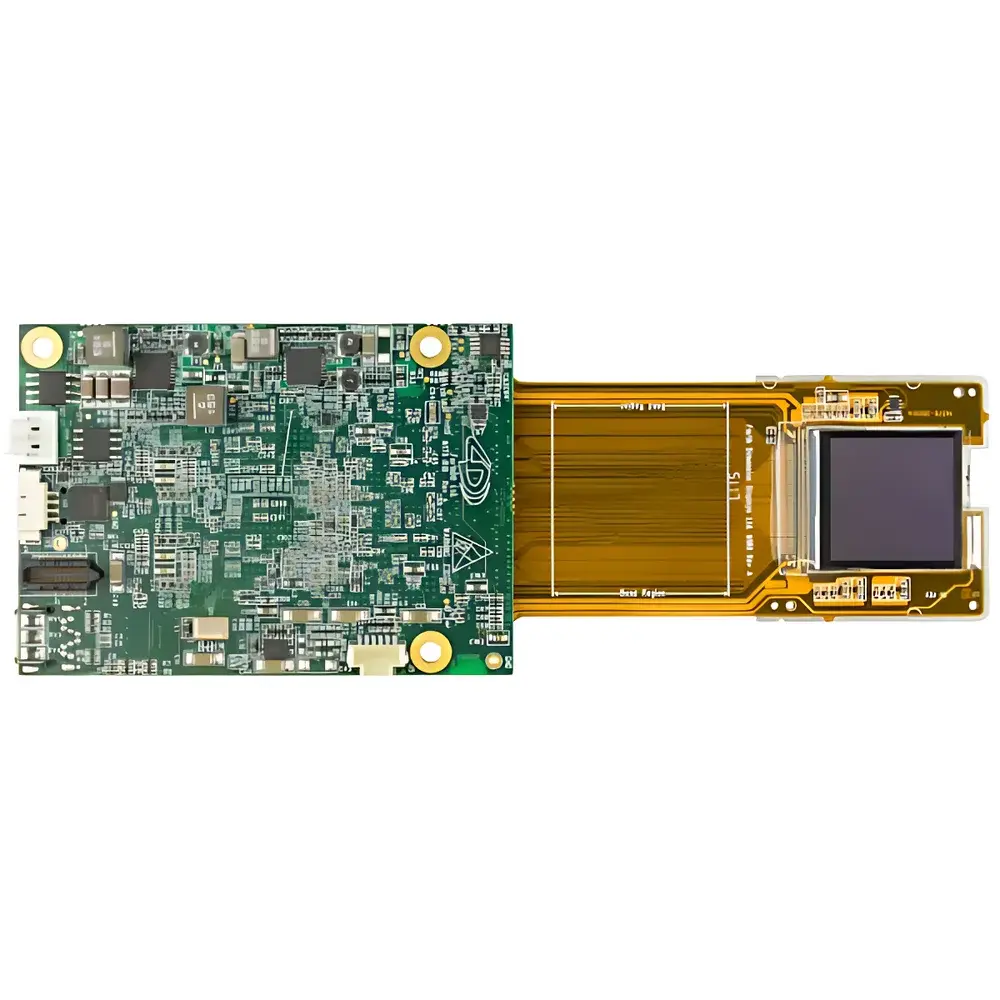
ForthDD 2048×2048 Pure-Amplitude Ferroelectric Liquid Crystal Spatial Light Modulator (FLCOS-SLM)
| Brand | ForthDD |
|---|---|
| Resolution | 2048 × 2048 pixels |
| Refresh Rate | 3.6 kHz |
| Fill Factor | >94% |
| Operating Wavelength Range | 430–700 nm |
| Interface | USB 3.0 |
| Type | Amplitude-Only Modulation |
| Technology | Ferroelectric Liquid Crystal on Silicon (FLCOS) |
| Origin | United Kingdom |
| Compliance | CE, RoHS |
Overview
The ForthDD 2048×2048 Pure-Amplitude Ferroelectric Liquid Crystal Spatial Light Modulator (FLCOS-SLM) is a high-performance optical modulation device engineered for precision structured illumination microscopy (SIM), light-sheet fluorescence microscopy (LSFM), and other advanced wavefront-shaping applications requiring binary or analog amplitude control. Unlike conventional nematic liquid crystal SLMs, this device leverages ferroelectric liquid crystal (FLC) technology integrated onto a silicon backplane, enabling microsecond-scale switching dynamics and intrinsic bistability—critical for high-frame-rate pattern sequencing without temporal drift or thermal hysteresis. The modulator operates exclusively in amplitude mode, providing high-contrast ON/OFF intensity modulation across the visible spectrum (430–700 nm), with minimal phase perturbation (<λ/50 RMS over full aperture). Its monolithic pixel architecture delivers uniform electro-optic response and exceptional spatial fidelity, making it suitable for quantitative optical metrology and reproducible super-resolution imaging workflows.
Key Features
- Native 2048 × 2048 pixel resolution: Enables sub-micron pattern definition and fine-grained spatial frequency control for multi-angle SIM reconstruction and adaptive light-sheet generation.
- 3.6 kHz frame rate: Supports real-time pattern cycling required for rapid acquisition in multi-phase SIM protocols (e.g., 3-phase, 5-phase, or rotationally multiplexed schemes) without motion-induced artifacts.
- Optical fill factor >94%: Minimizes diffraction sidelobes and improves modulation contrast ratio (>500:1 typical), essential for clean structured illumination with low background scatter.
- USB 3.0 interface with deterministic latency: Provides plug-and-play integration with standard Windows/Linux-based microscopy control systems; firmware supports precise timing synchronization via hardware trigger input (TTL-compatible).
- Visible-band optimized optics: Anti-reflection coated quartz window and FLC alignment layers ensure broadband transmission stability and polarization preservation across 430–700 nm.
- Robust thermal management: Passive heatsink design maintains stable electro-optic response over extended operation (>8 hours continuous use at 25°C ambient).
Sample Compatibility & Compliance
This FLCOS-SLM is compatible with standard epi- and oblique illumination paths in inverted and upright microscopes. It accepts collimated input beams up to Ø12 mm (1/e²) and integrates seamlessly with commercial SIM platforms (e.g., OMX, DeltaVision OMX, Nikon N-SIM) via custom MATLAB/Python API wrappers or native support in Micro-Manager and μManager. The device complies with EU directives CE 2014/30/EU (EMC) and 2011/65/EU (RoHS), and conforms to IEC 61000-6-3 for radiated emissions. While not certified for ISO 13485 or FDA 21 CFR Part 11 out-of-the-box, its deterministic behavior, audit-trail-capable software drivers, and hardware-triggered synchronization make it suitable for GLP-compliant research environments where traceable optical calibration and version-controlled pattern sequences are maintained.
Software & Data Management
ForthDD provides a cross-platform SDK supporting C/C++, Python (via ctypes), and MATLAB interfaces. Pattern loading uses 16-bit grayscale bitmaps mapped linearly to amplitude transmission (0 = minimum transmission, 65535 = maximum). The SDK includes built-in functions for generating sinusoidal grating stacks, rotated stripe families, and hexagonal lattice patterns—optimized for SIM reconstruction pipelines. All pattern uploads are timestamped and logged locally; optional integration with LabVIEW or National Instruments DAQ systems enables synchronized camera triggering and metadata embedding. Raw pattern files (.bin or .tif) are stored in vendor-neutral formats, ensuring long-term data reproducibility and compatibility with open-source reconstruction tools such as SIMToolbox or FairSIM.
Applications
- Structured Illumination Microscopy (SIM): Generation of high-contrast, multi-orientation illumination patterns for 2× lateral resolution enhancement in fixed and live-cell imaging.
- Light-Sheet Fluorescence Microscopy (LSFM): Dynamic projection of scanned or static light sheets with programmable thickness and Bessel-like profiles for selective plane excitation.
- Optical trapping and beam shaping: Real-time amplitude masking for multi-spot optical tweezers or custom intensity distribution synthesis.
- Computational adaptive optics: Integration into closed-loop wavefront correction systems using amplitude-only feedback algorithms.
- Diffractive optical element (DOE) emulation: Emulation of static DOEs via time-multiplexed pattern sequences, enabling reconfigurable optical setups without mechanical alignment.
FAQ
What is the difference between this pure-amplitude FLCOS-SLM and a phase-only SLM?
This device modulates only the intensity (amplitude) of incident light, suppressing phase modulation to <λ/50 RMS. Phase-only SLMs induce wavefront curvature and require careful compensation in interferometric or holographic setups—whereas amplitude-only modulation simplifies optical alignment and eliminates unwanted zero-order interference artifacts in widefield SIM.
Can this SLM be used with pulsed lasers?
Yes—its microsecond switching time and lack of thermal inertia allow synchronization with nanosecond-pulsed visible lasers (e.g., 488 nm, 561 nm DPSS) when triggered externally via TTL input; average power handling is limited to ≤500 mW/cm² at 532 nm.
Is calibration data provided with the unit?
Each unit ships with factory-measured pixel-wise transmission uniformity maps and gamma correction LUTs, referenced to NIST-traceable photodiode measurements at three wavelengths (488 nm, 561 nm, 640 nm).
Does the USB interface support real-time pattern updates during acquisition?
Yes—USB 3.0 bandwidth allows full-frame (2048×2048) pattern reloads in <280 µs, enabling frame-synchronized illumination changes at up to 3.6 kHz without CPU bottlenecking when using DMA-enabled drivers.
How is thermal drift managed during extended imaging sessions?
The device incorporates a passive aluminum heatsink and thermally isolated FLC layer design; measured transmission drift remains within ±0.3% over 8 hours at 25°C ambient, verified per ISO 10110-7 test protocol.




