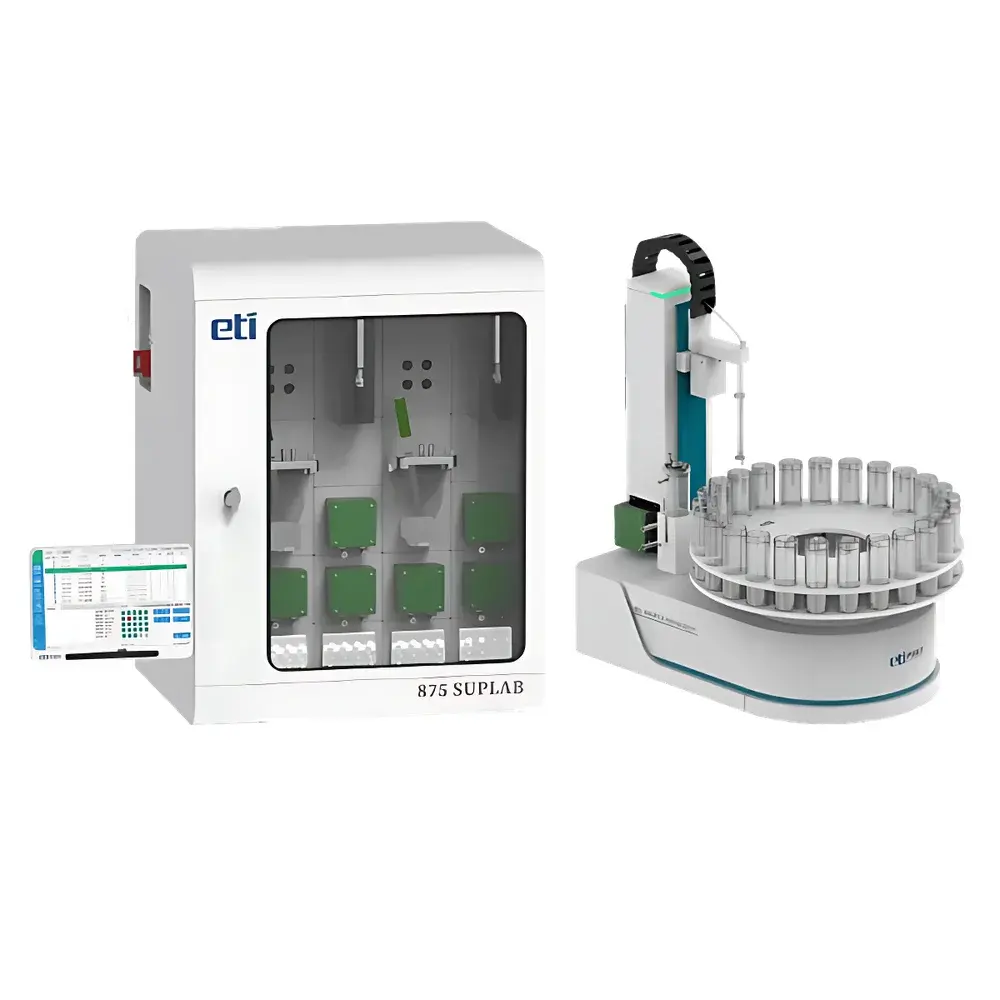
ETI 875 SupLab Automated Potentiometric Titrator
| Brand | ETI |
|---|---|
| Origin | Guangdong, China |
| Manufacturer Type | Authorized Distributor |
| Country of Origin | China |
| Model | 875 SupLab |
| Pricing | Available Upon Request |
| Dimensions (Total System) | 1200 mm (W) × 650 mm (D) × 1750 mm (H) |
| Control Unit | 260 mm (W) × 100 mm (D) × 200 mm (H) |
| Sample Handling Unit | 450 mm (W) × 650 mm (D) × 750 mm (H) |
| Analytical Unit | 650 mm (W) × 500 mm (D) × 1550 mm (H) |
| Power Supply | 198–242 V AC, 50 Hz ± 0.5 Hz, 500 VA |
| Operating Environment | 15–30 °C, RH 45–85 % (max. daily temperature fluctuation ≤5 °C) |
| Touchscreen Interface | 10-inch full-color serial touch panel |
| Standard Configuration | 4 modular detection channels |
| Throughput | ~10 min for simultaneous quantification of up to 4 analytes in a single sample |
Overview
The ETI 875 SupLab Automated Potentiometric Titrator is an industrial-grade online reaction analysis system engineered for high-reliability, unattended titrimetric monitoring in continuous or batch process environments. Unlike conventional benchtop titrators, the 875 SupLab integrates potentiometric endpoint detection with optional photometric sensing—enabling hybrid titration modes including acid-base, complexometric, precipitation, redox, and photometric titration. Its core architecture follows ASTM E2081 and ISO 8655-7 principles for volumetric accuracy and electrode response traceability. Designed for integration into QC/QA workflows in semiconductor fabrication, metal surface treatment lines, fine chemical synthesis, and petroleum refining, the system delivers repeatable endpoint determination through real-time potential gradient analysis (dE/dV) coupled with dual-wavelength absorbance tracking where photometric modules are deployed. The instrument operates under GLP-compliant conditions and supports audit-ready data generation per FDA 21 CFR Part 11 requirements when paired with validated software configurations.
Key Features
- Fully automated sample identification and method assignment via barcode/RFID scanning or manual input on the 10-inch color touchscreen interface
- Dynamic sequence optimization: measurement order adapts in real time based on reagent availability, electrode conditioning status, and priority flags assigned to samples
- Integrated multi-channel liquid handling system with independent syringe pumps and precision burettes (±0.1% volumetric accuracy per ISO 8655-3)
- Simultaneous multi-analyte quantification within a single sample matrix using spatially segregated detection modules—no manual re-injection required
- Modular design supporting up to four parallel titration channels; each channel configurable for distinct titrant types, electrode sets, and detection principles (potentiometric or photometric)
- Onboard environmental monitoring: internal temperature and humidity sensors log ambient conditions continuously to flag potential drift contributors during long-duration runs
Sample Compatibility & Compliance
The 875 SupLab accommodates aqueous, organic-aqueous, and low-conductivity matrices typical in electroplating baths, etchant solutions, catalyst slurries, and hydrocarbon distillates. It complies with IEC 61000-6-2 (electromagnetic immunity) and IEC 61000-6-4 (emission standards), and its electrical safety conforms to GB 4793.1–2007 (equivalent to IEC 61010-1). For regulated environments, the system supports user access levels, electronic signatures, and full audit trails—including timestamped records of electrode calibration, titrant standardization, and raw potential/absorbance curves. Validation documentation aligns with USP , EP 2.2.20, and ISO/IEC 17025:2017 requirements for testing laboratories.
Software & Data Management
The embedded control software provides intuitive workflow configuration, method library management, and real-time visualization of titration curves (E vs. V, dE/dV vs. V, or A vs. V). All raw and processed data are stored in encrypted SQLite databases with automatic backup to network drives or USB media. Export formats include CSV, PDF reports (with digital signature fields), and XML structured for LIMS integration (ASTM E1482-compliant schema). Optional cloud synchronization enables remote diagnostics and centralized fleet monitoring across distributed manufacturing sites. Data integrity safeguards include write-once storage mode, checksum verification, and tamper-evident logging of all user-initiated actions.
Applications
- Real-time monitoring of free acid and total metal ion concentrations in zinc/nickel/copper electroplating baths
- Quantification of chloride, sulfate, and nitrate impurities in high-purity electronic-grade solvents
- In-process control of neutralization endpoints during polymerization catalyst quenching
- Automated quality release testing of corrosion inhibitors and surfactant blends in refinery streams
- Multi-parameter validation of cleaning solution composition in semiconductor wafer fab wet benches
FAQ
What titration modes does the 875 SupLab support?
It supports potentiometric titration (acid-base, redox, complexometric, precipitation) and photometric titration (dual-wavelength absorbance tracking), with method selection configurable per channel.
Can the system be integrated into existing DCS or MES platforms?
Yes—via Modbus TCP, OPC UA, or RESTful API interfaces; hardware-level dry-contact I/O is also available for direct PLC handshaking.
Is electrode calibration traceable to national standards?
Calibration routines include NIST-traceable reference solutions (e.g., pH 4.01, 7.00, 10.01 buffers; Ag/AgCl standards); calibration logs contain certificate numbers and expiration dates.
How is data security maintained during remote access?
All remote connections require TLS 1.2+ encryption; session timeouts are enforced after 15 minutes of inactivity, and two-factor authentication is supported via RADIUS integration.
What maintenance intervals are recommended for long-term operation?
Electrode cleaning and recalibration every 8 operational hours; syringe pump lubrication and tubing replacement every 6 months or 2,000 cycles—whichever occurs first.
Related Products