
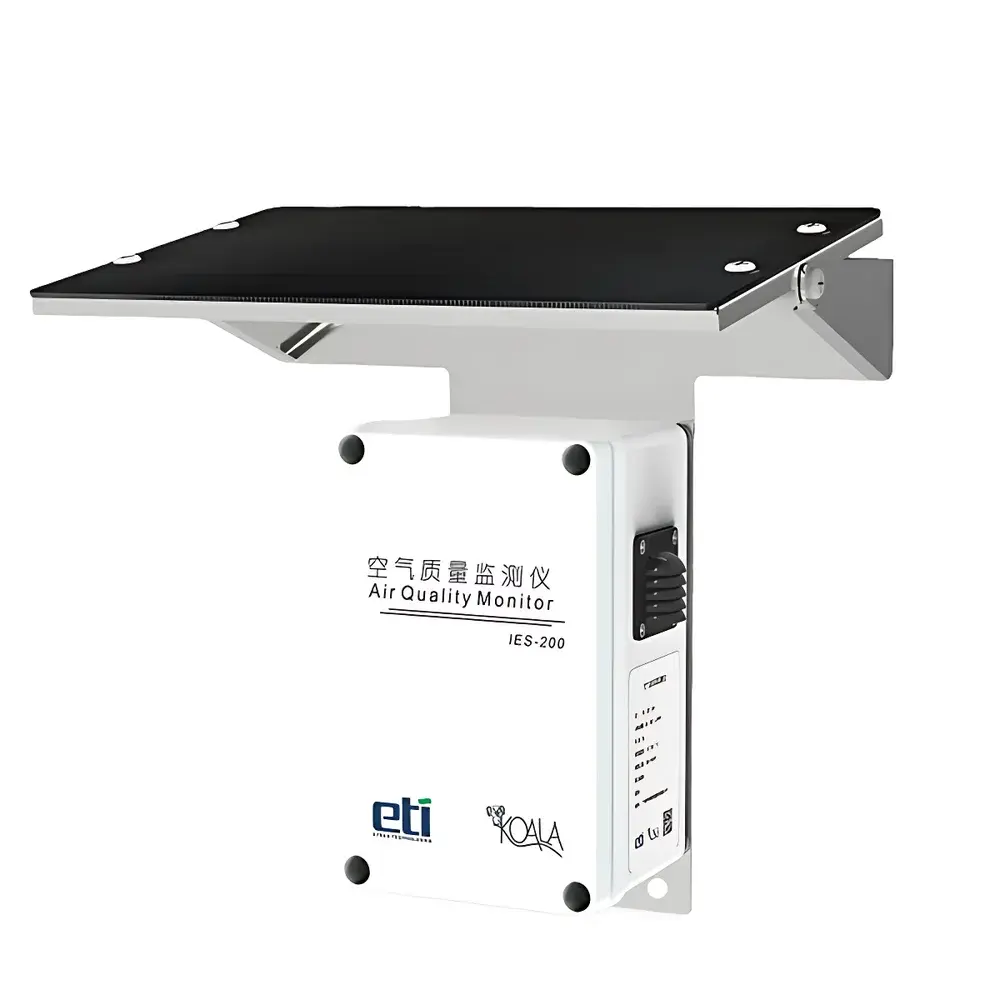
ETI IES-200 Multi-Parameter Air Quality Monitoring System
| Brand | ETI |
|---|---|
| Model | IES-200 |
| Origin | Guangdong, China |
| Instrument Type | Continuous Ambient Air Monitoring System |
| Measured Parameters | SO₂, CO, NO₂, O₃, TVOC, PM₁.₀, PM₂.₅, PM₁₀ |
| Detection Principle | Electrochemical (SO₂/CO/NO₂/O₃), PID (TVOC), Laser Scattering (PM) |
| Range | SO₂ 0–2 ppm |
| Resolution | SO₂ 0.05 ppm |
| Response Time (t₉₀) | SO₂/CO/NO₂/O₃ ≤90 s |
| Accuracy | ±5% of reading (gas) |
| Linearity Error | ±2% FS |
Overview
The ETI IES-200 Multi-Parameter Air Quality Monitoring System is an integrated, vehicle-mounted ambient air monitoring platform engineered for high-temporal-resolution mobile monitoring of gaseous pollutants and particulate matter in urban and industrial environments. It operates on a hybrid sensor architecture: electrochemical cells for sulfur dioxide (SO₂), carbon monoxide (CO), nitrogen dioxide (NO₂), and ozone (O₃); photoionization detection (PID) for total volatile organic compounds (TVOC); and real-time laser scattering photometry for mass concentration measurements of PM₁.₀, PM₂.₅, and PM₁₀. Designed for continuous, unattended operation during drive-by or fixed-route surveys, the system delivers synchronized georeferenced data streams compliant with international ambient air quality monitoring frameworks including ISO 12039 (SO₂), ISO 4226 (PM), and EPA Method TO-15 (VOCs). Its embedded GPS module ensures precise spatial tagging of each measurement, enabling dynamic mapping of pollution gradients across road networks.
Key Features
- Real-time, multi-parameter acquisition at 1-second temporal resolution, synchronized with GNSS position, speed, heading, and device ID
- Onboard fault diagnostics with automatic event logging and timestamped error flagging per sensor channel
- Integrated data correction algorithms for sensor drift compensation and cross-interference mitigation (e.g., humidity-corrected PM readings, NO₂–O₃ interplay compensation)
- Local storage capacity supporting ≥3 years of raw time-series data (1 Hz sampling) with automated rollover and integrity checksums
- Secure cloud synchronization via TLS 1.2–encrypted MQTT or HTTPS protocols; supports configurable upload intervals (10 s to 1 h)
- Ruggedized IP65-rated enclosure with thermal management for stable operation across −20 °C to +50 °C ambient conditions
Sample Compatibility & Compliance
The IES-200 is validated for ambient air matrixes meeting ISO 12039, ISO 7935 (CO), and ISO 10155 (NO₂) sampling requirements. It accommodates variable flow rates (0.8–1.2 L/min) and inlet configurations compatible with standard 1/4″ PTFE tubing and cyclonic pre-separators for coarse particle removal. All gas sensors are factory-calibrated against NIST-traceable standards, with optional field recalibration using certified span gases (ISO 6141). Particulate channels meet EN 12341:2014 specifications for PM₂.₅ and PM₁₀ reference equivalence under controlled wind-speed and humidity conditions. The system supports audit-ready data provenance: full GLP-compliant metadata embedding (sensor serials, calibration dates, firmware versions, GPS HDOP) and tamper-evident digital signatures per data packet.
Software & Data Management
Data from the IES-200 is managed through ETI’s proprietary CloudAQ Platform—a web-based SaaS environment supporting role-based access control (RBAC), multi-tenant isolation, and FDA 21 CFR Part 11–compliant electronic records (audit trail, electronic signatures, data retention policies). Users generate spatiotemporal analytics including time-weighted average (TWA) concentrations, exceedance frequency histograms, and rolling 7-day moving averages. Road-level pollution cloud maps are rendered using inverse distance weighting (IDW) interpolation, with overlay options for traffic volume, land use, and meteorological layers (wind direction, temperature inversion index). Raw datasets export natively to CSV, NetCDF, or Excel (.xlsx) formats—including full metadata headers and QC flags—ensuring interoperability with GIS tools (QGIS, ArcGIS) and statistical platforms (R, Python pandas).
Applications
- Mobile emission hotspot identification along arterial roads, highways, and port access corridors
- Validation of dispersion modeling outputs (e.g., AERMOD, CALPUFF) with high-density ground-truth measurements
- Long-term trend analysis of urban background and near-roadway exposure gradients
- Supporting municipal air quality action plans (AQAPs) and EU Directive 2008/50/EC compliance reporting
- Industrial fence-line monitoring with real-time alerting on VOC or NO₂ excursions above site-specific thresholds
- Academic research on traffic-related air pollution (TRAP) health impact studies requiring microscale exposure assignment
FAQ
What calibration standards are used for factory certification?
All gas sensors are calibrated using NIST-traceable primary standards (e.g., Scott Specialty Gases, Linde Gas) with gravimetric uncertainty ≤1.5%. PM channels are verified against ISO 12103-1 A2 test dust and TSI 8020 condensation particle counters.
Is remote firmware update supported?
Yes—over-the-air (OTA) updates are delivered via signed binary packages with SHA-256 verification and rollback capability. Updates require administrative authentication and trigger automatic pre- and post-update self-diagnostic sequences.
How is data integrity ensured during intermittent network connectivity?
The onboard SD card maintains write-locked ring buffers with cyclic redundancy checks (CRC-32). Upon reconnection, the system resumes transmission from the last acknowledged packet sequence number, preventing duplication or omission.
Can the system integrate with third-party environmental dashboards (e.g., OpenAQ, AirNow)?
Yes—via RESTful API endpoints supporting JSON and XML payloads. Prebuilt connectors exist for OpenAQ ingestion and AirNow’s AirNowAPI v2 schema, including AQI calculation per EPA 451/B-13-001 methodology.
What is the recommended maintenance interval for sensor modules?
Electrochemical sensors: 6–12 months depending on exposure history; PID lamps: 12–18 months; PM optical units: quarterly visual inspection and annual cleaning per ISO 14644-1 Class 8 cleanroom protocol.







