
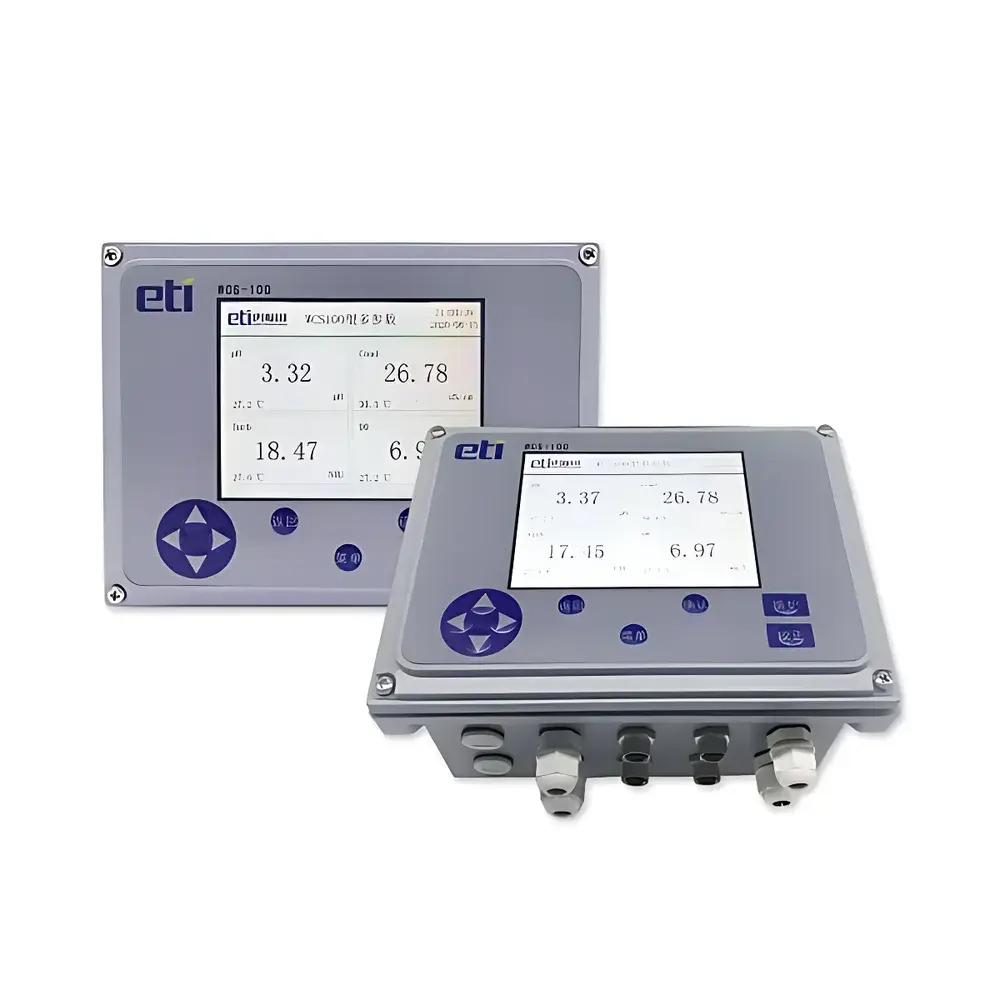
ETI WCS100 Multi-Parameter Online Water Quality Analyzer
| Brand | ETI |
|---|---|
| Origin | Guangdong, China |
| Model | WCS100 |
| Instrument Type | Online Water Quality Analyzer |
| Measured Parameters | pH, Conductivity, Dissolved Oxygen (DO), Turbidity, Temperature, Phycocyanin (Blue-Green Algae), Chlorophyll-a, ORP |
| Conductivity Range | 0–20,000 µS/cm |
| Conductivity Principle | Two-Electrode Conductometry |
| Conductivity Resolution | 0.01 µS/cm (at 20 µS/cm), 0.1 µS/cm (at 200 µS/cm), 1 µS/cm (at 2000 µS/cm), 10 µS/cm (at 20,000 µS/cm) |
| Turbidity Range | 0–1000 NTU / 0–4000 NTU |
| Turbidity Principle | 90° Light Scattering |
| Turbidity Resolution | 0.01 NTU |
| DO Range | 0–20 mg/L |
| DO Principle | Fluorescence Quenching |
| pH Range | 0–14 pH |
| pH Resolution | 0.01 pH |
| Temperature Range | −5 to +80 °C |
| Temperature Compensation | Integrated NTC Sensor |
| Response Time (T90) | <60 s (Conductivity, Turbidity, DO), T95 <10 s (pH) |
| Enclosure Rating | IP68 (sensor + cable) |
Overview
The ETI WCS100 Multi-Parameter Online Water Quality Analyzer is an integrated, field-deployable instrumentation platform engineered for continuous, real-time monitoring of critical water quality parameters in diverse aquatic environments. Based on modular sensor architecture and embedded electrochemical and optical sensing principles, the system supports simultaneous measurement of pH, conductivity, dissolved oxygen (DO), turbidity, temperature, oxidation-reduction potential (ORP), phycocyanin (as a proxy for cyanobacterial biomass), and chlorophyll-a. Its design adheres to fundamental metrological requirements for environmental monitoring—emphasizing long-term stability, low drift, and traceable calibration protocols. The analyzer operates autonomously in unattended installations, delivering high reproducibility across dynamic conditions typical of surface water bodies, drinking water intakes, municipal wastewater treatment plants, and industrial effluent discharge points.
Key Features
- Modular sensor interface supporting up to nine interchangeable probes—enabling flexible configuration for site-specific regulatory or operational requirements.
- Automatic sensor recognition and plug-and-play initialization—eliminating manual parameter mapping and reducing commissioning time.
- Integrated NTC-based temperature compensation across all electrochemical and optical sensors—ensuring accuracy across the full operating range (−5 to +80 °C).
- User-configurable data logging intervals—from 1-minute snapshots to hourly composites—optimized for SCADA integration or local SD-card archival.
- IP68-rated sensor housings and submersible cabling—certified for permanent immersion in freshwater and brackish environments without external enclosures.
- Optimized optical path design for turbidity detection using 90° scattered light geometry per ISO 7027-1:2016, with dual-range capability (0–1000 NTU and 0–4000 NTU) and 0.01 NTU resolution.
- Fluorescence-based DO sensing—free from oxygen consumption during measurement, offering stable performance under low-flow or stagnant conditions.
Sample Compatibility & Compliance
The WCS100 is validated for use in natural and engineered water matrices including rivers, lakes, reservoirs, potable water distribution systems, activated sludge basins, and industrial process streams. It complies with core physical and electrical safety standards applicable to permanently installed environmental instrumentation (IEC 61000-6-2/6-3, IEC 60529 for IP68). While not certified to ISO/IEC 17025 as a standalone testing laboratory, its measurement algorithms and calibration routines are aligned with reference methods defined in ASTM D1293 (pH), ASTM D5391 (conductivity), ASTM D888 (DO), and ISO 7027-1 (turbidity). Data integrity features—including timestamped records, sensor health diagnostics, and calibration history logs—support adherence to GLP and basic GMP documentation practices.
Software & Data Management
The analyzer includes embedded firmware with a web-accessible configuration interface (HTTP/HTTPS) and Modbus TCP/RTU protocol support for seamless integration into existing SCADA, DCS, or cloud-based environmental data platforms. All measurements are tagged with UTC timestamps, sensor IDs, and status flags (e.g., “calibrated”, “out-of-range”, “signal-noise-ratio-low”). Local storage accommodates ≥30 days of second-resolution data on internal flash memory, extendable via microSD card (up to 32 GB). Audit trails record all configuration changes, calibration events, and firmware updates—meeting minimum traceability expectations under EPA Guidance for Continuous Monitoring Systems (2021) and EU WFD Article 8 reporting frameworks. No proprietary cloud subscription is required; raw CSV exports and RESTful API endpoints are available for third-party analytics pipelines.
Applications
- Real-time early warning for algal bloom development through synchronized phycocyanin and chlorophyll-a trending in reservoirs and intake channels.
- Compliance monitoring of discharge permits—tracking pH, conductivity, and DO against jurisdictional limits (e.g., US EPA NPDES, China’s GB 8978-1996).
- Process control in drinking water treatment—monitoring coagulant dosing efficacy via turbidity decay profiles and disinfection residual correlation with ORP.
- Industrial pretreatment verification—detecting conductivity spikes indicating accidental chemical ingress or cross-contamination events.
- Long-term trend analysis for watershed management programs—leveraging multi-year temperature-compensated conductivity datasets to infer salinity intrusion or baseflow contributions.
FAQ
Can the WCS100 be calibrated remotely?
Yes—via secure web interface or Modbus commands. Calibration coefficients (slope, offset, zero) can be uploaded following field validation using NIST-traceable standards. Full calibration logs—including operator ID, standard values, and deviation metrics—are retained locally.
Is the system compatible with third-party telemetry hardware?
Yes. RS485 serial output, 4–20 mA analog outputs (user-assignable per parameter), and Ethernet connectivity enable interoperability with cellular RTUs, LoRaWAN gateways, and industrial PLCs without middleware.
What maintenance intervals are recommended for submerged sensors?
Quarterly visual inspection and cleaning are advised. Fluorescent DO and pH sensors typically require recalibration every 3–6 months depending on fouling risk; turbidity optics should be verified annually using formazin or AMCO AEPA standards.
Does the system support alarm thresholds with relay outputs?
Yes. Up to eight programmable limit alarms (high/low) per parameter, each configurable with hysteresis and delay timers. Dry-contact relays (SPDT, 250 VAC/3 A) are provided for local actuation of pumps, sirens, or isolation valves.
Related Products







