
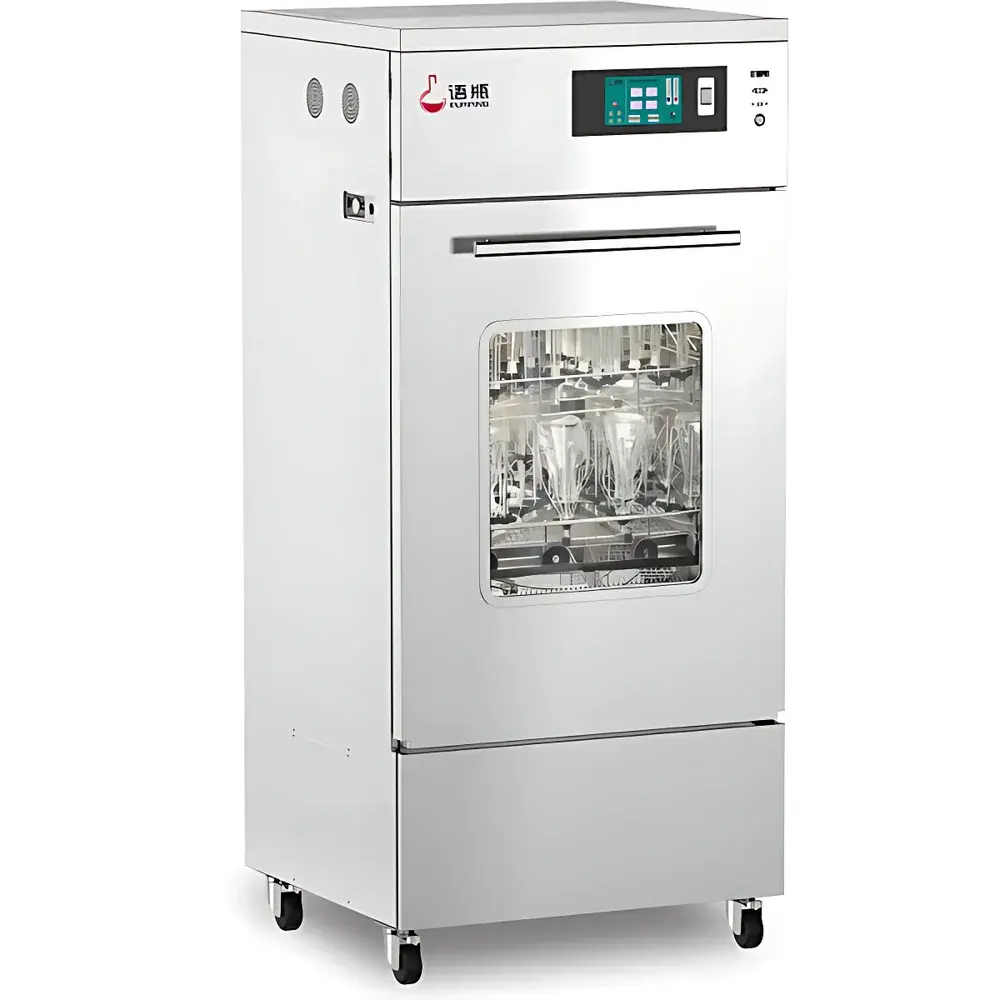
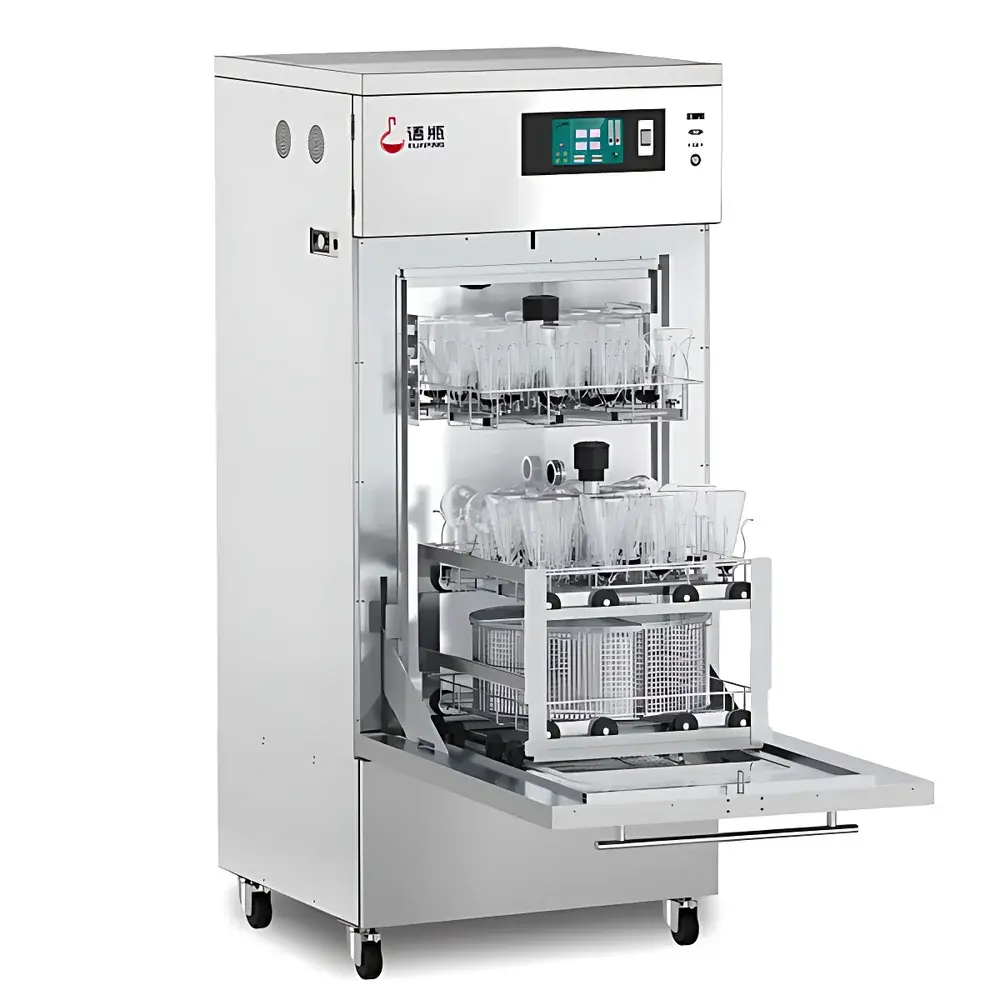
EURPING Q920 Laboratory Bottle Washer
| Brand | EURPING |
|---|---|
| Origin | Tianjin, China |
| Manufacturer Type | Direct Manufacturer |
| Product Category | Domestic |
| Model | Q920 |
| Price Range | USD 14,000 – 42,500 (FOB) |
| Chamber Volume | 291 L |
| Heating Power | 9 kW |
| Maximum Wash Temperature | 95 °C |
| Compatible Detergents | Acidic and Alkaline Cleaning Solutions |
| External Dimensions (L×W×D) | 790 × 760 × 1750 mm |
| Electrical Supply | 380 V, 50 Hz |
| Circulation Pump Power | 1.2 kW |
| Wash Cycle Water Flow Rate | 0–800 L/min (VFD-controlled) |
| Drying System | Dual-compressor internal recirculating hot-air dryer (≥220 m³/h airflow, vacuum pressure 110 mbar) |
| Control System | Microprocessor-based controller with US-sourced IC chips, opto-isolated circuitry, full-color capacitive touch panel, 30 pre-installed standard programs + 120 user-definable protocols |
| Data Management | RS232 interface, thermal printer support, A₀ value logging, black-box event recorder, optional real-time conductivity monitoring |
| Safety | Electronic door lock with automatic thermal interlock, dual temperature sensors, leak detection, detergent level alarm, auto-drain on cycle completion, integrated high-molecular filter on inlet solenoid valve |
| Construction | 316L stainless steel interior (passivated), 304 stainless steel exterior, triple-tier adjustable wash racks, dual-layer high-temp borosilicate glass viewing window with LED interior lighting |
| Compliance | Designed to support ISO 15190, ISO 13485, GLP/GMP traceability requirements |
Overview
The EURPING Q920 Laboratory Bottle Washer is an engineered solution for high-throughput, repeatable, and auditable cleaning of critical laboratory glassware and plasticware in regulated environments. Built upon a validated thermodynamic cleaning platform, it employs heated aqueous circulation—combined with precisely metered alkaline or acidic detergents—to achieve microbiological and residue removal consistent with ISO 15190 Annex B and ASTM E2523-17 standards for analytical instrument cleanliness. Its core architecture integrates thermal disinfection (95 °C sustained hold), mechanical impingement via radial 12-port manifold distribution, and controlled drying under vacuum-assisted hot-air recirculation—eliminating condensation risks and ensuring complete moisture evacuation from complex geometries including pipettes, vials, and volumetric flasks. Designed for laboratories where reproducibility, data traceability, and process control are non-negotiable, the Q920 serves as a foundational unit in QC/QA workflows across environmental testing, pharmaceutical manufacturing, clinical diagnostics, food safety, and geochemical analysis.
Key Features
- 291 L passivated 316L stainless steel chamber with dual-layer high-temperature borosilicate viewing window and integrated LED illumination for real-time process observation
- VFD-controlled circulation pump delivering 0–800 L/min adjustable flow, enabling optimization for delicate vs. heavily soiled loads
- Triple-tier configurable wash rack system supporting simultaneous processing of up to 460 × 2 mL HPLC vials, 172 × 100 mL volumetric pipettes (vertical orientation), or 5 L beakers per cycle
- Centralized 12-way radial water distribution manifold ensuring uniform spray pressure across all rack positions—no pressure gradient between proximal and distal nozzles
- Dual-compressor hot-air drying system (≥220 m³/h, 110 mbar vacuum) with internal heat exchange and automatic condensate drainage—no external venting required
- Microprocessor control with US-sourced ICs, opto-isolation, and full-color capacitive touch interface supporting 30 factory-standard and 120 fully customizable wash protocols
- Three independent peristaltic pumps for precise detergent dosing (acid/alkali/rinse aid); built-in flowmeter enables dynamic water volume tracking and detergent concentration validation
- Comprehensive safety architecture: electronic door lock with thermal cutoff, dual NTC temperature sensors, leak detection, detergent level monitoring, and auto-drain functionality at cycle end
Sample Compatibility & Compliance
The Q920 accommodates a broad spectrum of laboratory vessels—including chromatography vials, serological pipettes, volumetric flasks, centrifuge tubes, digestion vessels, and custom-shaped containers—without requiring adapter fixtures. Its programmable parameters allow method-specific validation for residual protein, endotoxin, heavy metal, or organic solvent carryover per USP , EP 2.6.27, and ISO 8573-1 cleanliness classifications. The system’s construction materials (316L interior, passivation-certified), closed-loop water management, and absence of stagnant zones align with ISO 13485 cleanroom equipment design principles. When configured with optional conductivity monitoring and enabled audit-trail logging, the Q920 supports compliance with FDA 21 CFR Part 11, EU Annex 11, and GLP/GMP documentation requirements for cleaning process validation.
Software & Data Management
All wash cycles generate timestamped, parameter-locked records including A₀ values (calculated per EN ISO 15883-1), detergent consumption, temperature profiles, flow rates, and door status events. These are stored locally in a tamper-resistant “black-box” memory module and exportable via RS232 to external LIMS or ELN systems. Optional real-time conductivity monitoring provides continuous feedback on rinse water purity—critical for trace-metal analysis labs. The three-level password system (operator / supervisor / administrator) enforces role-based access control, while program duplication prevention and immutable parameter locking ensure method integrity. Data exports comply with CSV and PDF formats suitable for regulatory submission.
Applications
The Q920 is routinely deployed in accredited environmental testing labs processing EPA Method 1631/200.8 samples; pharmaceutical QC labs validating cleaning procedures for HPLC autosampler vials per ICH Q5C; biotech facilities decontaminating cell culture flasks; food safety labs preparing AOAC 999.10-compliant sample containers; and geological survey labs cleaning acid-washed digestion vessels for ICP-MS analysis. Its ability to deliver >27 final rinses with ultra-pure water—coupled with vacuum-assisted drying—makes it particularly suited for applications demanding sub-ppb contamination thresholds.
FAQ
Does the Q920 meet international validation requirements for cleaning process qualification?
Yes—the system supports IQ/OQ/PQ execution per ASTM E2500 and provides raw data logs necessary for A₀-based thermal validation and residue limit verification.
Can the Q920 be integrated into a centralized lab automation network?
While natively RS232-equipped, Ethernet or OPC UA integration is available via third-party middleware certified for LabVantage, STARLIMS, or LabWare environments.
Is pure water supply mandatory for final rinses?
For applications requiring ≤0.1 µS/cm conductivity (e.g., trace metal analysis), a dedicated DI or UPW feed is recommended; the onboard booster pump ensures stable delivery regardless of facility line pressure.
How is detergent compatibility verified for regulated use?
EURPING provides material compatibility charts for common GMP-grade detergents (e.g., SoluServe™, Hellmanex™ III) and supports detergent residue testing protocols using TOC or conductivity endpoints.
What maintenance intervals are recommended for long-term reliability?
Quarterly inspection of spray manifolds, annual calibration of temperature/flow sensors, and biannual replacement of inlet filtration media—documented in the included PM checklist aligned with ISO/IEC 17025 clause 6.4.10.



