
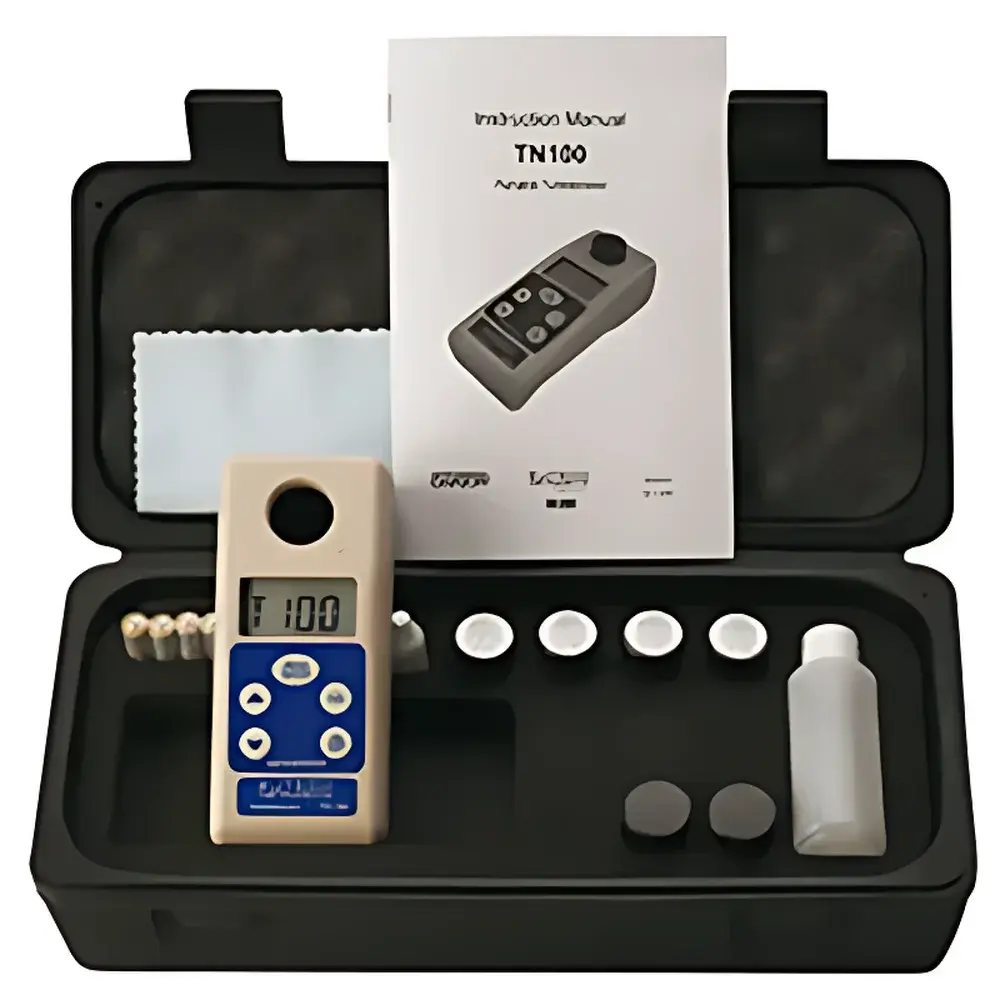
EUTECH TN 100 Portable Turbidimeter
| Brand | EUTECH |
|---|---|
| Origin | USA |
| Model | TN 100 |
| Type | Portable Turbidimeter |
| Measurement Range | 0–1000 NTU |
| Resolution | 0.01 NTU (0–19.99 NTU), 0.1 NTU (20.0–99.9 NTU), 1 NTU (100–1000 NTU) |
| Accuracy | ±2% of reading ±1 digit (0–500 NTU) |
| Repeatability | ≤±1% of reading |
| Calibration Points | 4-point (0.02, 20.0, 100, 800 NTU) |
| Response Time | <6 seconds |
| Light Source | Infrared LED (850 nm) |
| Sample Volume | 10 mL |
| Operating Temperature | 0–50 °C |
| IP Rating | IP67 |
| Power Supply | 4 × 1.5 V AAA alkaline batteries (>1200 measurements per set) |
| Dimensions (Instrument) | 15.5 × 6.8 × 4.6 cm |
| Weight (Instrument) | 200 g |
| Enclosure Material | ABS plastic |
Overview
The EUTECH TN 100 Portable Turbidimeter is a precision optical instrument engineered for reliable, field-deployable turbidity measurement in accordance with ISO 7027 and DIN 27027 standards. It operates on the principle of infrared (850 nm) nephelometry—measuring the intensity of light scattered at 90° from a collimated beam passing through a water or liquid sample. This method ensures minimal interference from color, absorbance, or particle fluorescence, delivering high reproducibility and metrological traceability. Designed for compliance with U.S. EPA Method 180.1 requirements for non-formazin turbidity standards, the TN 100 eliminates reliance on unstable formazin suspensions, reducing calibration drift and cross-laboratory variability. Its compact, ruggedized architecture supports both routine quality control in municipal water facilities and regulatory sampling in environmental fieldwork.
Key Features
- Infrared LED light source (850 nm) provides stable, long-life emission with negligible thermal drift and immunity to sample coloration effects.
- Automatic range selection across three dynamic intervals (0.01–19.99 NTU, 20.0–99.9 NTU, 100–1000 NTU) optimizes resolution without manual intervention.
- Four-point calibration using certified non-formazin standards (0.02, 20.0, 100, and 800 NTU) enables traceable accuracy aligned with GLP-compliant workflows.
- IP67-rated enclosure ensures full dust ingress protection and submersion resistance up to 1 m for 30 minutes—ideal for outdoor, wastewater, or industrial site use.
- High-contrast backlit LCD display with intuitive icon-driven interface facilitates operation under variable ambient lighting conditions.
- Battery life exceeds 1200 measurements on four standard AAA alkaline cells, supporting extended unattended field deployment.
Sample Compatibility & Compliance
The TN 100 accepts standard 10 mL glass vials (included) with optical-grade quartz-like transmission properties, minimizing scattering artifacts from container walls. It is validated for use with potable water, surface water, wastewater effluents, filtered process streams, and pharmaceutical rinse solutions. Regulatory alignment includes full conformance with ISO 7027:2016 (turbidity measurement by infrared nephelometry), DIN EN ISO 7027-1:2016, and U.S. EPA Method 180.1 (2021 revision) for non-formazin calibration protocols. While not intrinsically compliant with 21 CFR Part 11, audit-ready calibration logs—including date/time stamps, operator ID fields, and deviation flags—can be manually documented to support GMP/GLP audit trails when integrated into validated laboratory information management systems (LIMS).
Software & Data Management
The TN 100 operates as a standalone instrument with no embedded Bluetooth or USB connectivity. All measurement data are displayed and retained in real time on the unit’s local screen; no internal memory or data logging capability is provided. Users are expected to record results manually or integrate readings into external digital workflows via standardized observation protocols. For laboratories requiring electronic records, the device supports synchronization with third-party LIMS platforms through manual entry or barcode-assisted transcription. Calibration verification reports—including reference standard lot numbers, expiration dates, and technician signatures—must be maintained separately in accordance with ISO/IEC 17025 documentation requirements.
Applications
- Drinking water treatment: Verification of filtration efficiency and post-disinfection clarity prior to distribution.
- Environmental monitoring: Field assessment of turbidity in rivers, lakes, and stormwater runoff per EPA NPDES permit conditions.
- Pharmaceutical manufacturing: Monitoring of purified water (PW) and water-for-injection (WFI) system integrity during sanitization cycles.
- Food & beverage QC: Detection of suspended solids in clarified juices, brewing wort, or dairy processing streams.
- Educational laboratories: Teaching core principles of light scattering, Beer-Lambert deviations, and metrological uncertainty in physical chemistry curricula.
FAQ
Does the TN 100 support GLP-compliant electronic data capture?
No—the instrument lacks onboard memory, timestamping, or user authentication features required for direct 21 CFR Part 11 compliance. Manual transcription into validated systems is necessary.
Can I use formazin standards for calibration?
While technically possible, doing so violates the instrument’s design intent and voids metrological alignment with ISO 7027 and EPA 180.1. Non-formazin standards are mandatory for stated accuracy claims.
What is the minimum detectable turbidity level?
The effective limit of detection is 0.02 NTU, defined as the lowest certified calibration point with demonstrated repeatability ≤±1% and signal-to-noise ratio >10:1 under controlled lab conditions.
Is the instrument suitable for measuring highly colored samples?
Yes—its 850 nm infrared source minimizes absorption-related bias common in visible-light turbidimeters, making it appropriate for tea-colored surface waters or dyed industrial effluents.
How often should calibration be performed?
Daily verification using the 0.02 NTU and 20.0 NTU standards is recommended for regulated applications; full 4-point calibration is required after battery replacement, firmware updates, or exposure to extreme thermal shock.






