
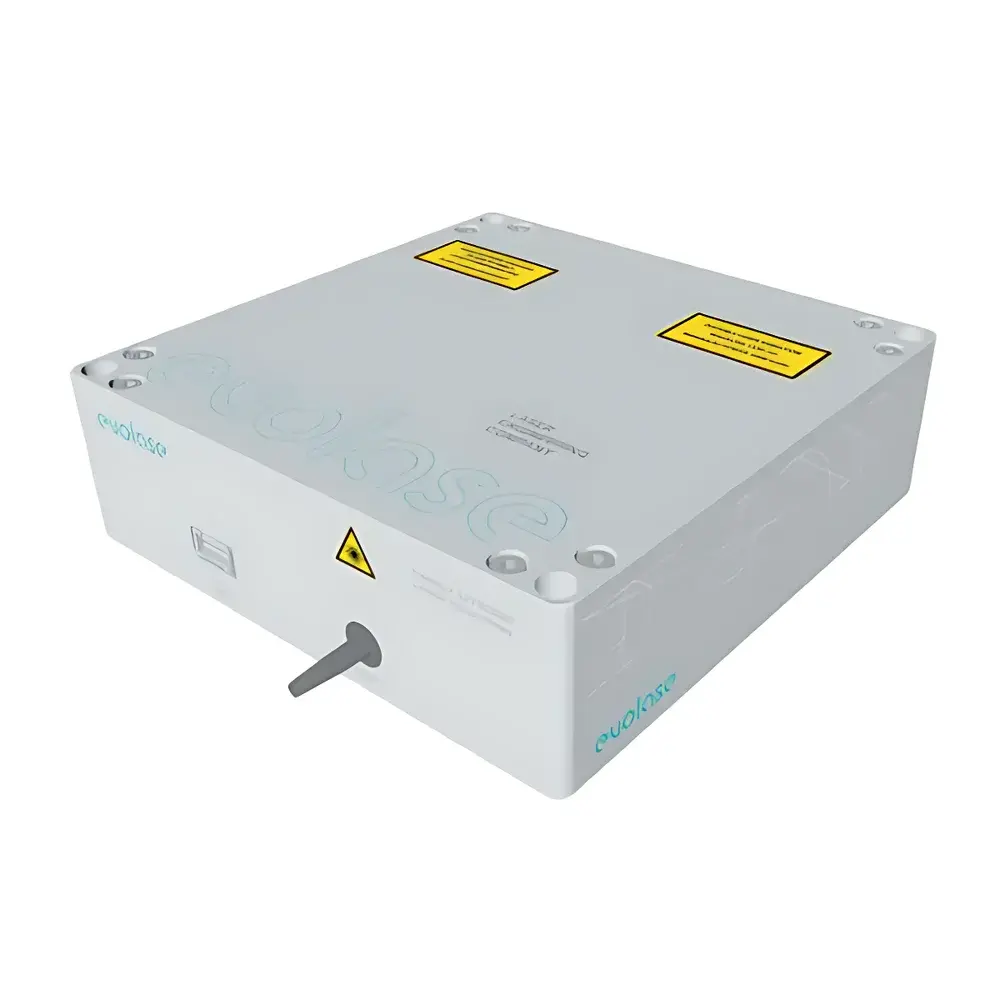
Evolase EPFL-PS-NS-1550 Compact High-Power Picosecond/Nanosecond Fiber Laser
| Brand | Evolase |
|---|---|
| Model | EPFL-PS-1550 / EPFL-NS-1550 |
| Wavelength | 1550 ±1 nm |
| Pulse Width (FWHM) | 35 ps / 1–10 ns |
| Repetition Rate | 100 kHz–2 MHz |
| Avg. Output Power | 1 W / 3 W |
| Pulse Energy | 1 µJ (25 kW peak) / 250 µJ (25 kW peak) |
| Power Stability | <1% RMS |
| Beam Quality (M²) | <1.2 |
| Polarization | Linear or Random |
| Output Fiber | SMF-28, 10/125 µm |
| Trigger | External TTL |
| Operating Voltage | 5.5–12 VDC |
| Dimensions | 230 × 230 × 290 mm |
| Operating Temp. | −10 to +40 °C |
| Relative Humidity | 10–80% non-condensing |
| Ambient Air Class | ISO 9 or better |
Overview
The Evolase EPFL-PS-NS-1550 is a dual-mode, compact fiber-integrated laser source engineered for high-reliability pulsed operation at the eye-safe 1550 nm wavelength window. It operates in either picosecond (35 ps FWHM) or nanosecond (1–10 ns FWHM) pulse regimes—switchable via configuration—enabling flexible deployment across time-resolved sensing, nonlinear optics, and photonics-based metrology. Based on master oscillator power amplifier (MOPA) architecture with all-fiber seed and amplification stages, the system delivers diffraction-limited beam quality (M² < 1.2), excellent amplitude stability (<1% RMS over 8 hours), and intrinsic immunity to thermal lensing and mechanical misalignment. Its fully sealed, conduction-cooled enclosure meets industrial environmental specifications (ISO 9 ambient air, −10 to +40 °C operating range), eliminating the need for active cooling or optical tables—making it suitable for embedded integration into LiDAR modules, portable spectroscopic platforms, and field-deployable quantum sensing systems.
Key Features
- Eye-safe 1550 nm emission compliant with IEC 60825-1 Class 1/Class 1M safety requirements under standard operating conditions
- Dual operational modes: selectable picosecond (EPFL-PS-1550) or nanosecond (EPFL-NS-1550) output without hardware modification
- High peak power delivery: up to 25 kW (ps mode) and 25 kW (ns mode), enabling efficient nonlinear frequency conversion and plasma generation
- Integrated external TTL triggering with sub-10 ns jitter, supporting synchronization with gated detectors, streak cameras, or time-of-flight electronics
- Hermetically sealed, fanless chassis (230 × 230 × 290 mm) designed for shock/vibration resistance per MIL-STD-810G guidelines
- Low-power DC operation (5.5–12 VDC) compatible with battery-powered or UAV-mounted platforms
- Single-mode polarization-maintaining output via SMF-28 fiber (10/125 µm core/cladding), with optional FC/APC or collimated free-space coupling
Sample Compatibility & Compliance
The EPFL-PS-NS-1550 is compatible with standard telecom-grade single-mode fiber interfaces and supports direct coupling into photonic integrated circuits (PICs), nonlinear waveguides, and fiber-coupled spectrometers. Its 1550 nm center wavelength aligns with low-loss transmission windows in silica fiber and atmospheric transparency bands used in differential absorption LiDAR (DIAL) and coherent wind sensing. The system complies with CE marking requirements (EMC Directive 2014/30/EU, RoHS 2011/65/EU), and its optical safety classification conforms to EN 60825-1:2014. For regulated environments—including GLP-compliant metrology labs and ISO/IEC 17025-accredited calibration facilities—the laser supports optional firmware logging of operational parameters (pulse count, average power, temperature) with timestamped audit trails.
Software & Data Management
Operation is managed via ASCII-based serial protocol (RS-232 or USB-C virtual COM port), enabling full remote control of repetition rate, pulse width selection (where applicable), output enable/disable, and status monitoring. A cross-platform Python SDK (compatible with Windows, Linux, and macOS) provides wrappers for common instrument control frameworks including PyVISA and LabVIEW drivers (NI-VISA). All configuration changes are stored in non-volatile memory; no host PC is required for standalone operation. Firmware updates are performed via signed binary packages validated using SHA-256 checksums—ensuring integrity during field maintenance. Optional integration with third-party data acquisition systems (e.g., National Instruments DAQmx, Keysight PathWave) supports synchronized acquisition of laser-triggered signals with metadata tagging.
Applications
- Coherent and direct-detection LiDAR for autonomous navigation, terrain mapping, and atmospheric aerosol profiling
- Time-of-flight mass spectrometry (TOF-MS) ionization sources requiring precise temporal gating
- Optical time-domain reflectometry (OTDR) with sub-centimeter spatial resolution
- Pump-probe spectroscopy in mid-IR generation (via ZGP/OPO pumping) and carrier dynamics studies in 2D materials
- Micromachining of transparent dielectrics (e.g., fused silica, sapphire) with minimal heat-affected zones
- Calibration of ultrafast photodetectors and streak camera response functions
FAQ
Is the EPFL-PS-NS-1550 qualified for airborne or mobile platform integration?
Yes. Its conduction-cooled design, DC input flexibility, and MIL-STD-810G-aligned mechanical robustness support deployment in UAVs, ground vehicles, and maritime survey systems.
Can pulse width be adjusted continuously within the ps or ns range?
No. The device offers discrete operational modes: fixed 35 ps (EPFL-PS-1550) or tunable 1–10 ns (EPFL-NS-1550). Mode switching requires reconfiguration via firmware command.
What fiber connector types are supported by default?
Standard delivery includes FC/APC-terminated SMF-28 output. Custom terminations (e.g., SC/APC, bare fiber, collimated output) are available under OEM agreement.
Does the laser support analog modulation of pulse amplitude?
No. Amplitude control is digital-only (on/off and preset power levels). Analog current modulation is not implemented to preserve pulse fidelity and thermal stability.
Is FDA 21 CFR Part 11 compliance supported?
While the base unit does not include electronic signature or role-based access control, optional firmware add-ons provide audit-trail logging, user authentication, and electronic record export—enabling validation for regulated pharmaceutical or medical device R&D workflows.




