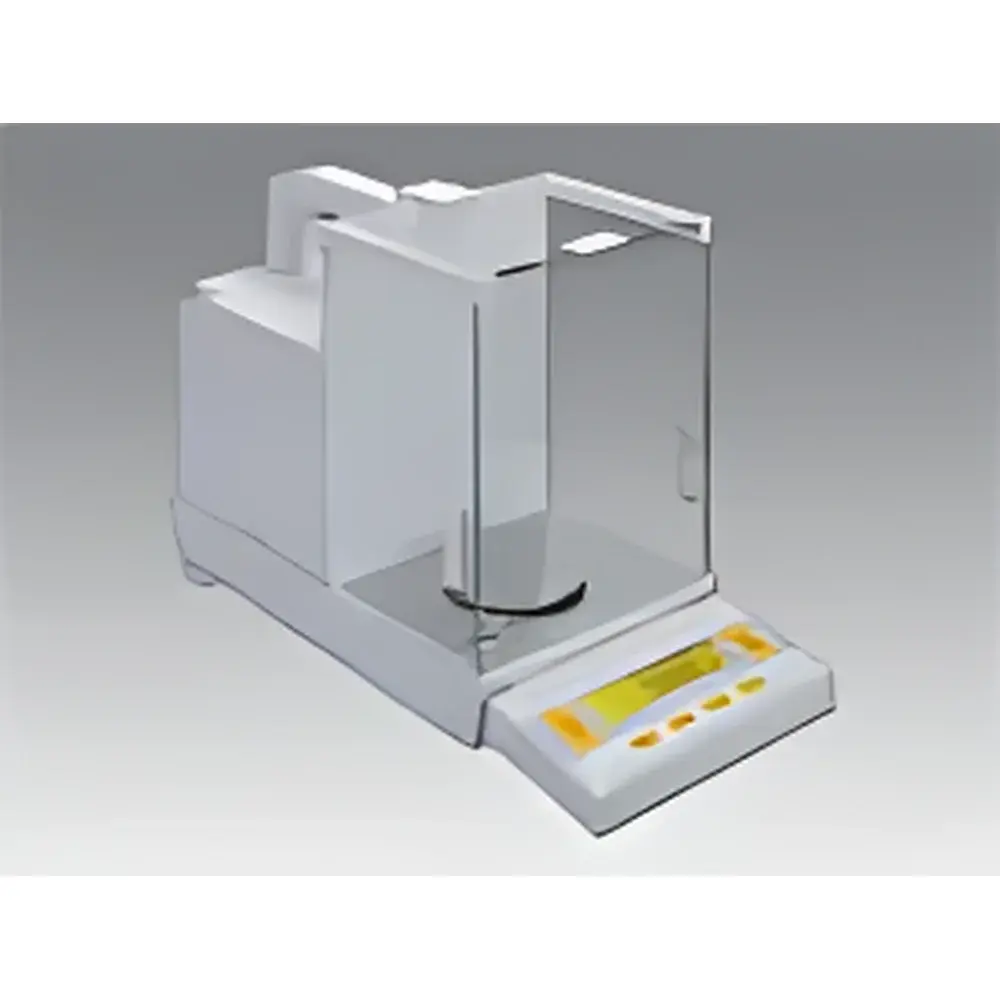
FA2104S Precision Dual-Range Analytical Balance
| Origin | Shanghai, China |
|---|---|
| Manufacturer Type | Authorized Distributor |
| Origin Category | Domestic (China) |
| Model | FA2104S |
| Price | USD 920 (FOB Shanghai) |
| Max Capacity | 210 g / 60 g |
| Readability | 1 mg / 0.1 mg |
| Repeatability | ≤ 0.1 mg |
| Linearity | ±0.2 mg |
| Draft Shield Dimensions | 195 × 160 × 235 mm |
| Overall Dimensions | 195 × 445 × 300 mm |
| Pan Diameter | Φ90 mm |
| Sensor Type | Electromagnetic Force Compensation (EMFC) |
| Display | Backlit LCD |
| Interface | RS232 |
| Power Options | AC Adapter (100–240 VAC) or 9 V DC Battery |
| Compliance | ISO 9001, ASTM E1272, GLP-compliant data logging capability |
Overview
The FA2104S Precision Dual-Range Analytical Balance is an electromagnetic force compensation (EMFC) based laboratory instrument engineered for high-accuracy mass measurement in environments requiring both broad dynamic range and sub-milligram resolution. Unlike strain-gauge-based systems prone to creep and thermal drift, the FA2104S employs a closed-loop EMFC transducer that delivers exceptional long-term stability, minimal hysteresis, and intrinsic temperature compensation across its operational range. Its dual-range architecture—210 g at 1 mg readability and 60 g at 0.1 mg readability—enables seamless transition between routine gross weighing and high-precision analytical tasks without compromising repeatability (≤0.1 mg) or linearity (±0.2 mg). Designed for compliance with international metrological standards, the balance supports traceable calibration via internal self-calibration routines and external weight verification protocols aligned with ISO/IEC 17025 requirements.
Key Features
- Electromagnetic force compensation (EMFC) sensor with active temperature compensation and zero-point tracking
- Dual-range operation: 210 g / 1 mg and 60 g / 0.1 mg modes—optimized for flexibility in QC, R&D, and teaching labs
- Backlit LCD display with adjustable contrast and multiple display modes (mass, count, %, density)
- Integrated draft shield (195 × 160 × 235 mm) with sliding front door and removable side panels for rapid cleaning and sample access
- RS232 serial interface supporting bidirectional communication with LIMS, Excel, or custom data acquisition software
- Four-stage shock absorption system with user-adjustable damping and configurable stabilization time (0.5–3 s)
- Comprehensive internal diagnostics including overload detection, sensor fault reporting, and calibration status monitoring
- Programmable auto-zero tracking, auto-tare, and auto-calibration triggered by time interval or temperature drift threshold
- Multi-unit conversion: grams, milligrams, ounces (oz), carats (ct), grains, and percent relative to reference mass
Sample Compatibility & Compliance
The FA2104S accommodates a wide variety of sample types—including powders, granules, liquids in tared containers, and small solid components—within its Φ90 mm stainless-steel weighing pan and enclosed draft chamber. Its sealed sensor housing and corrosion-resistant pan surface ensure reliable performance in moderately humid or chemically exposed lab environments. The balance meets fundamental requirements of ISO 9001 quality management systems and conforms to ASTM E1272 (Standard Specification for Laboratory Balances) for repeatability, linearity, and eccentricity testing. When operated with documented calibration procedures and audit-trail-enabled software (via RS232), it supports GLP and GMP workflows, including 21 CFR Part 11–compliant electronic records when integrated with validated third-party data capture platforms.
Software & Data Management
Data output is standardized through ASCII-based RS232 protocol, enabling direct integration with laboratory information management systems (LIMS), statistical process control (SPC) tools, and spreadsheet applications. Each transmitted record includes timestamp, mode identifier (e.g., “GROSS”, “NET”, “COUNT”), unit code, and status flags (e.g., “OVERLOAD”, “CALIBRATING”). Internal memory retains up to 99 calibration events and 200 weighing logs with date/time stamps. Firmware supports firmware-upgradable parameter configuration—including stabilization delay, auto-zero sensitivity, and display brightness—via PC utility provided under license. All calibration and diagnostic logs are exportable for internal audit or regulatory review.
Applications
The FA2104S serves as a primary mass standard in pharmaceutical formulation labs (e.g., active pharmaceutical ingredient (API) dispensing per USP ), academic chemistry teaching labs (stoichiometric calculations, gravimetric analysis), food quality control (moisture loss assays, ingredient batching), and materials science (powder density determination, catalyst loading verification). Its dual-range functionality eliminates the need for separate coarse and fine balances in mid-throughput settings, reducing cross-contamination risk and improving workflow continuity. The built-in counting function—calibrated via sample averaging—is routinely deployed for inventory management of standardized parts (e.g., tablets, microcentrifuge tubes, PCB components).
FAQ
What is the difference between the 210 g / 1 mg and 60 g / 0.1 mg ranges?
The balance automatically switches between high-capacity (210 g, 1 mg resolution) and high-resolution (60 g, 0.1 mg resolution) modes based on user selection. This architecture improves signal-to-noise ratio in the lower range while maintaining structural integrity at higher loads.
Does the FA2104S support external calibration weights?
Yes—it accepts Class E2 or better certified weights for manual calibration verification and adjustment of linearity and eccentricity parameters via service menu.
Is battery operation suitable for continuous use?
The 9 V DC battery provides up to 8 hours of intermittent operation; however, AC power is recommended for extended calibration-intensive workflows to maintain thermal equilibrium and minimize drift.
Can the balance be connected to a networked LIMS?
Via RS232-to-Ethernet gateway or USB-serial adapter, yes—provided the host system supports ASCII framing and configurable baud rate (default: 9600, N, 8, 1).
How is traceability maintained during calibration?
Each internal calibration event logs date, time, ambient temperature, and deviation from nominal value. These records are exportable and may be archived alongside certified weight certificates to satisfy ISO/IEC 17025 Clause 6.5 requirements.