
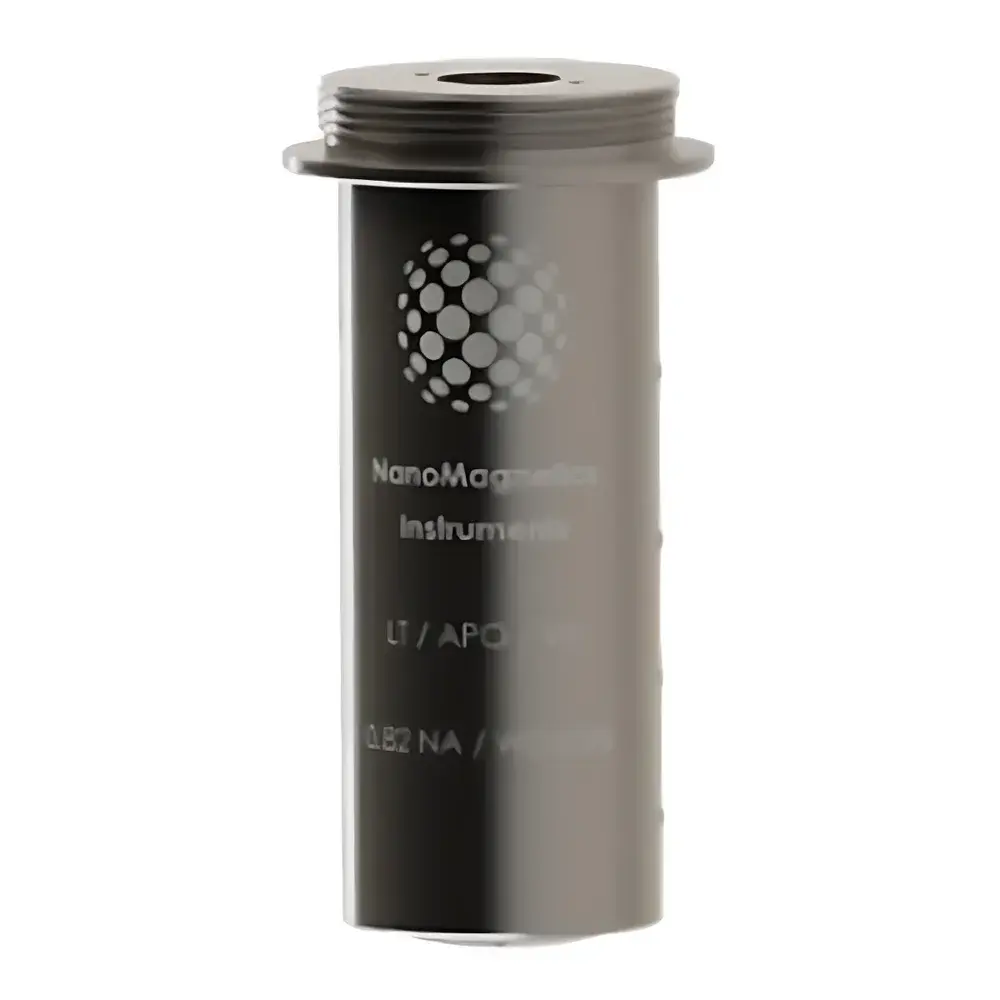
Fangcun LT-APO Cryogenic Achromatic Objective Lens
| Brand | Fangcun Instruments |
|---|---|
| Origin | Shanghai, China |
| Manufacturer Type | Authorized Distributor |
| Origin Category | Domestic (China) |
| Model | LT-APO |
| Price | Upon Request |
| Clear Aperture (CA) | 4.7 mm |
| Focal Length (FL) | 2.8 mm |
| Numerical Aperture (NA) | 0.82 |
| Working Distance (WD) | 0.95 mm (1.45 mm with spacer) |
| AR Coating | >80% transmission, 400–1000 nm |
| Achromatic Correction Range (Df < ±1 D) | 540–780 nm |
| Environmental Rating | Compatible with cryogenic temperatures (≤4 K), high magnetic fields (≥16 T), and ultra-high vacuum (UHV, ≤1×10⁻⁹ mbar) |
| Physical Dimensions | Diameter 24 mm, Length 49 mm, Mass 46 g |
| Mounting Thread | RMS (0.80″ × 36 TPI, 3 mm thread depth) |
Overview
The Fangcun LT-APO Cryogenic Achromatic Objective Lens is an engineered optical component designed for high-resolution imaging and spectroscopic applications in extreme physical environments—specifically low-temperature (<4 K), high-magnetic-field (up to 16 T), and ultra-high-vacuum (UHV, ≤1×10⁻⁹ mbar) systems. Unlike standard microscope objectives, the LT-APO employs a rigorously optimized all-glass, multi-element achromatic doublet design with matched thermal expansion coefficients across its lens stack, minimizing focus drift and spherical aberration under thermal contraction. Its high numerical aperture (NA = 0.82) enables diffraction-limited performance at visible-to-NIR wavelengths (400–1000 nm), while its RMS-threaded mechanical interface ensures compatibility with industry-standard cryostat viewports and UHV-compatible lens mounts. The objective operates on the principle of paraxial ray convergence with minimized chromatic and spherical residuals—critical for quantitative confocal microscopy, cathodoluminescence mapping, and magneto-optical Kerr effect (MOKE) measurements where optical path stability directly impacts signal fidelity.
Key Features
- True apochromatic correction over 540–780 nm (Df < ±1 D), validated via interferometric wavefront analysis at 4 K
- AR-coated optics delivering >80% average transmission across 400–1000 nm, with residual reflectivity <0.5% per surface at design wavelengths
- Thermally invariant mechanical housing constructed from oxygen-free high-conductivity (OFHC) copper and Invar-composite spacers, ensuring sub-micron focal stability from 300 K to 4 K
- Compact form factor (Ø24 mm × 49 mm, 46 g) optimized for integration into confined cryogenic probe heads and split-pair magnet bore assemblies
- RMS mounting interface (0.80″ × 36 TPI, 3 mm engagement depth) compliant with ISO 8039 and compatible with commercial cryo-stages from Janis, BlueFors, and Oxford Instruments
- No internal adhesives or epoxies—fully solder-sealed and bakeable to 150°C, meeting UHV outgassing requirements per ASTM E595
Sample Compatibility & Compliance
The LT-APO is routinely deployed in condensed matter physics laboratories for in situ optical characterization of quantum materials—including topological insulators, 2D van der Waals heterostructures, and superconducting thin films—under simultaneous low-temperature and high-field conditions. It complies with key regulatory and operational standards relevant to scientific instrumentation: mechanical dimensions conform to ISO 8039 (RMS thread specification); vacuum integrity satisfies ESA PSS-01-702 and NASA MSFC-SPEC-123 for UHV compatibility; and thermal cycling performance adheres to IEC 60068-2-14 (cold testing) and IEC 60068-2-2 (dry heat). While not a medical or diagnostic device, its optical calibration traceability supports GLP-aligned data acquisition when integrated with NIST-traceable photodetectors and calibrated light sources.
Software & Data Management
As a passive optical component, the LT-APO does not incorporate embedded firmware or digital interfaces. However, it is fully interoperable with third-party imaging and control platforms including LabVIEW-based DAQ systems (NI PXIe-6363), Python-controlled motorized stages (Thorlabs Kinesis), and commercial microscopy suites such as ThorImageLS and Andor Solis. When paired with CCD/EMCCD cameras and spectrometers, the lens contributes to end-to-end measurement uncertainty budgets defined per ISO/IEC 17025. Audit trails for lens installation, thermal cycling history, and alignment verification can be maintained within laboratory information management systems (LIMS) supporting 21 CFR Part 11 compliance—particularly where optical alignment records are required for method validation in metrology-critical experiments.
Applications
- Confocal photoluminescence (PL) and Raman spectroscopy of monolayer TMDs at 4 K and 12 T
- In situ Faraday and Voigt magneto-optical rotation measurements in dilution refrigerator inserts
- High-spatial-resolution cathodoluminescence imaging in SEM-cryo-transfer systems
- Optical readout of spin qubits in silicon carbide and diamond NV centers under milli-Kelvin temperatures
- Time-resolved pump-probe microscopy of ultrafast carrier dynamics in correlated electron systems
FAQ
Is the LT-APO suitable for use in liquid helium immersion cryostats?
Yes—the lens housing and optical cementing process are qualified for direct immersion in liquid helium (4.2 K) and pumped He-4/He-3 mixtures down to 0.05 K, provided proper thermal anchoring and vibration isolation are implemented.
Can the LT-APO be used with standard microscope bodies or only custom cryogenic setups?
It is intended exclusively for integration into custom optical pathways (e.g., cryostat viewports, vacuum feedthroughs, or magnetic field-access ports) and is not compatible with standard infinity-corrected microscope tubes due to its finite conjugate design and RMS threading.
Does the lens require recalibration after thermal cycling?
No—its athermalized mechanical design eliminates the need for refocusing or recentering between 300 K and 4 K; however, final alignment verification using a collimated HeNe laser is recommended post-installation.
What is the maximum permissible magnetic field gradient for stable operation?
The lens has been tested up to 16 T in homogeneous fields and remains functional in gradients ≤5 T/cm; ferromagnetic components are absent, and induced eddy currents are negligible below 1 kHz modulation frequencies.







