
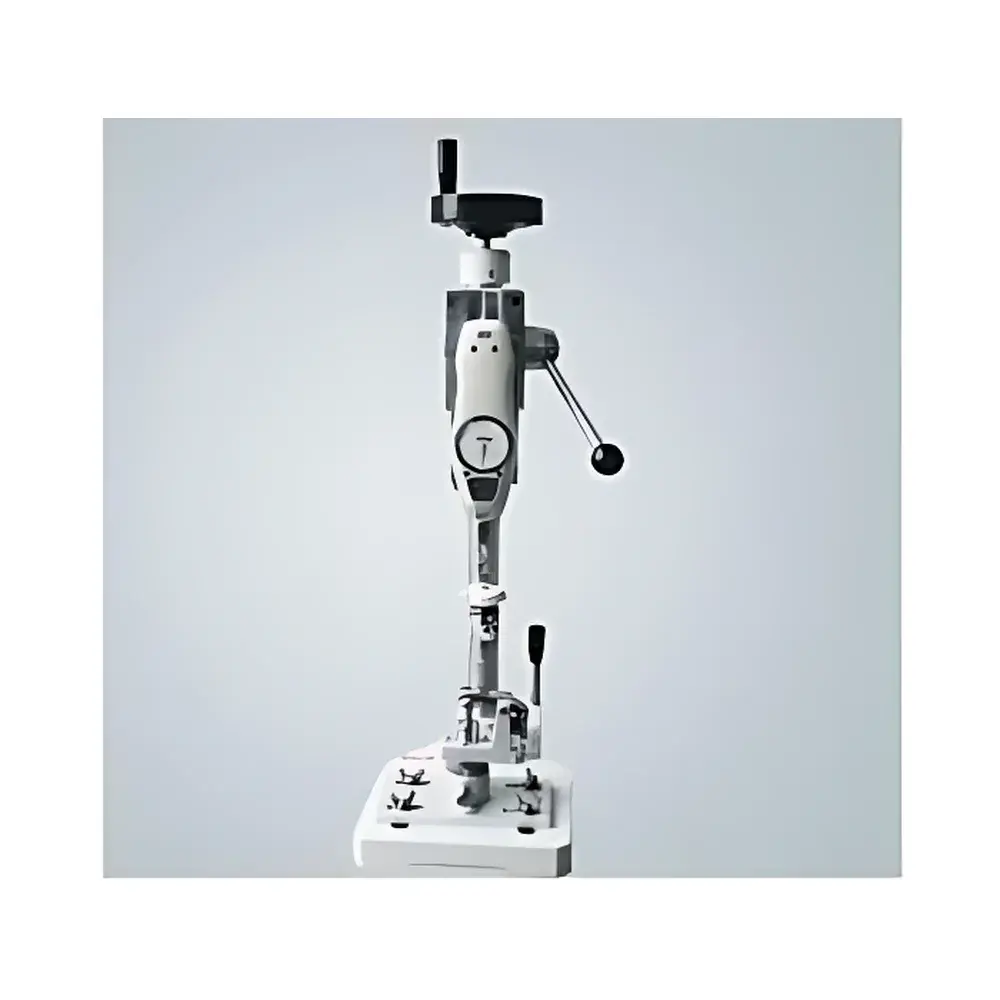
Fangyuan FY200 Button Pull Tester
| Brand | Fangyuan Instruments |
|---|---|
| Origin | Zhejiang, China |
| Manufacturer Type | Authorized Distributor |
| Country of Origin | China |
| Model | FY200 |
| Price | Upon Request |
| Load Cell Capacity | 30 kgf (294.2 N) |
| Force Measurement Accuracy | ±0.5% FS |
| Clamping Options | Concave 3-Jaw Button Clamp (TNG463), Convex 2-Jaw Button Clamp (TNG464), Long-Nose Pliers (6"), Push-Rod Fabric Base Fixture (TNG466), 3-Jaw General Clamp (TNG467), 2-Jaw Button Clamp (TNG468) |
| Construction | Stainless Steel Gripping Components |
| Compliance Standards | ASTM F963–23 §4.5, ISO 8124–1:2022, EN71–1:2014+A1:2018, CPSIA Section 101(b), GB/T 31888–2015 |
Overview
The Fangyuan FY200 Button Pull Tester is a dedicated mechanical force testing instrument engineered for quantitative assessment of attachment strength between buttons, snaps, hooks, and other fasteners and textile substrates in apparel and infant wear. It operates on the principle of controlled uniaxial tensile loading applied perpendicular to the fabric surface, simulating real-world stress conditions that may lead to detachment during normal use or child handling. The device complies with internationally recognized safety standards governing children’s product durability—including ASTM F963–23 (Toy Safety Standard), ISO 8124–1 (Safety of Toys – Part 1: Safety Aspects Related to Mechanical and Physical Properties), EN71–1 (European Toy Safety Directive), and the U.S. Consumer Product Safety Improvement Act (CPSIA) Section 101(b). Its design prioritizes repeatability, operator safety, and traceable force application—critical requirements for quality control laboratories conducting third-party compliance verification or internal pre-shipment testing.
Key Features
- High-precision 30 kgf (294.2 N) digital push-pull force gauge (TNG462) with ±0.5% full-scale accuracy and real-time analog/digital display
- Modular clamping system including stainless steel concave 3-jaw clamp (TNG463) for flat or recessed buttons and convex 2-jaw clamp (TNG464) for domed or shank-mounted fasteners
- Dedicated push-rod fabric base fixture (TNG466) ensuring consistent substrate immobilization without slippage or edge deformation during pull cycles
- Supplementary tooling set: long-nose pliers (6-inch reach, TNG465), general-purpose 3-jaw clamp (TNG467), and auxiliary 2-jaw button clamp (TNG468) for non-standard fastener geometries
- All contact components fabricated from corrosion-resistant stainless steel to maintain dimensional stability and avoid cross-contamination in multi-sample workflows
- Ergonomic manual actuation lever with calibrated mechanical advantage—no external power supply required, enabling deployment in cleanroom, audit-ready, or field-based QC environments
Sample Compatibility & Compliance
The FY200 accommodates a broad range of fastener types—including sew-through buttons (flat, shank, two-hole, four-hole), snap fasteners (metal/plastic), hook-and-loop closures, zippers pulls, and decorative appliqués—across woven, knitted, nonwoven, and laminated fabrics. Sample thickness ranges from 0.5 mm to 8 mm; minimum fabric specimen size is 100 × 100 mm to ensure adequate margin beyond clamping zones. Test protocols follow standardized displacement rates (e.g., 300 mm/min per ASTM F963 Annex A4.5.1) and hold durations (e.g., 10 s dwell at peak load per EN71–1 Clause 8.11). Data output supports GLP-compliant recordkeeping when paired with optional thermal printer or RS-232/USB data logging modules (not included by default).
Software & Data Management
While the FY200 operates as a standalone mechanical-electronic tester, its TNG462 force gauge supports optional PC connectivity via RS-232 or USB interface for integration into laboratory information management systems (LIMS). Raw force vs. time datasets can be exported in CSV format for statistical process control (SPC) analysis, capability indices (Cp/Cpk), and audit trail generation. When used in regulated environments—such as contract testing labs serving FDA-regulated infant apparel importers—the system supports 21 CFR Part 11–compliant electronic signatures and user-access-level controls when deployed with validated third-party software platforms.
Applications
- Pre-production validation of button attachment integrity across garment categories (infantwear, school uniforms, medical scrubs)
- Root cause analysis of seam failure modes in QA investigations following customer returns or regulatory nonconformances
- Supplier qualification audits requiring documented evidence of mechanical fastener retention per ISO/IEC 17025–accredited test methods
- Material development support for textile engineers optimizing thread tension, stitch density, or thermobonding parameters
- Internal compliance screening prior to submission to CPSC-accredited third-party laboratories
FAQ
What standards does the FY200 Button Pull Tester directly support?
It is configured to execute test sequences aligned with ASTM F963–23 §4.5, ISO 8124–1:2022 Clause 8.11, EN71–1:2014+A1:2018 Annex B, and CPSIA Section 101(b) mechanical fastener requirements.
Can the FY200 test plastic snaps and metal rivets?
Yes—its interchangeable clamping fixtures (TNG463, TNG464, TNG468) accommodate both rigid and deformable fastener profiles; selection depends on geometry and mounting method (e.g., rivet flange diameter, snap cap curvature).
Is calibration certification included with purchase?
Each unit ships with a factory calibration report traceable to NIM (National Institute of Metrology, China); annual recalibration against certified deadweight standards is recommended for ISO/IEC 17025 compliance.
Does the system require compressed air or electrical power?
No—the FY200 is manually actuated via lever mechanism; only the digital force gauge requires a standard 9 V battery (included), providing >100 hours of continuous operation.
How is fabric slippage prevented during testing?
The push-rod base fixture (TNG466) applies uniform compressive preload to the fabric backing while the upper clamp engages the fastener, eliminating lateral movement and ensuring axial force transmission without substrate distortion.





