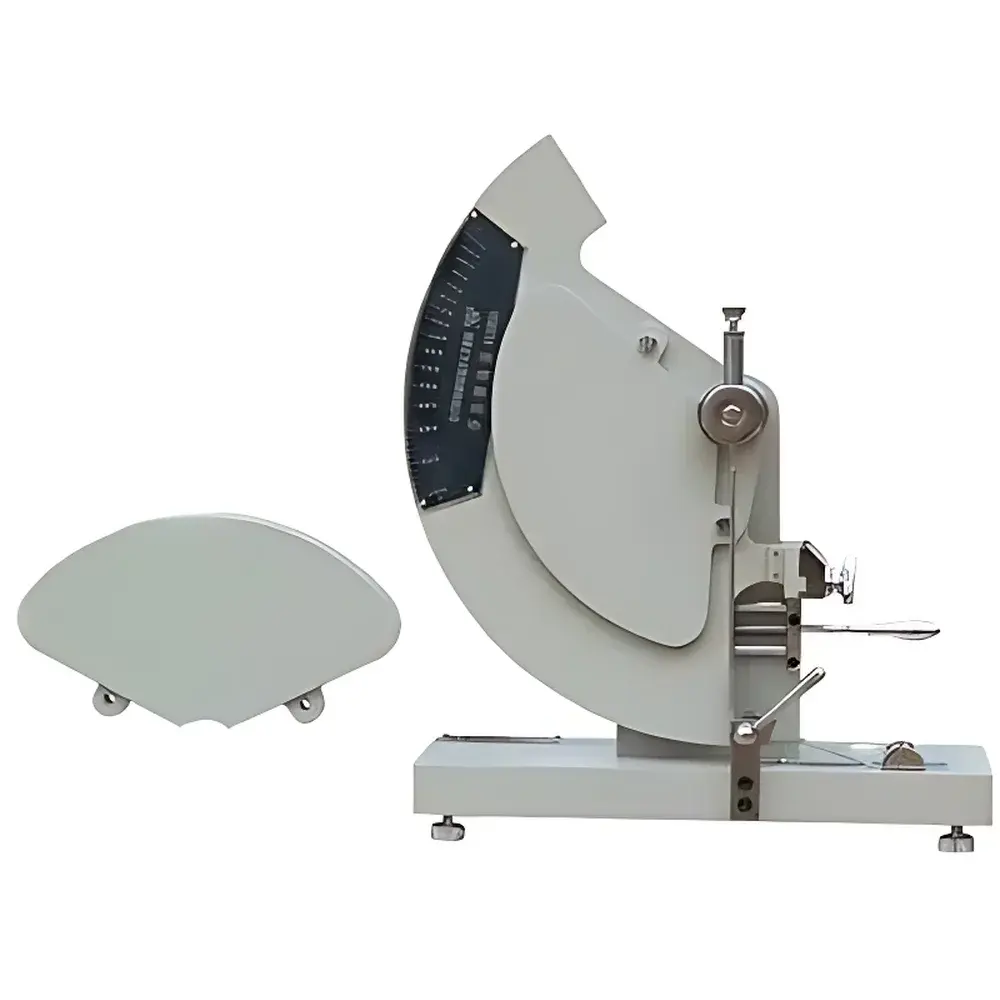
Fangyuan YG033A Elmendorf Tear Tester
| Brand | Fangyuan |
|---|---|
| Model | YG033A |
| Tear Force Range | 16 N, 32 N, 64 N |
| Force Accuracy | ≤ ±1 division |
| Notch Length | 20 ± 0.2 mm |
| Tear Distance | 43 mm |
| Specimen Size | 100 mm × 63 mm (L × W) |
| Dimensions | 400 mm × 210 mm × 390 mm (L × W × H) |
| Weight | 27 kg |
| Compliant Standards | GB/T 3917.1, FZ/T 6006, FZ/T 75001, ASTM D1424, ASTM D5734 |
Overview
The Fangyuan YG033A Elmendorf Tear Tester is a precision mechanical instrument engineered for the quantitative determination of tear resistance in textile materials using the standardized pendulum impact method—commonly referred to as the Elmendorf principle. This method relies on the energy absorption capacity of a fabric specimen during controlled propagation of a pre-cut notch under gravitational acceleration of a calibrated falling pendulum. The instrument measures the average force required to propagate a tear across a defined length (43 mm), providing a repeatable and internationally recognized metric for comparative material evaluation. Designed specifically for quality control laboratories, R&D departments, and third-party testing facilities in the global textile supply chain, the YG033A delivers high reproducibility in accordance with ISO/IEC 17025–aligned test environments.
Key Features
- Triple-range tear force calibration (16 N, 32 N, 64 N) enables precise measurement across low-, medium-, and high-strength fabric classes—including lightweight synthetics, heavy-duty canvas, and technical geotextiles.
- Mechanically robust pendulum system with hardened steel knife edge and precisely machined pivot bearing ensures minimal friction loss and long-term dimensional stability.
- Fixed-notch geometry: 20 ± 0.2 mm incision length maintained via CNC-machined specimen clamp assembly, guaranteeing consistent stress concentration initiation per ASTM D1424 and GB/T 3917.1 requirements.
- Dedicated specimen holder accommodates standardized 100 mm × 63 mm specimens without lateral slippage, minimizing operator-induced variability.
- Compact footprint (400 × 210 × 390 mm) and self-contained design facilitate integration into regulated laboratory workspaces with limited benchtop area.
- Zero external power requirement—fully mechanical operation eliminates dependency on electrical infrastructure or software dependencies during routine QC testing.
Sample Compatibility & Compliance
The YG033A supports a broad spectrum of textile substrates, including but not limited to woven fabrics (cotton, polyester, blends), nonwovens (spunbond, meltblown, needlepunched), coated textiles (PVC-, PU-, silicone-laminated), and laminated composites used in protective apparel and industrial filtration. It is validated for conformance with major national and international standards: GB/T 3917.1 (China), FZ/T 6006 (nonwoven-specific tear testing), FZ/T 75001 (coated fabric tear protocol), ASTM D1424 (Elmendorf tear for woven fabrics), and ASTM D5734 (Elmendorf tear for nonwovens). All test procedures comply with fundamental principles outlined in ISO 9073-4 for nonwoven mechanical testing and are compatible with GLP documentation workflows when paired with certified calibration records and traceable weight standards.
Software & Data Management
As a fully mechanical analog instrument, the YG033A does not incorporate embedded firmware or digital data logging. However, it is fully compatible with external laboratory information management systems (LIMS) and electronic lab notebooks (ELN) through manual entry of readout values from the calibrated scale. For audit readiness, users may document test parameters—including specimen identification, environmental conditions (temperature/humidity per ISO 139), operator ID, and calibration certificate number—in accordance with 21 CFR Part 11–compliant recordkeeping practices when integrated into GMP-regulated textile testing operations. Optional accessories include certified calibration weights and traceable reference specimens for inter-laboratory proficiency testing.
Applications
- Quality assurance of raw fabric batches prior to cutting and sewing in apparel manufacturing.
- Evaluation of tear propagation resistance in medical gowns, surgical drapes, and barrier fabrics per ISO 16603 and AAMI PB70 requirements.
- Comparative assessment of fiber architecture modifications (e.g., spunbond vs. meltblown layers) in filtration media development.
- Regulatory submission support for textile components in personal protective equipment (PPE) certified under EN 14126 or ASTM F1670/F1671.
- Research into polymer degradation effects—e.g., UV exposure, laundering cycles, or chemical immersion—on structural integrity of technical textiles.
FAQ
Is the YG033A compliant with ASTM D1424 and ASTM D5734?
Yes—the instrument’s pendulum mass, notch geometry, and tear distance meet all dimensional and procedural specifications defined in both standards.
What calibration documentation is provided with the unit?
Each unit ships with a factory calibration report referencing NIST-traceable weights and includes a calibration verification checklist aligned with ISO/IEC 17025 Clause 6.5.
Can the YG033A be used for knitted fabrics?
While not explicitly referenced in primary standards, knitted fabrics may be tested under controlled conditions; however, results require careful interpretation due to inherent loop mobility and anisotropic behavior.
Does the instrument require annual recalibration?
Per ISO/IEC 17025 and internal QA protocols, mechanical verification—including pendulum swing amplitude, knife edge wear inspection, and scale linearity check—is recommended at least annually or after 500 test cycles.
Are replacement pendulums available for different force ranges?
Yes—interchangeable pendulum arms (16 N, 32 N, 64 N) are supplied as standard accessories and can be swapped without tools in under 90 seconds.