
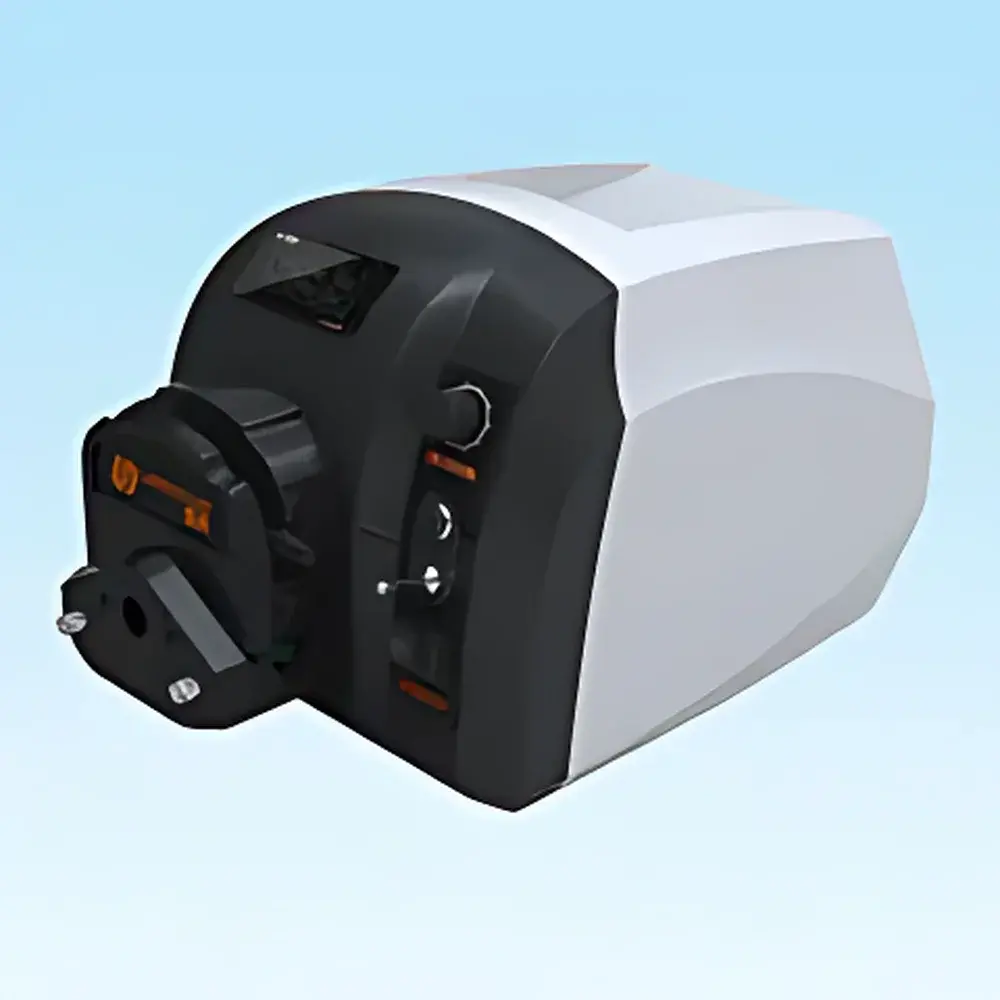
LeFeng BT101S (YZ15) Adjustable-Speed Peristaltic Pump
| Brand | LeFeng |
|---|---|
| Origin | Hebei, China |
| Model | BT101S (YZ15) |
| Pump Type | Peristaltic Pump |
| Flow Rate Range | 0.006–420 mL/min |
| Speed Range | 0.1–150 rpm |
| Speed Resolution | 0.1 rpm |
| Speed Accuracy | ±0.5% |
| Power Supply | AC 220 V ±10%, 50/60 Hz (standard) |
| Operating Temperature | 0–40 °C |
| Relative Humidity | <80% RH |
| Enclosure Rating | IP31 |
| Dimensions (L×W×H) | 255 × 180 × 185 mm |
| Weight | 5.0 kg |
| Communication Interface | RS485 with MODBUS RTU protocol |
| Compatible Pump Heads | YZ15, YZ25, DG1, DG2 |
| Minimum Flow Rate (with appropriate tubing) | 0.00016 mL/min |
| Maximum Flow Rate (with appropriate tubing) | 575 mL/min |
Overview
The LeFeng BT101S (YZ15) Adjustable-Speed Peristaltic Pump is an entry-level, microprocessor-controlled peristaltic pump engineered for reliable, low-maintenance fluid transfer in academic laboratories, quality control environments, and small-scale industrial R&D settings. It operates on the principle of positive displacement via roller compression of flexible tubing—eliminating fluid contact with internal pump components and ensuring contamination-free operation essential for sensitive biological, pharmaceutical, and chemical applications. Designed with a compact footprint and intuitive interface, the BT101S delivers consistent volumetric delivery across its full speed range without requiring recalibration between flow rate changes. Its modular architecture supports interchangeable pump heads (YZ15, YZ25, DG1, DG2), enabling users to optimize flow performance and pressure tolerance by selecting tubing bore size, wall thickness, and material compatibility (e.g., silicone, Viton®, Tygon®).
Key Features
- Four-digit LED display with 0.1 rpm resolution and ±0.5% speed accuracy—enabling precise manual control and repeatable flow conditions.
- Dedicated front-panel controls for start/stop, forward/reverse direction, full-speed override, and power-on state retention (non-volatile memory retains last-used parameters after power loss).
- Integrated “Simple Dispensing” mode—a timed, single-cycle dispensing function that minimizes operator variability during routine aliquoting or media preparation tasks.
- RS485 serial interface compliant with MODBUS RTU protocol—facilitating integration into automated lab systems, PLC networks, or custom SCADA platforms for centralized monitoring and remote parameter adjustment.
- IP31-rated enclosure—providing protection against vertically falling drips and solid objects ≥2.5 mm, suitable for standard laboratory benchtop use under controlled environmental conditions (0–40 °C, <80% RH).
- Lightweight aluminum chassis (5.0 kg) with ergonomic dimensions (255 × 180 × 185 mm)—optimized for space-constrained workstations and mobile cart installations.
Sample Compatibility & Compliance
The BT101S does not directly interact with samples; fluid path integrity is maintained entirely within user-supplied peristaltic tubing. Compatibility is therefore determined by tubing selection—validated options include medical-grade silicone (for general aqueous solutions), fluoropolymer-lined tubing (for organic solvents), and acid-resistant elastomers (e.g., EPDM or Viton®). While the pump itself is not certified to ISO 13485 or FDA 21 CFR Part 11, its MODBUS-enabled architecture supports audit-trail-capable software integration when deployed within validated systems adhering to GLP or GMP frameworks. Users are responsible for qualifying tubing materials per USP Class VI, ISO 10993, or relevant pharmacopeial requirements for their specific application.
Software & Data Management
As a standalone instrument, the BT101S requires no proprietary software for basic operation. However, its RS485/MODBUS interface allows seamless integration with third-party control platforms—including LabVIEW™, MATLAB®, Python-based automation scripts (via PyModbus), and industrial HMI systems. When incorporated into regulated workflows, data logging, parameter change history, and operational timestamps must be managed externally by the host system. For traceability in QA/QC labs, integration with LIMS or ELN platforms is achievable using standard MODBUS register mapping (e.g., holding registers for setpoint speed, direction status, run time, and error flags). No embedded firmware encryption or electronic signature capability is provided natively.
Applications
- Continuous or intermittent dosing of reagents in spectrophotometric or titration setups.
- Media feeding in microbial bioreactors and cell culture perfusion systems.
- Low-pressure solvent delivery in preparative chromatography or inline filtration units.
- Calibration solution transfer in ICP-MS or AAS sample introduction modules.
- Automated buffer exchange in electrophoresis or dialysis stations.
- Dispensing of viscous or shear-sensitive fluids (e.g., polymer solutions, enzyme cocktails, cell suspensions) where pulsation damping can be achieved via tubing selection and flow rate optimization.
FAQ
What pump heads are compatible with the BT101S?
The BT101S supports YZ15, YZ25, DG1, and DG2 pump heads—each optimized for different tubing inner diameters and pressure ratings. Head selection directly influences maximum flow rate, backpressure tolerance, and tubing lifespan.
Can the BT101S be used in sterile or cleanroom environments?
The unit meets IP31 ingress protection but lacks HEPA-filtered enclosures or stainless-steel housings required for ISO Class 5+ cleanrooms. Sterility assurance depends entirely on tubing sterilization (autoclaving, gamma irradiation) and external housing design.
Is calibration documentation provided with the pump?
No factory calibration certificate is included. Users performing critical quantitative transfers should perform in-house flow verification using gravimetric or volumetric methods traceable to NIST standards.
Does the pump support analog input/output signals?
No—only digital communication via RS485/MODBUS RTU is supported. Analog 0–10 V or 4–20 mA interfaces are not available on this model.
How is tubing life monitored or predicted?
Tubing fatigue is application-dependent. LeFeng recommends visual inspection before each use and replacement after 100–500 hours of continuous operation, depending on speed, pressure, and tubing material. No built-in wear sensors or predictive maintenance functions are implemented.



