
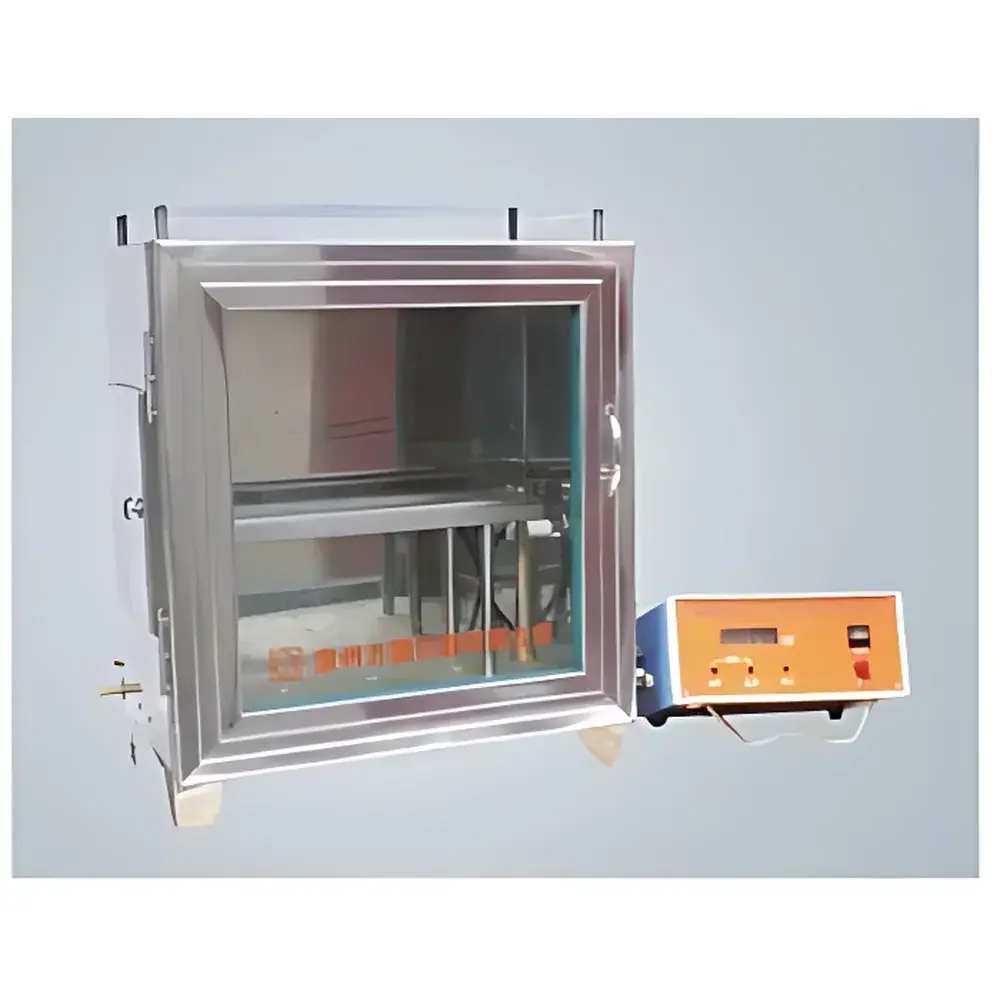
Fangyuan YG815B Horizontal Flame Resistance Tester for Textiles
| Brand | Fangyuan |
|---|---|
| Model | YG815B |
| Test Method | Horizontal Flame Spread |
| Chamber Temperature Range | 0–99 °C (1 °C resolution) |
| Ignition Time | 15 s |
| Burner Orifice Diameter | 9.5 mm (standard) |
| Distance from Burner Tip to Specimen Surface | 19 mm |
| Specimen Holder Dimensions | 360 × 100 × 9 mm (L × W × H) |
| Test Chamber Internal Dimensions | 350 × 400 × 750 mm (L × W × H) |
| Overall Dimensions | 410 × 480 × 800 mm (L × W × H) |
| Control Box Dimensions | 250 × 200 × 100 mm (L × W × H) |
| Power Supply | AC 220 V, 50 Hz |
| Compliance Standard | FZ/T 01028–1993 |
Overview
The Fangyuan YG815B Horizontal Flame Resistance Tester is a precision-engineered instrument designed specifically for evaluating the flammability behavior of textile fabrics under standardized horizontal orientation conditions. It operates on the principle of controlled flame exposure to a horizontally mounted specimen, measuring the rate and extent of flame propagation along the fabric surface. This method quantifies flame spread distance and afterflame/afterglow duration—key metrics used to classify materials according to their inherent resistance to ignition and flame propagation. The tester conforms strictly to FZ/T 01028–1993, the Chinese national standard for horizontal flame testing of textiles, and serves as a foundational tool in quality assurance workflows for apparel, upholstery, protective workwear, and technical textiles where regulatory compliance and fire safety performance are critical.
Key Features
- Stable, digitally monitored chamber temperature control (0–99 °C, ±1 °C resolution), ensuring consistent thermal environment during test execution.
- Precision-machined burner assembly with dual orifice options (9.5 mm standard; 20 mm optional for thick or layered fabrics), enabling accurate flame geometry and heat flux delivery per test specification.
- Fixed 19 mm vertical separation between burner tip and specimen surface—engineered to maintain repeatable ignition conditions across sequential tests.
- Dedicated specimen holder (360 × 100 × 9 mm) with rigid clamping mechanism to prevent lateral movement or sagging during combustion, preserving dimensional integrity of the test zone.
- Self-contained test chamber (350 × 400 × 750 mm internal volume) constructed from non-combustible, heat-resistant materials to contain flame events and minimize external interference.
- Modular electrical control unit (250 × 200 × 100 mm) featuring isolated power regulation, manual ignition timing circuitry (15 s fixed duration), and fail-safe current interruption logic.
Sample Compatibility & Compliance
The YG815B accommodates woven, knitted, nonwoven, and laminated textile specimens up to 360 mm in length and 100 mm in width, including coated, laminated, and multi-layer composites common in industrial and functional apparel applications. Specimens must be conditioned per ISO 139 or GB/T 6529 prior to testing to ensure moisture equilibrium. While primarily aligned with FZ/T 01028–1993, the instrument’s geometric and procedural fidelity permits comparative evaluation against analogous horizontal flame standards—including ASTM D3823 (Standard Test Method for Flammability of Textiles – Horizontal Direction) and ISO 10047 (Textiles – Determination of Flammability – Horizontal Method)—when adapted with appropriate calibration verification and reporting protocols. The device supports documentation traceability required for internal QA audits and third-party certification submissions.
Software & Data Management
The YG815B operates via manual control interface without embedded software; however, it is fully compatible with external digital data capture systems. Users may integrate high-speed video recording (≥240 fps), calibrated thermal imaging, or time-synchronized stopwatch logging to document flame front progression, afterflame duration, and char length. All raw observations—including measured flame spread distance (mm), afterflame time (s), afterglow time (s), and visual classification (e.g., “Pass”, “Fail”, or “Class 1/2/3”)—are recorded manually in accordance with GLP-aligned lab notebooks or LIMS-compatible electronic forms. For regulated environments, laboratories may implement 21 CFR Part 11–compliant audit trails when pairing the instrument with validated electronic record systems that capture operator ID, timestamp, environmental conditions, and final pass/fail determination.
Applications
- Pre-production screening of flame-retardant (FR) treated cotton, polyester, aramid, and modacrylic fabrics.
- Verification of FR finish durability following repeated laundering (per AATCC TM135 or ISO 105-C06).
- Comparative assessment of intrinsic vs. topical flame resistance in technical textiles for automotive interiors, railway seating, and contract furnishings.
- Supporting R&D efforts in developing novel halogen-free or phosphorus-based flame retardant chemistries.
- Training and proficiency testing for textile testing technicians in accredited laboratories seeking CNAS or ILAC-MRA recognition.
FAQ
What standards does the YG815B comply with?
The instrument is engineered and validated to meet FZ/T 01028–1993. Its mechanical and operational parameters also support alignment with ASTM D3823 and ISO 10047 when implemented within a documented method equivalence framework.
Is the YG815B suitable for testing non-textile materials such as foams or films?
No—it is purpose-built for planar textile specimens with defined thickness and tensile stability. Non-textile substrates require alternative test configurations (e.g., ASTM D3675 or UL 94 HB) and dedicated apparatus.
Does the system include automated data logging or PC connectivity?
The base YG815B model features manual operation only. Data acquisition must be performed externally using synchronized instrumentation; no built-in USB, Ethernet, or Bluetooth interfaces are provided.
Can the burner orifice be changed during operation?
Yes—the 9.5 mm and 20 mm orifices are interchangeable via tool-free quick-release fittings, allowing rapid adaptation between standard and thick-fabric test modes without recalibration.
What maintenance is required to ensure long-term measurement reliability?
Monthly inspection of burner tip integrity, quarterly cleaning of gas pathways with compressed air, and annual verification of thermocouple accuracy against NIST-traceable references are recommended per manufacturer guidelines.



