
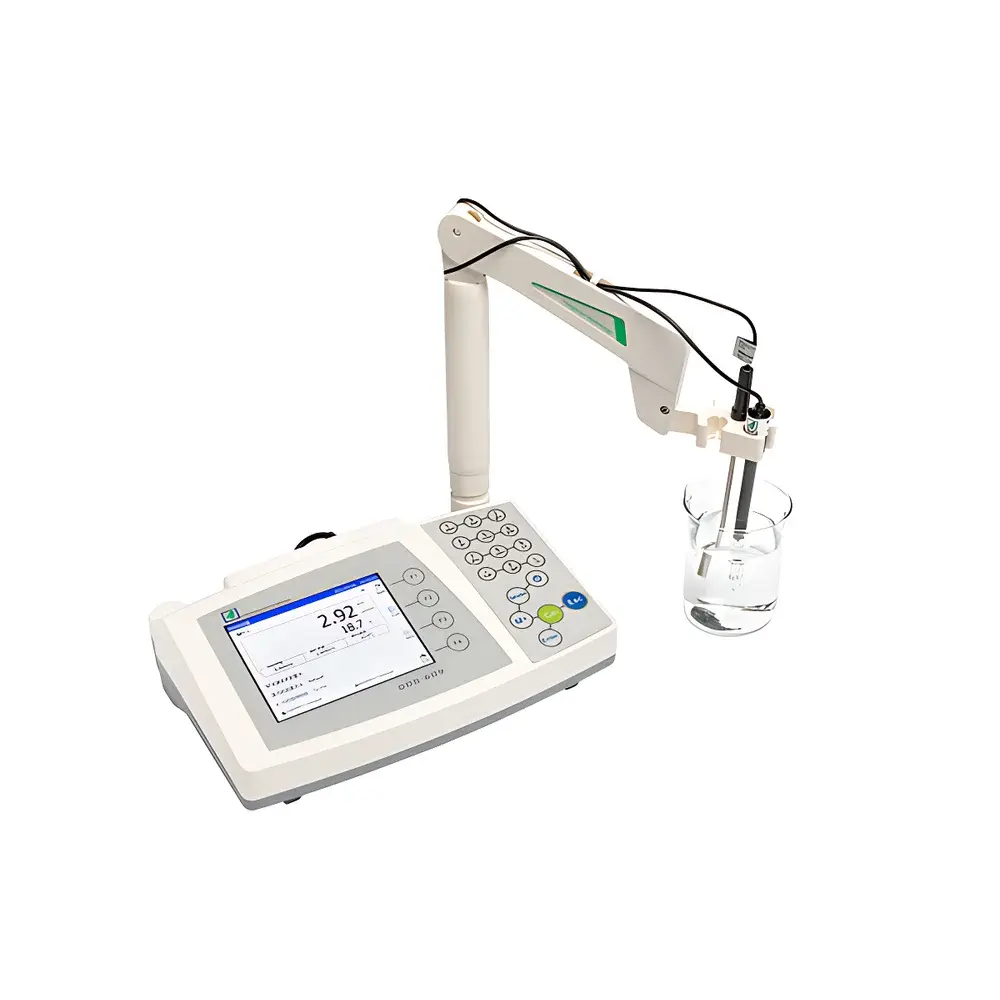
FangZhou DDS-609 Aluminum Chloride-Specific Conductivity Meter
| Brand | FangZhou |
|---|---|
| Origin | Sichuan, China |
| Manufacturer Type | Authorized Distributor |
| Product Category | Domestic |
| Model | DDS-609 Aluminum Chloride-Specific Conductivity Meter |
| Detection Parameters | Multi-parameter (Conductivity, Resistivity, TDS, Salinity, Conductivity Ash, Temperature) |
| Portability | Benchtop |
| Application Environment | Laboratory |
| Conductivity Range | (0–2×10⁵) µS/cm |
| TDS Range | (0.00–300.0) g/L |
| Resistivity Range | (5.00–10⁸) Ω·cm |
| Salinity Range | (0.00–80.00) ppt |
| Temperature Range | (−25.0–135.0) °C |
| Accuracy | ±0.5% FS |
| Minimum Conductivity Resolution | 0.0001 µS/cm |
Overview
The FangZhou DDS-609 Aluminum Chloride-Specific Conductivity Meter is a high-precision benchtop electrochemical analyzer engineered for rigorous laboratory quantification of ionic conductivity in aluminum chloride (AlCl₃) solutions and related electrolyte systems. Unlike generic conductivity meters, the DDS-609 incorporates application-tuned calibration logic and temperature compensation algorithms optimized for the non-linear conductance behavior of AlCl₃ across varying concentrations and hydrolysis states—particularly relevant in catalyst synthesis, metal refining, pharmaceutical excipient preparation, and wastewater treatment process control. It operates on the principle of two-electrode or four-electrode AC conductance measurement (frequency-selective, 1 kHz default), minimizing polarization error and enabling stable readings in low-conductivity ultrapure water and high-conductivity molten-salt analogs. The instrument complies with IEC 60746-3 (Electrochemical analyzers — Part 3: Conductivity), and its architecture supports traceable, auditable measurements aligned with GLP and ISO/IEC 17025 laboratory requirements.
Key Features
- 8-range auto-ranging conductivity measurement with dynamic resolution switching—from 0.0001 µS/cm (DJS=0.01 cell) to 2000 mS/cm—ensuring optimal signal-to-noise ratio across ultra-pure to saturated AlCl₃ solutions.
- Dual-mode temperature compensation: linear (adjustable α coefficient: 0.000–0.030%/°C) and non-linear (programmable polynomial curve), with ATC (Pt1000 sensor) and MTC options; reference temperature adjustable from 15.0 to 25.0 °C in 0.1 °C increments.
- Application-specific water-grade modes: Lab Grade I/II/III, USP Purified Water & Water for Injection, and SEMI-F47 Electronic Grade (EW-I/EW-II/EW-III), each with configurable alarm thresholds for conductivity, temperature, and stability criteria.
- Comprehensive electrode management system: stores electrode ID, DJS value, calibration history (date/time/user), validation status, and drift tracking—enabling full lifecycle traceability per ISO 17025 Clause 6.4.10.
- Secure user access control: role-based authentication supporting up to 1000 users with password policies, audit trail logging, and granular permission assignment (e.g., calibration lockout for operators).
- GLP-compliant data integrity: all measurements embed metadata—including method ID, electrode serial number, ambient temperature, operator ID, sample ID, and real-time diagnostic flags—with immutable timestamping (RTC-backed dual-date/time display).
Sample Compatibility & Compliance
The DDS-609 is validated for aqueous AlCl₃ solutions (0.001–5.0 mol/L), hydrolyzed species (e.g., [Al(H₂O)₆]³⁺, [Al(OH)]²⁺), and mixed electrolytes containing Cl⁻, NO₃⁻, or SO₄²⁻ counterions. It accommodates standard DIN/ISO conductivity cells (DJS = 0.01, 0.1, 1.0, 10.0 cm⁻¹) with shielded BNC or mini-DIN connectors. Calibration adheres to ASTM D1125 (Standard Test Methods for Electrical Conductivity and Resistivity of Water) and JJG 376-2007 (Chinese metrological verification regulation). Built-in reference standards include NIST-traceable KCl solutions (0.01, 0.1, 1.0, 10.0 mS/cm), NaCl (0.5, 5.0, 35.0 ppt), and customizable user-defined standards—supporting dual-standard verification per USP . The device bears CE marking and conforms to EMC Directive 2014/30/EU and LVD Directive 2014/35/EU.
Software & Data Management
Data storage capacity exceeds 1,000,000 measurement records, organized by sample ID, method, date, and operator. Export is supported via RS-232 (ASCII protocol) and USB 2.0 (mass storage mode), with three report formats: Simple (CSV), Standard (structured TXT), and GLP-compliant (PDF with digital signature placeholder, audit log appendix, and electronic signature field per 21 CFR Part 11 Annex 11). PC software (Windows/macOS compatible) enables direct import into Excel, Word, or LIMS platforms using ODBC drivers; statistical functions include mean, SD, RSD, trend analysis, and pass/fail compliance reporting against user-defined limits. All data transfers retain full metadata integrity without truncation or reformatting.
Applications
- Quality control of AlCl₃ catalyst batches in Friedel-Crafts acylation processes—monitoring hydrolysis-induced conductivity drift as an indicator of active species concentration.
- In-process verification of rinse water purity in semiconductor wet benches, where residual Al³⁺ contamination must remain below 0.1 ppb (inferred via calibrated conductivity/TDS correlation).
- Stability testing of AlCl₃-based ionic liquids used in battery electrolytes—tracking conductivity decay under thermal stress (60–120 °C) per IEC 62660-1.
- Environmental monitoring of industrial effluents from aluminum smelters, complying with EPA Method 120.1 for total dissolved solids estimation in chloride-rich matrices.
- Educational labs conducting Arrhenius-type conductivity vs. temperature studies on AlCl₃ hydration equilibria (e.g., ΔH° determination from slope of ln(κ) vs. 1/T plots).
FAQ
Does the DDS-609 support direct measurement of aluminum ion concentration?
No—it measures bulk ionic conductivity, not speciated Al³⁺. Quantitative Al³⁺ determination requires ICP-OES or colorimetric assay; however, the DDS-609 provides rapid, non-destructive process screening when correlated with validated calibration curves.
Can the instrument store custom temperature compensation curves for AlCl₃ solutions?
Yes. Users may define up to 10 non-linear compensation profiles via the built-in polynomial editor (up to 4th order), using empirical data from reference measurements at known temperatures.
Is firmware upgrade available remotely?
Firmware updates are delivered via encrypted USB drive with SHA-256 checksum verification; remote network update is disabled by design to maintain regulatory compliance and data integrity.
What documentation is provided for 21 CFR Part 11 compliance?
The instrument includes a Validation Support Package: IQ/OQ protocols, electronic audit trail specification, electronic signature configuration guide, and test reports for ALCOA+ data integrity principles (Attributable, Legible, Contemporaneous, Original, Accurate, Complete, Consistent, Enduring, Available).
How does the DDS-609 handle electrode fouling during prolonged AlCl₃ measurement?
It features real-time electrode diagnostics—including impedance spectroscopy sweep (optional module), polarization voltage monitoring, and automatic cleaning cycle initiation alerts—triggering visual/audible warnings when contact resistance exceeds user-defined thresholds.
Related Products






