
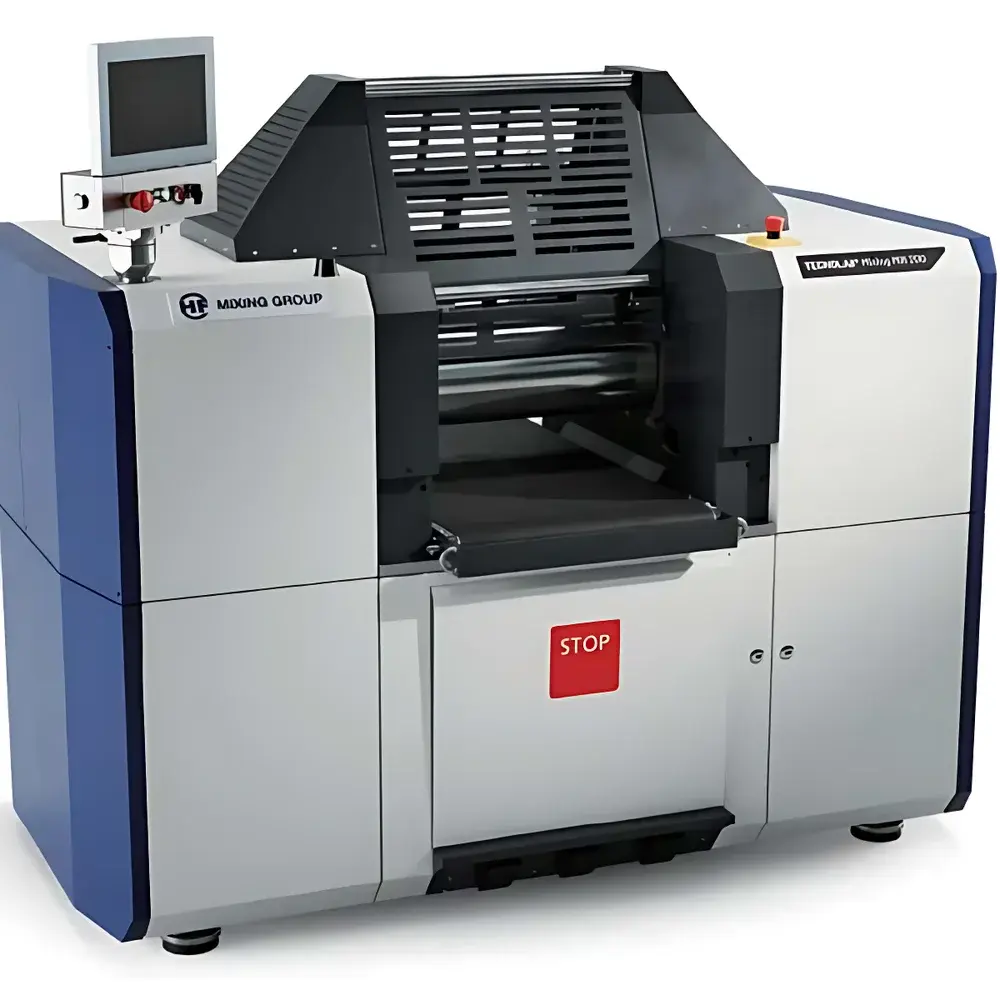
Farrel MM 150×300 FF Open Two-Roll Mill
| Brand | Farrel |
|---|---|
| Origin | USA |
| Model | MM 150×300 FF |
| Roll Diameter | 150 mm |
| Roll Length | 330 mm |
| High-Speed Roll Max Speed | 27.4 rpm |
| Low-Speed Roll Max Speed | 20 rpm |
| Speed Ratio | 1:1.4 (fixed) |
| Roll Gap Adjustment Range | 0–10 mm |
| Adjustment Precision | ±0.1 mm |
| Roll Surface Treatment | Hardened, quenched & ground |
| Roll Cooling/Heating | Drilled rolls with rotary unions |
| Drive System | AC variable-frequency motor |
| Safety Compliance | EU Machinery Directive 2006/42/EC |
| Overload Protection | Mechanical torque-limiting clutch |
| Emergency Stop | Dual-channel safety brake system |
| Vibration Isolation | Integrated anti-vibration mounts |
Overview
The Farrel MM 150×300 FF Open Two-Roll Mill is an engineered laboratory-scale compounding and dispersion platform designed for rigorous R&D and quality control workflows in rubber and thermoplastic polymer processing. Based on classical shear-dominated mixing mechanics—where material is continuously sheared, folded, and redistributed between two counter-rotating, temperature-controlled rolls—the mill delivers reproducible rheological history under defined mechanical and thermal boundary conditions. Its fixed speed ratio of 1:1.4 generates controlled slip and extensional flow components essential for breaking down agglomerates, dispersing fillers (e.g., carbon black, silica), and homogenizing masterbatches or color concentrates. The unit operates within the foundational framework of polymer melt rheology and viscoelastic deformation theory, making it indispensable for formulation development, batch consistency validation, and pre-production compound optimization prior to extrusion or molding.
Key Features
- Hardened, quenched, and precision-ground steel rolls (Ø150 mm × 330 mm L) ensure dimensional stability, surface integrity, and long-term wear resistance under repeated thermal cycling and high-shear loading.
- AC variable-frequency drive system enables precise, stepless speed control of both rolls—high-speed roll up to 27.4 rpm, low-speed roll up to 20 rpm—while maintaining strict 1:1.4 differential velocity for consistent shear rate profiles.
- Manually adjustable roll gap with micrometer-scale resolution (±0.1 mm), facilitating fine-tuned control over residence time, shear intensity, and sheet thickness for standardized sample preparation.
- Drilled internal roll channels coupled with rotary unions support active temperature management (cooling/heating) across a typical operational range of 20–120 °C, critical for studying thermal sensitivity, scorch behavior, or crystallization kinetics.
- Integrated mechanical overload protection via torque-limiting clutch prevents damage during unexpected jamming or high-viscosity events; dual-channel safety brake system halts rotation within <150 ms upon emergency activation.
- Compliance with EU Machinery Directive 2006/42/EC—including CE marking, interlocked guarding, and validated risk assessment—ensures safe deployment in GLP-compliant laboratories and regulated manufacturing environments.
Sample Compatibility & Compliance
The MM 150×300 FF accommodates natural rubber (NR), synthetic elastomers (SBR, BR, EPDM, NBR), thermoplastics (PP, PE, PVC), thermoplastic elastomers (TPEs), and highly loaded compounds including conductive composites and pigment masterbatches. Its open-roll geometry allows direct visual monitoring of dispersion state, mastication progress, and surface tack—enabling real-time process decisions not feasible in sealed internal mixers. All mechanical and electrical subsystems conform to IEC 60204-1 (safety of machinery – electrical equipment) and ISO 13857 (safety distances). The machine supports audit-ready documentation for GMP-relevant workflows, including maintenance logs, calibration records for gap adjustment mechanisms, and traceable verification of safety circuit response times.
Software & Data Management
While the MM 150×300 FF operates as a standalone mechanical system without embedded digital controls, its design fully supports integration into structured laboratory data ecosystems. Optional external sensors—including RTDs for roll surface temperature mapping, load cells for nip force quantification, and infrared pyrometers for sheet surface profiling—can feed time-synchronized datasets into LIMS or ELN platforms via analog outputs (4–20 mA) or Modbus RTU. All safety-critical functions (emergency stop, overload disengagement, guard interlock status) generate discrete digital signals compatible with PLC-based supervisory systems, enabling full traceability per FDA 21 CFR Part 11 requirements when paired with compliant electronic record software.
Applications
- Formulation screening of curatives, antioxidants, and processing aids in NR/SBR compounds
- Dispersion efficiency evaluation of nanofillers (graphene, CNTs) in thermoplastic matrices
- Pre-compounding of conductive polymer blends for ESD/EMI shielding applications
- Batch-to-batch consistency testing of masterbatches prior to extrusion line feed
- Scorch time determination (ASTM D5289) using controlled-temperature roll sequences
- Hot-mixing protocols for thermoset prepregs and phenolic resins
FAQ
Is the MM 150×300 FF suitable for processing high-viscosity silicone elastomers?
Yes—its hardened roll surfaces, robust torque transmission, and 1:1.4 speed ratio provide sufficient mechanical energy input for deagglomeration and homogenization of high-consistency HTV silicones, provided roll temperatures are maintained above the material’s glass transition threshold.
Can the roll gap be motorized or automated?
No—the gap adjustment is manually operated via calibrated handwheel for precision and repeatability; motorized actuation is not offered on this model due to regulatory preference for deterministic, non-software-dependent mechanical control in compounding QA/QC environments.
Does Farrel provide IQ/OQ documentation packages?
Yes—validated installation qualification (IQ) and operational qualification (OQ) protocols are available upon request, aligned with ISO/IEC 17025 and ASTM D3182 standards for rubber testing equipment qualification.





