
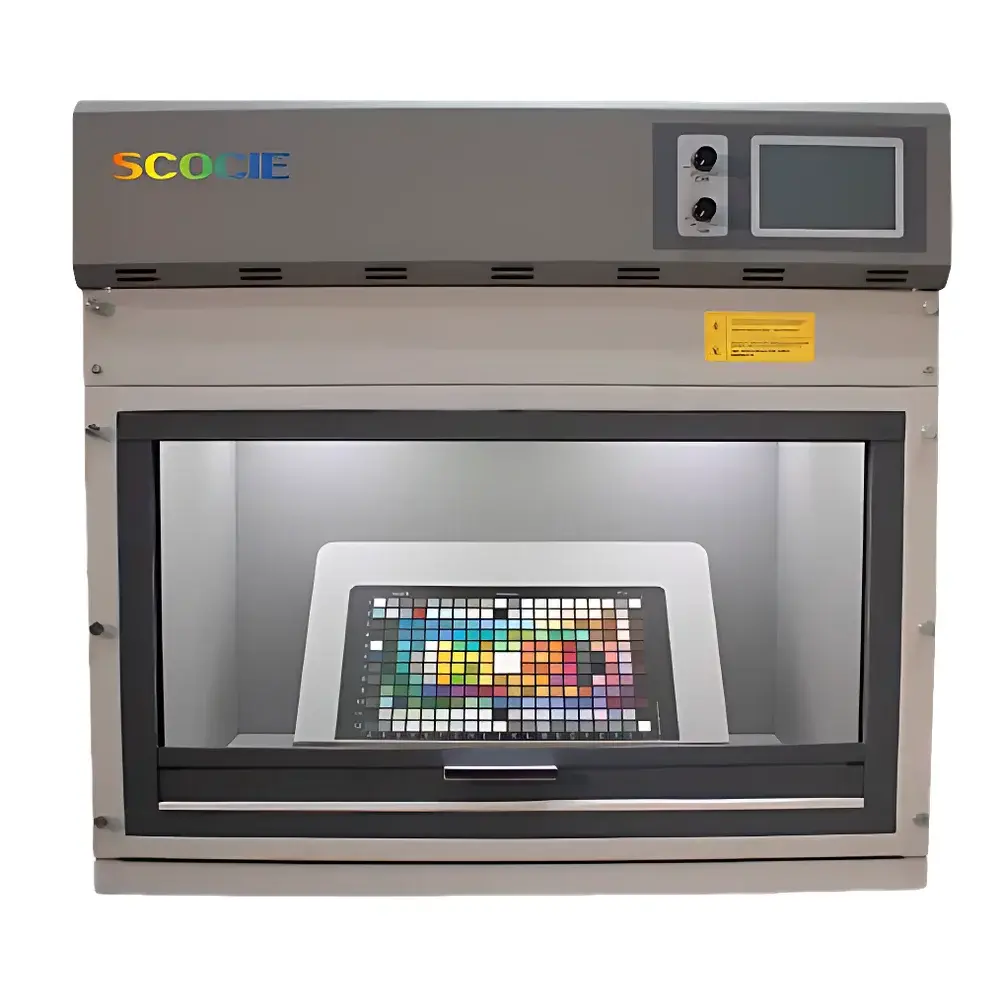
FastnessGrade FG-5000 Color Fastness Analyzer
| Origin | Shanghai, China |
|---|---|
| Manufacturer Type | Authorized Distributor |
| Origin Category | Domestic (China) |
| Model | FG-5000 |
| Price Range | USD 28,000–42,000 |
| Instrument Type | Benchtop Spectrophotometric Color Measurement System |
| Optical Geometry | 0°/45° Integrating Sphere |
| Illuminant | High-Stability LED Array |
| Spectral Range | 350–700 nm |
| Spectral Resolution | 10 nm |
| Repeatability (ΔE*ab) | ≤0.03 |
| CIE Standard Observers | 2° & 10° |
| Color Spaces | CIE L*a*b*, L*C*h*, ΔE*ab, ΔE*00, CMC(l:c), DIN99d |
| Compliance | ISO 105-A02, ISO 105-A03, ISO 105-A04, ISO 105-B02, ISO 105-X12, ISO 11664-4, ASTM D2244, AATCC TM16, AATCC TM20, AATCC TM8, AATCC TM165, GB/T 3920, GB/T 8427, GB/T 4802.1 |
Overview
The FastnessGrade FG-5000 Color Fastness Analyzer is a benchtop spectrophotometric imaging system engineered for objective, repeatable, and standardized evaluation of textile color fastness properties. Unlike conventional visual assessment methods relying on trained human observers under controlled lighting, the FG-5000 integrates high-fidelity RGB imaging with calibrated spectral measurement (350–700 nm) and advanced image-based comparative analysis to quantify color change (ΔE*ab ≤ 0.03), staining transfer, pilling morphology, and surface abrasion effects. Its 0°/45° integrating sphere optical architecture ensures uniform illumination and minimizes directional reflectance artifacts—critical for accurate evaluation of textured, napped, or irregular surfaces such as knits, velvets, and nonwovens. The system operates on CIE-compliant photometric principles and supports dual standard observers (2° and 10°), enabling traceable correlation with international fastness standards including ISO 105, AATCC Test Methods, and GB/T specifications.
Key Features
- Benchtop modular design with integrated LED-based 0°/45° optical path and 10 nm spectral resolution across 350–700 nm
- Automated digital fastness grading for color change (ISO 105-A02/A03), staining (ISO 105-A04), lightfastness (ISO 105-B02), and crocking (ISO 105-X12)
- Multi-sample simultaneous capture capability—up to six specimens per imaging cycle without repositioning
- Embedded standard illuminant simulation (D65, A, F2, F7, F11) compliant with CIE S 014-2/E:2020 and ISO/CIE 11664-2
- Pilling assessment module using ISO 12945-1–compliant image segmentation and grayscale matching against ISO 105-X11 reference standards
- FDA 21 CFR Part 11–ready software architecture with audit trail, electronic signature support, and role-based user access control
Sample Compatibility & Compliance
The FG-5000 accommodates flat, flexible, and moderately textured specimens up to 150 mm × 150 mm, including woven fabrics, knits, denim, leather, coated substrates, and printed films. Its imaging field-of-view and depth-of-field optimization allow reliable measurement of samples with surface relief up to ±1.2 mm. All fastness evaluation algorithms are aligned with ISO/IEC 17025–accredited test methodologies and validated against certified reference materials (CRMs) traceable to NIM (China National Institute of Metrology). The instrument meets electromagnetic compatibility (EMC) requirements per IEC 61326-1 and safety standards per IEC 61010-1. It supports GLP/GMP-aligned documentation workflows required for textile QC labs serving global brands and regulatory submissions in EU REACH, US CPSC, and Japan JIS contexts.
Software & Data Management
FastnessGrade Control Suite v4.2 is a Windows-based application delivering full instrument control, automated report generation (PDF/CSV/XLSX), and centralized database management. Each measurement session records full spectral data, raw and processed images, operator ID, timestamp, environmental metadata (ambient temperature/humidity), and calibration history. The software implements hierarchical data integrity safeguards—including immutable audit trails, version-controlled method templates, and encrypted backup export—fully compliant with FDA 21 CFR Part 11 Annex 11 and ISO/IEC 17025:2017 clause 7.5. Remote collaboration features enable synchronized multi-site grading via secure HTTPS API endpoints, supporting real-time review by QA teams across APAC, EMEA, and North America without physical sample shipment.
Applications
- Textile & Apparel: Quantitative grading of wash, rub, light, and perspiration fastness per ISO 105 and AATCC protocols
- Home Textiles & Upholstery: Evaluation of pilling resistance (ISO 12945-1), seam slippage discoloration, and coating adhesion color shift
- Printing & Packaging: Spectral match verification of CMYK spot colors on flexible substrates and UV-cured inks
- Food & Agriculture: Objective maturity indexing of fruits/vegetables and browning quantification in baked goods
- R&D Labs: Correlation studies between pigment chemistry, fiber morphology, and fastness performance under accelerated aging conditions
FAQ
Does the FG-5000 replace manual gray scale evaluation entirely?
Yes—when operated under defined SOPs and validated against inter-laboratory round-robin data, the FG-5000 achieves ≥92% concordance with expert panel grading per ISO 105-A02 and AATCC TM16, eliminating subjective bias and inter-operator variability.
Can it measure fluorescent or optically brightened samples?
Yes—the LED array includes UV-enhanced channels (365 nm peak) and the software applies CIE 15:2018–compliant fluorescence correction during spectral integration.
Is calibration traceable to national metrology institutes?
All factory calibrations are performed using NIM-traceable ceramic tile standards (L*, a*, b* certified to ±0.02 ΔE*ab) and verified annually via external accredited service providers.
What network security protocols does the software support?
TLS 1.2+ encryption, LDAP/Active Directory integration, and configurable firewall port policies ensure compliance with ISO 27001 and corporate IT governance frameworks.
How is pilling grade determined algorithmically?
The system applies multi-threshold grayscale segmentation to isolate pill clusters, computes spatial density, contrast ratio, and average diameter relative to ISO 105-X11 reference images, then maps results to the 1–5 ISO pilling scale using polynomial regression trained on 12,000+ expert-graded samples.





