
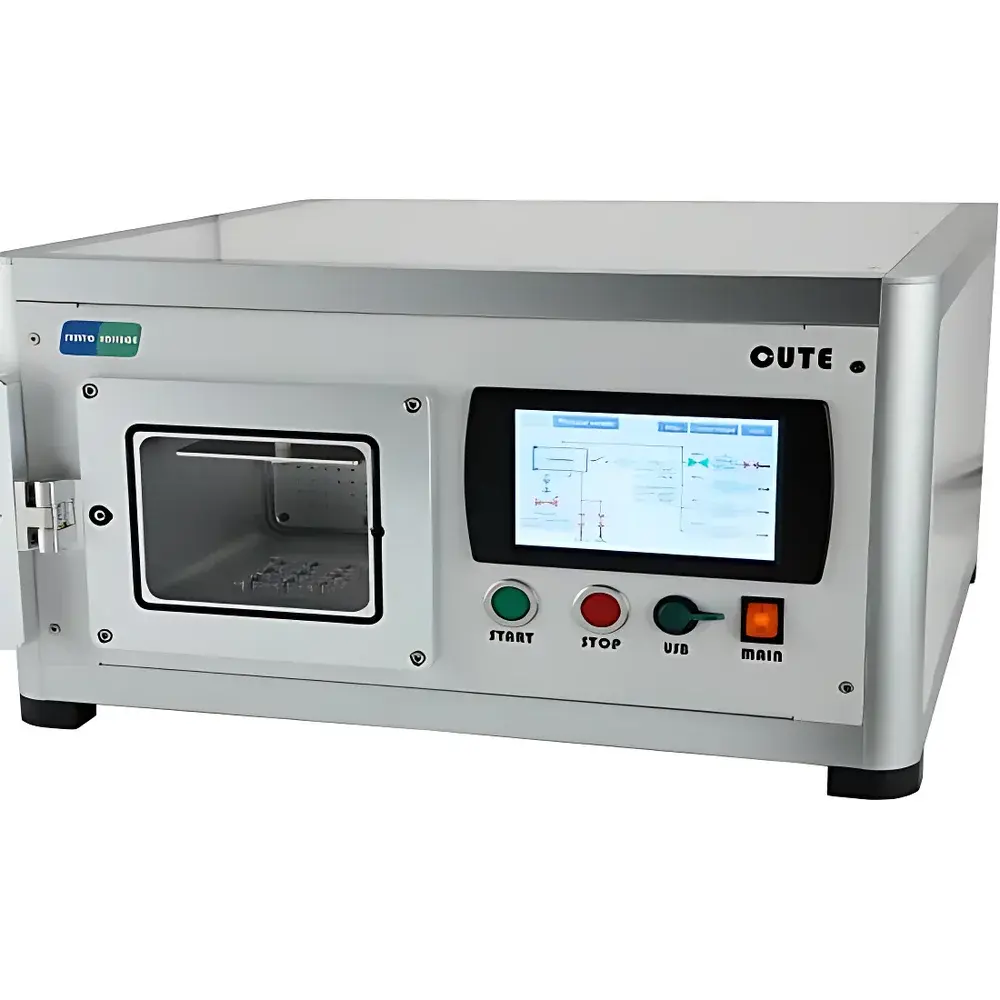
Femto Science CUTE Series Plasma Cleaner
| Brand | Femto Science |
|---|---|
| Origin | South Korea |
| Model | CUTE |
| Chamber Dimensions | 140 mm × 200 mm × 110 mm |
| Power Output | Up to 100 W (adjustable, 20–100 kHz RF frequency) |
| Vacuum System | 80 L/min pumping speed, ultimate vacuum ≤ 1 × 10⁻³ Torr, pressure range: atmospheric to 5 × 10⁻⁵ Torr |
| Gas Control | 1 standard MFC-controlled inlet (0–100 sccm, ±1% FS accuracy), 2 additional blank ports for future expansion |
| User Interface | Color TFT touchscreen with graphical workflow interface |
| Operation Modes | Semi-automatic and fully programmable (up to 10 stored recipes, each supporting up to 10 sequential process steps) |
| Chamber Material | Anodized aluminum alloy |
| Operator Levels | 2-tier access control (operator & administrator) |
Overview
The Femto Science CUTE Series Plasma Cleaner is a compact, benchtop-capable low-pressure radio-frequency (RF) plasma system engineered for non-destructive surface modification and ultra-clean preparation of sensitive substrates. Operating on the principle of capacitively coupled glow discharge plasma generation at frequencies between 20–100 kHz, the CUTE system produces stable, spatially uniform plasma without arcing or localized thermal damage—critical for preserving nanoscale integrity in delicate materials such as graphene monolayers, transition metal dichalcogenides (TMDs), PDMS microfluidic devices, and biofunctionalized surfaces. Unlike wet-chemical cleaning methods, plasma treatment removes organic contaminants via oxidative volatilization (e.g., hydrocarbons → CO₂ + H₂O), modifies surface energy through functional group incorporation (e.g., –OH, –COOH), enhances interfacial adhesion prior to bonding or coating, and enables controlled isotropic etching of thin polymer or resist layers. Its design emphasizes reproducibility, operator safety, and integration into regulated R&D environments—including those aligned with ISO 14644 cleanroom practices and GLP-compliant documentation workflows.
Key Features
- Stable, low-power RF plasma source (≤100 W, adjustable frequency) optimized for gentle yet effective surface activation without substrate heating or sputtering damage
- Anodized aluminum chamber (140 × 200 × 110 mm internal volume) offering high corrosion resistance, electromagnetic shielding, and long-term vacuum integrity
- Integrated mass flow controller (MFC) for precise, repeatable gas dosing (0–100 sccm, ±1% full-scale accuracy) with one active inlet and two reserved ports for multi-gas or reactive gas expansion
- High-performance vacuum subsystem: dual-stage rotary vane pump achieving ≤1 × 10⁻³ Torr base pressure and real-time monitoring across a 5 × 10⁻⁵–760 Torr dynamic range
- Intuitive color TFT touchscreen interface supporting both manual operation and fully programmable batch processing—with up to 10 customizable recipes, each containing up to 10 time-, power-, and gas-parameter-defined steps
- Dual-level user authentication (operator/administrator) enabling audit-ready parameter locking, change logging, and role-based access control compatible with FDA 21 CFR Part 11 requirements when paired with external LIMS or ELN systems
Sample Compatibility & Compliance
The CUTE system accommodates a broad spectrum of substrates including silicon wafers, glass slides, quartz crystals, PET/PC films, PDMS chips, ceramic sensors, and biological scaffolds. Its low-energy plasma regime ensures compatibility with temperature-sensitive polymers (e.g., PMMA, SU-8, parylene) and fragile 2D materials where conventional O₂/Ar plasmas may induce defect formation or layer delamination. The system complies with IEC 61000-6-3 (EMC emissions) and IEC 61000-6-2 (immunity) standards. While not certified for medical device sterilization per ISO 14937 or EN 556, its validated cleaning performance meets ASTM F2459 (standard guide for plasma cleaning of medical device components) and ISO 10993-12 (sample preparation for biocompatibility testing). Routine maintenance protocols align with ISO/IEC 17025 calibration traceability guidelines for laboratory equipment.
Software & Data Management
The embedded control firmware supports timestamped event logging—including vacuum ramp profiles, RF power delivery history, gas flow transients, and recipe execution sequences. All operational data are exportable via USB to CSV format for offline analysis in MATLAB, Python (Pandas), or LabVIEW. Optional Ethernet connectivity (via third-party RS232-to-Ethernet bridge) enables remote monitoring and integration into centralized facility management platforms. Process parameter sets can be backed up/restored via USB drive, and administrator-mode password protection prevents unauthorized modification of critical settings—supporting ALCOA+ principles (Attributable, Legible, Contemporaneous, Original, Accurate, Complete, Consistent, Enduring, Available) for data integrity in QC/QA laboratories.
Applications
- Microfluidics: Hydrophilization of PDMS channels prior to irreversible bonding with glass or silicon; removal of mold-release agents from replica-molded chips
- Nanomaterials: Surface decontamination and oxygen-functionalization of graphene, MoS₂, and h-BN flakes prior to transfer or electrode fabrication
- Bio-MEMS & Tissue Engineering: Activation of PCL/PLGA scaffolds to improve collagen adsorption and mesenchymal stem cell adhesion
- Semiconductor Prototyping: Descum of photoresist residues post-lithography; native oxide removal from Au/Ti contacts before wire bonding
- Optics & Sensors: Cleaning of AR-coated lenses and QCM crystal surfaces without solvent-induced haze or coating degradation
- Food Science Research: Surface decontamination of packaging film test coupons for microbial adhesion studies under controlled atmospheric conditions
FAQ
What gases are compatible with the CUTE system?
Standard operation uses oxygen (O₂) for organic removal or argon (Ar) for inert surface activation. With optional MFC upgrades, nitrogen (N₂), air, or forming gas (N₂/H₂) mixtures can be introduced via the two auxiliary ports.
Is the chamber suitable for vacuum-compatible accessories like sample holders or RF electrodes?
Yes—the anodized aluminum chamber features standardized KF-25 vacuum flange interfaces (not included) and sufficient internal clearance to accommodate custom fixtures, provided total height remains below 100 mm.
Can process data be exported in machine-readable format for LIMS integration?
Yes—CSV exports include all real-time sensor values and timestamps. For automated API-driven integration, a Modbus TCP interface module is available as a factory-installed option.
Does the system support continuous plasma operation beyond 30 minutes?
Yes—thermal management is designed for sustained duty cycles. Chamber temperature rise remains <8°C above ambient after 60 min at 100 W, verified per IEC 60068-2-2 thermal stability testing.
What routine maintenance is required?
Recommended quarterly tasks include MFC calibration verification using certified reference gas, O-ring inspection/replacement (Viton®), and pump oil change per manufacturer specifications. No consumables beyond pump oil and occasional chamber wipes are required.
Related Products



