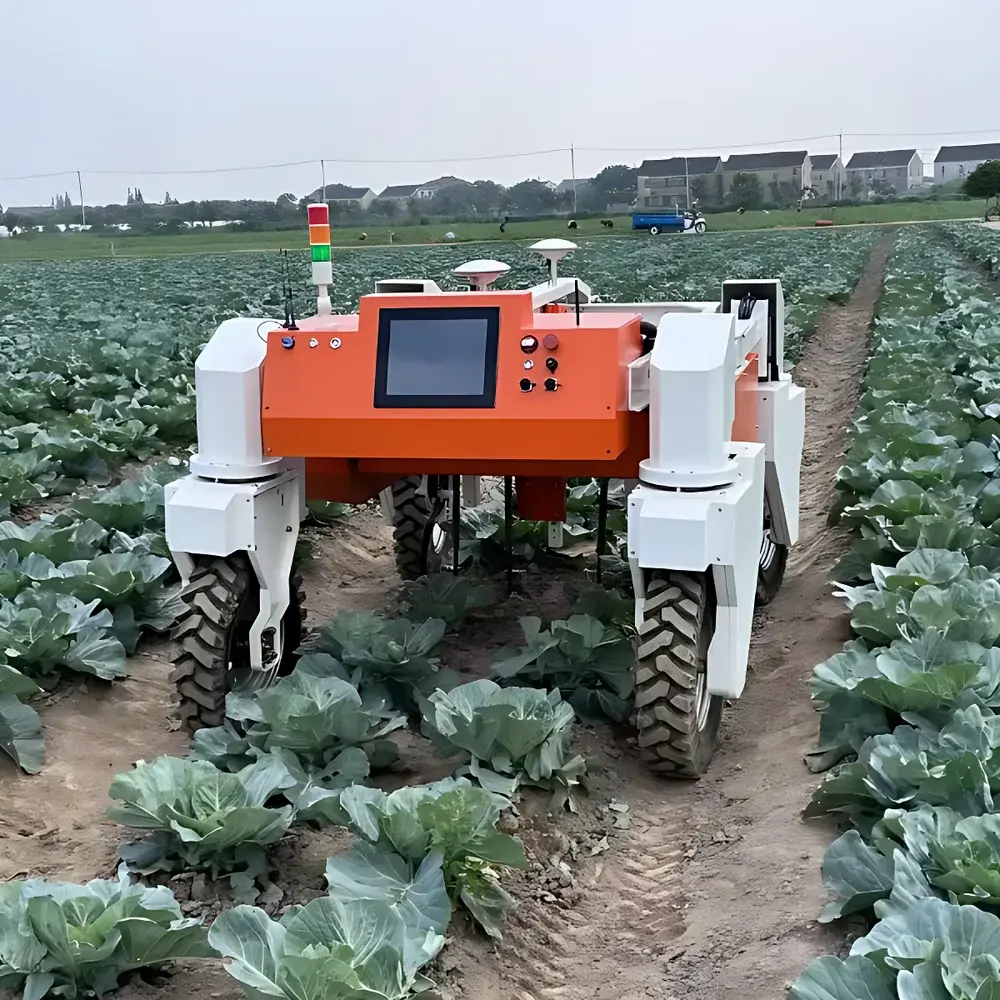
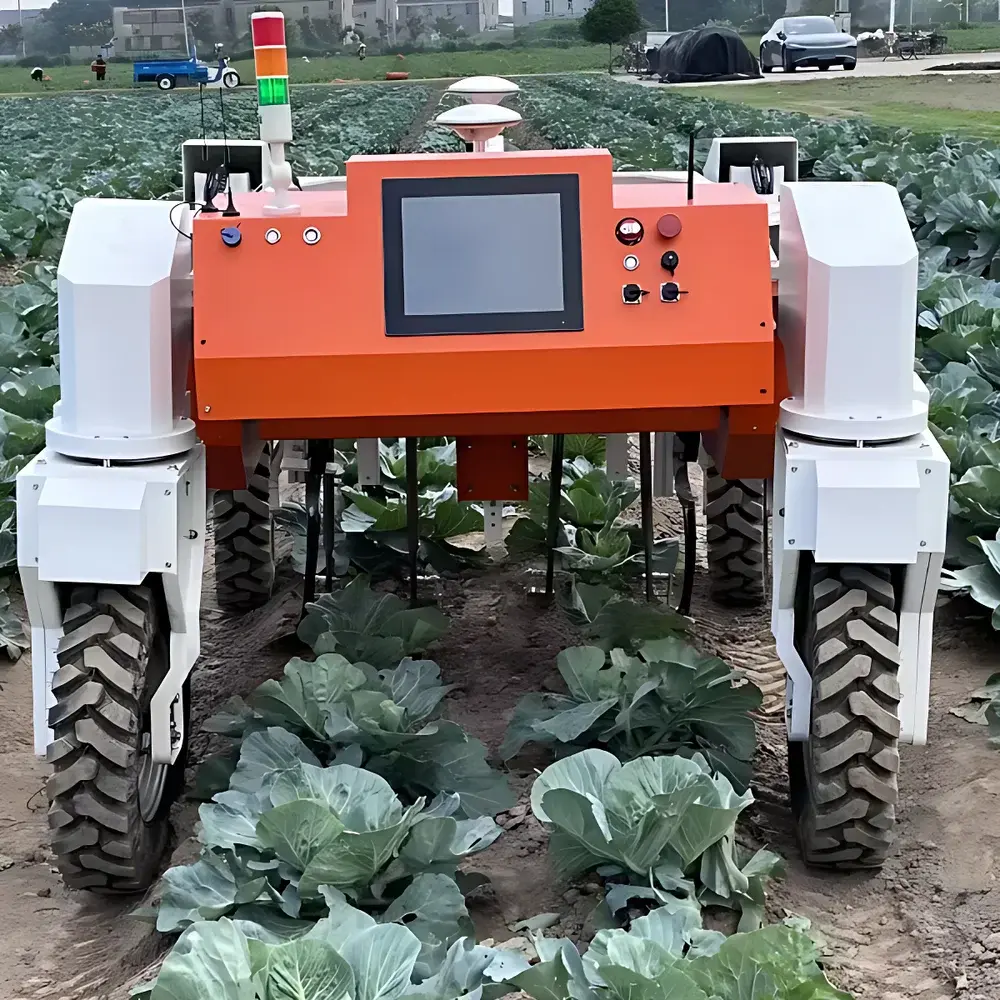
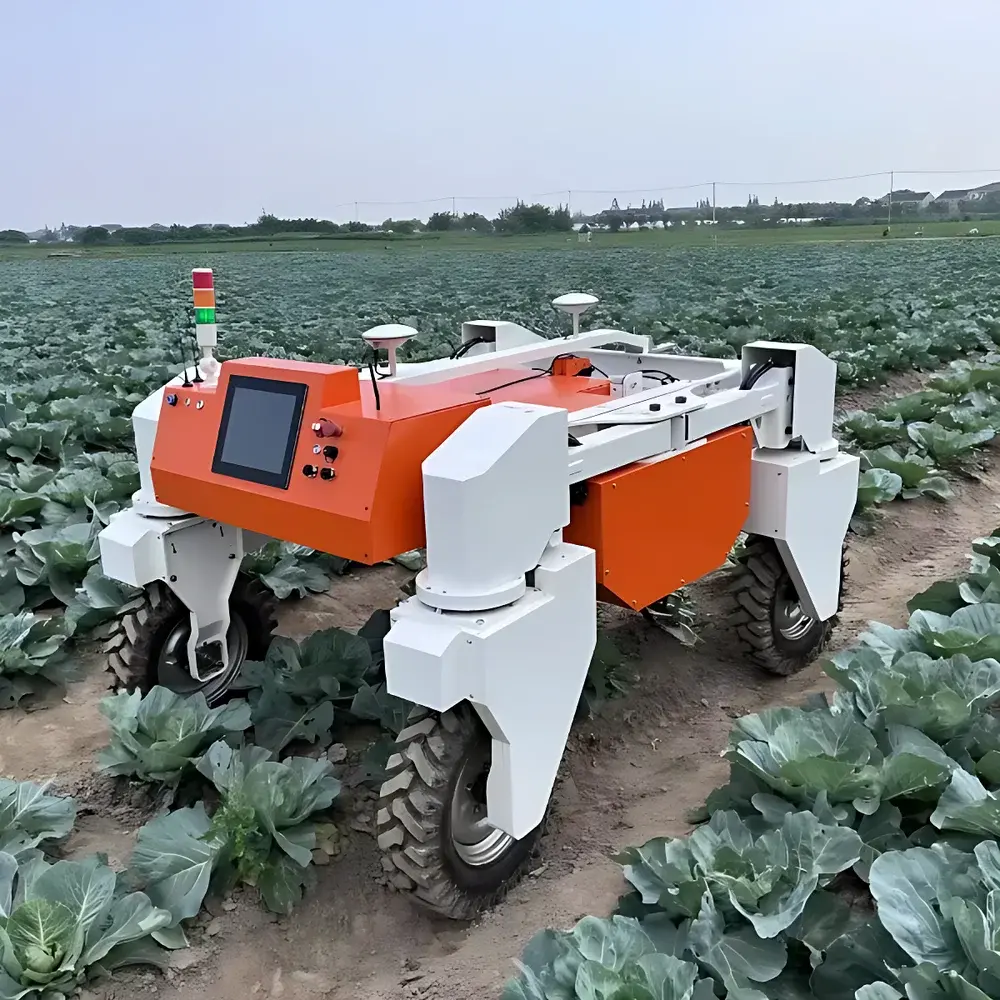
FHI-Bot Autonomous High-Clearance Field Inspection and Weeding Robot by BiAgro (RockTec)
| Brand | BiAgro (RockTec) |
|---|---|
| Origin | Shanghai, China |
| Manufacturer Type | Authorized Distributor |
| Country of Origin | China |
| Model | FHI-Bot |
| Pricing | Available Upon Request |
Overview
The FHI-Bot is an autonomous, electrically powered, high-clearance field robot engineered for precision mechanical weeding and routine agronomic inspection in open-field and greenhouse horticultural systems. Designed specifically for row-cropped systems—such as those used in vegetable, fruit, and specialty crop production—the platform operates on a Couette-flow-inspired locomotion principle adapted for agricultural terrain: four independently steered, four-wheel-drive (4WD/4WS) chassis architecture ensures sub-centimeter trajectory repeatability and robust lateral stability across uneven, soft, or partially vegetated soil surfaces. Its elevated ground clearance (>750 mm) enables unobstructed passage over raised beds, mulch films, and young crop canopies without physical contact, thereby eliminating mechanical stress on stems, roots, or developing fruits—a critical requirement for certified organic and low-input farming systems compliant with EU Regulation (EC) No 834/2007 and USDA NOP standards.
Key Features
- High-clearance modular chassis with adjustable wheel track width (1.2–1.8 m), enabling adaptation to diverse bed configurations and inter-row spacing standards (e.g., 0.6–1.5 m).
- Precision-guided mechanical weeding system: dual-mode operation combining rotary tillage tools for inter-row cultivation and oscillating blade actuators for intra-row (between-plant) weed removal—calibrated to avoid root zone disturbance.
- Multi-spectral vision system (RGB + NIR) integrated with real-time CNN-based weed detection algorithms, achieving >92% classification accuracy under variable lighting and canopy density conditions (tested per ISO 11783-12 Annex D protocols).
- RTK-GNSS navigation subsystem (L1/L2 dual-frequency) delivering ≤2 cm horizontal positioning accuracy; fused with inertial measurement unit (IMU) and LiDAR-based SLAM for reliable path planning in GPS-denied zones (e.g., dense canopy, tunnel greenhouses).
- Onboard environmental sensor suite: soil moisture (capacitive probe, 0–100% VWC), air temperature/humidity (±0.3°C, ±2% RH), and PAR (photosynthetically active radiation) sensors—data logged at 1 Hz with UTC timestamping and georeferencing.
- IP67-rated electronics enclosure and corrosion-resistant aluminum-alloy frame, validated for continuous operation in ambient temperatures from −5°C to +45°C and relative humidity up to 95% non-condensing.
Sample Compatibility & Compliance
The FHI-Bot is validated for use with transplanted or precision-planted crops including lettuce, tomato, pepper, strawberry, cabbage, and brassica species grown on raised beds, plastic mulch, or bare soil. It complies with ISO 20607:2018 (safety requirements for agricultural machinery), IEC 61000-6-2/6-4 (EMC immunity/emission), and meets CE marking requirements for machinery directive 2006/42/EC. Data acquisition workflows support GLP-aligned metadata tagging (ISO/IEC 17025:2017 Annex A.2) and are compatible with farm management information systems (FMIS) via ISO 11783-10 (ISOBUS VT) and AgGateway ADAPT-compliant JSON APIs.
Software & Data Management
The onboard control firmware runs on a real-time Linux kernel (PREEMPT_RT patchset) and interfaces with the RockTec AgROS™ middleware—designed for deterministic task scheduling and fail-safe emergency stop coordination. Field mission planning is performed via web-based dashboard (HTTPS/TLS 1.3 secured), supporting KML-based boundary import, multi-layer weed density heatmaps, and auto-generated compliance reports aligned with EU Farm Advisory System (FAS) reporting templates. All sensor logs and intervention records include cryptographic hash signatures and immutable audit trails, satisfying traceability requirements under FDA 21 CFR Part 11 for electronic records and signatures.
Applications
- Organic-certified vegetable production: automated post-emergence mechanical weeding without herbicides, reducing labor dependency by up to 70% compared to manual hoeing (field trial data, Shandong Province, 2023).
- Research-grade phenotyping: synchronized collection of canopy height, NDVI time-series, and soil surface temperature during routine patrol missions.
- Nursery and transplant acclimatization monitoring: non-invasive assessment of seedling vigor and early-stage pest pressure using thermal-visual fusion imaging.
- Greenhouse automation integration: interoperable with existing climate control systems via Modbus TCP, enabling coordinated irrigation-triggered weeding cycles.
- Contract farming service delivery: fleet-level remote diagnostics and OTA firmware updates managed through RockTec’s ISO 27001-certified cloud infrastructure.
FAQ
What crop spacing configurations does the FHI-Bot support?
It accommodates inter-row distances from 0.6 m to 1.8 m and intra-row plant spacing down to 12 cm, with automatic kinematic recalibration triggered by visual marker detection.
Can the robot operate in rain or high-humidity conditions?
Yes—the drive electronics, motor controllers, and sensor housings meet IP67 ingress protection; however, vision-based weed detection performance degrades above 95% RH due to lens condensation; optional heated optical windows are available as a configuration option.
Is the system compatible with third-party farm management software?
Yes—through standardized RESTful API endpoints and ISOBUS-compatible CAN bus gateways, enabling integration with platforms such as Granular, Climate FieldView, and AgriWebb.
Does the FHI-Bot require pre-mapped field boundaries for autonomous operation?
No—while RTK-GNSS-assisted mapping accelerates initial setup, the robot supports boundary learning via supervised edge-following mode using stereo vision and ultrasonic proximity feedback.
How is maintenance and calibration performed in the field?
All mechanical weeding tools feature quick-release couplings and wear-compensating blade mounts; onboard self-diagnostics report actuator drift, wheel slip ratios, and camera focus degradation—triggering maintenance alerts with actionable part numbers and torque specifications.