
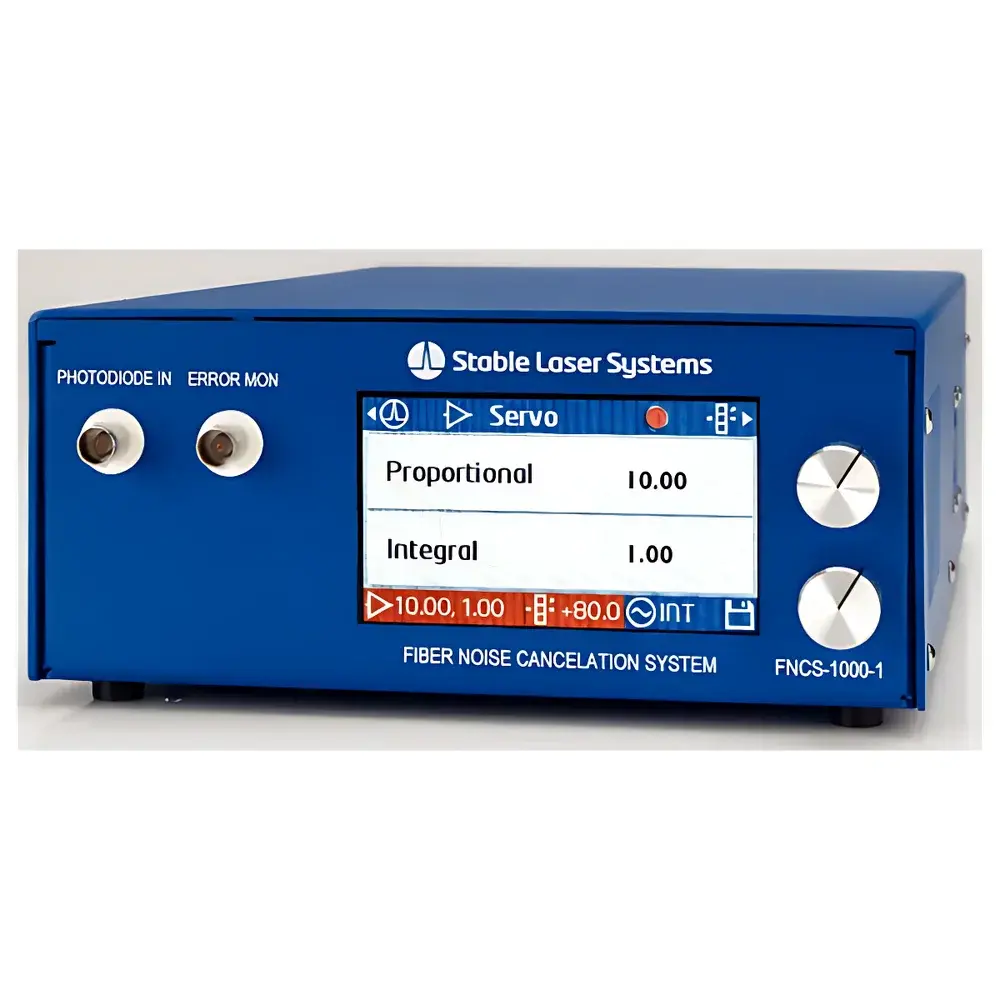
Fiber Noise Cancellation System for Ultra-Stable Laser Transmission
| Brand | Stable Laser Systems |
|---|---|
| Model | FNC-1550 |
| Type | Active Fiber-Based Phase Noise Suppression System |
| Origin | USA |
| Voltage | 110/115/230 V AC |
| Power Consumption | 25 W |
| Frequency Range | 50–60 Hz |
| Cooling Method | Air-Cooled |
| Servo Loop Bandwidth | 100 kHz |
| Residual Phase Noise Floor | <10 mrad RMS |
| Allan Deviation (τ = 1 s) | ≈ 5 × 10⁻¹⁷ @ 1550 nm |
| Display | 4.3″ Capacitive Touchscreen |
| Integrated Acousto-Optic Modulator (AOM) | 1 W RF Power |
| External RF Reference Output | Yes |
| Form Factor | Compact Benchtop Unit |
| Optical Interface | FC/APC or Optional Fiber Connectors |
Overview
The Fiber Noise Cancellation System (FNC-1550) is an active, closed-loop phase stabilization platform engineered for ultra-stable laser transmission over optical fiber links. It operates on the principle of real-time interferometric phase error detection and feedback-controlled optical path length correction—leveraging a high-bandwidth servo loop to suppress low-frequency phase drift and broadband acoustic/vibrational noise induced during fiber propagation. Unlike passive isolation methods, this system dynamically compensates for environmental perturbations—including temperature gradients, mechanical vibrations, and acoustic coupling—enabling sub-milliradian phase stability across kilometer-scale single-mode fiber spools. Designed specifically for metrology-grade applications such as optical frequency transfer, coherent lidar, atomic interferometry, and distributed quantum sensing, the FNC-1550 preserves the intrinsic coherence and linewidth integrity of reference lasers (e.g., ultra-stable cavity-stabilized diode or fiber lasers at 1550 nm), even when the laser source remains fixed in a remote laboratory while the experiment is conducted meters or kilometers away.
Key Features
- Real-time digital phase error tracking with 100 kHz servo bandwidth and <10 mrad RMS residual phase noise
- Integrated 1 W acousto-optic modulator (AOM) with dedicated RF driver for fast-path-length actuation
- 4.3-inch capacitive touchscreen interface for local configuration, loop gain tuning, and real-time error signal visualization
- External RF reference input/output for synchronization with master oscillators or timing distribution systems (e.g., 10 MHz or 100 MHz TTL-compatible)
- Compact, fan-cooled benchtop enclosure (210 × 170 × 85 mm) compatible with standard optical tables and rack-mount adapters
- Modular optical interface supporting FC/APC connectors; optional collimated free-space or polarization-maintaining fiber variants available upon request
- Firmware-upgradable architecture supporting future enhancements in adaptive filtering and multi-channel coordination
Sample Compatibility & Compliance
The FNC-1550 is optimized for single-mode fiber transmission at telecom wavelengths (C-band, λ = 1550 nm), though its control architecture supports wavelength-flexible operation between 1310 nm and 1625 nm with appropriate photodetector and AOM calibration. It maintains compatibility with industry-standard ultra-stable lasers—including compact semiconductor lasers, fiber lasers, and external-cavity diode lasers—provided they deliver sufficient optical power (>5 mW) and exhibit linewidths ≤ 100 kHz. The system complies with IEC 61000-6-3 (EMI emission limits) and IEC 61000-6-2 (immunity to electrostatic discharge and radiated RF fields). Its firmware architecture supports audit-ready logging and timestamped event records, facilitating alignment with GLP and ISO/IEC 17025 documentation requirements for calibration laboratories performing optical frequency dissemination or time-transfer validation.
Software & Data Management
The FNC-1550 includes embedded Linux-based firmware with Ethernet (RJ45) and USB-C host interfaces for remote monitoring and control via TCP/IP or SCPI commands. A Python SDK and LabVIEW VI library are provided for integration into automated test benches and data acquisition frameworks (e.g., National Instruments DAQmx, MATLAB Instrument Control Toolbox). All servo parameters—including proportional-integral gains, filter coefficients, and lock status—are programmatically accessible and persistently stored. Real-time error signal traces and Allan deviation plots can be exported in CSV or HDF5 format. For regulated environments, optional firmware enables 21 CFR Part 11-compliant user authentication, electronic signatures, and immutable audit trails—supporting FDA-regulated quantum sensor qualification protocols and NIST-traceable optical clock comparisons.
Applications
- Long-haul optical frequency transfer between national metrology institutes (e.g., NIST ↔ PTB, NIM ↔ NPL)
- Coherent optical beam combining in phased-array lidar and free-space optical communication terminals
- Stabilization of fiber-delivered local oscillators in cold-atom gravimeters and optical lattice clocks
- Phase-noise mitigation in dual-comb spectroscopy and distributed fiber-optic acoustic sensing (DAS) arrays
- Multi-node quantum network testbeds requiring synchronized optical phases across geographically separated nodes
- Calibration of ultra-low-noise photodetectors and balanced homodyne receivers used in gravitational-wave detector readout chains
FAQ
Can the FNC-1550 stabilize multiple independent fiber paths simultaneously?
Yes—multiple units operate independently without crosstalk; each maintains full servo autonomy and may be synchronized to a common RF reference for coordinated phase alignment.
Is it possible to integrate the FNC-1550 into an existing vacuum or cryogenic setup?
The unit itself is designed for ambient operation, but its fiber inputs/outputs support feedthrough-compatible patch cables; custom hermetic versions are available under OEM agreement.
Does the system support automatic re-lock after fiber disturbance events?
Yes—the firmware includes adaptive lock-acquisition algorithms that detect loss-of-lock conditions and initiate recovery sequences without manual intervention.
What level of optical power stability does the integrated AOM provide?
The 1 W AOM delivers ±0.5% RMS intensity stability over 24 hours at constant temperature, with thermal drift compensated via internal temperature monitoring and bias adjustment.
Can I export raw phase error data for post-processing in MATLAB or Python?
Yes—real-time streaming at up to 1 MS/s (decimated or full-rate) is supported via Ethernet; all data formats are documented in the SDK manual.
Related Products







