
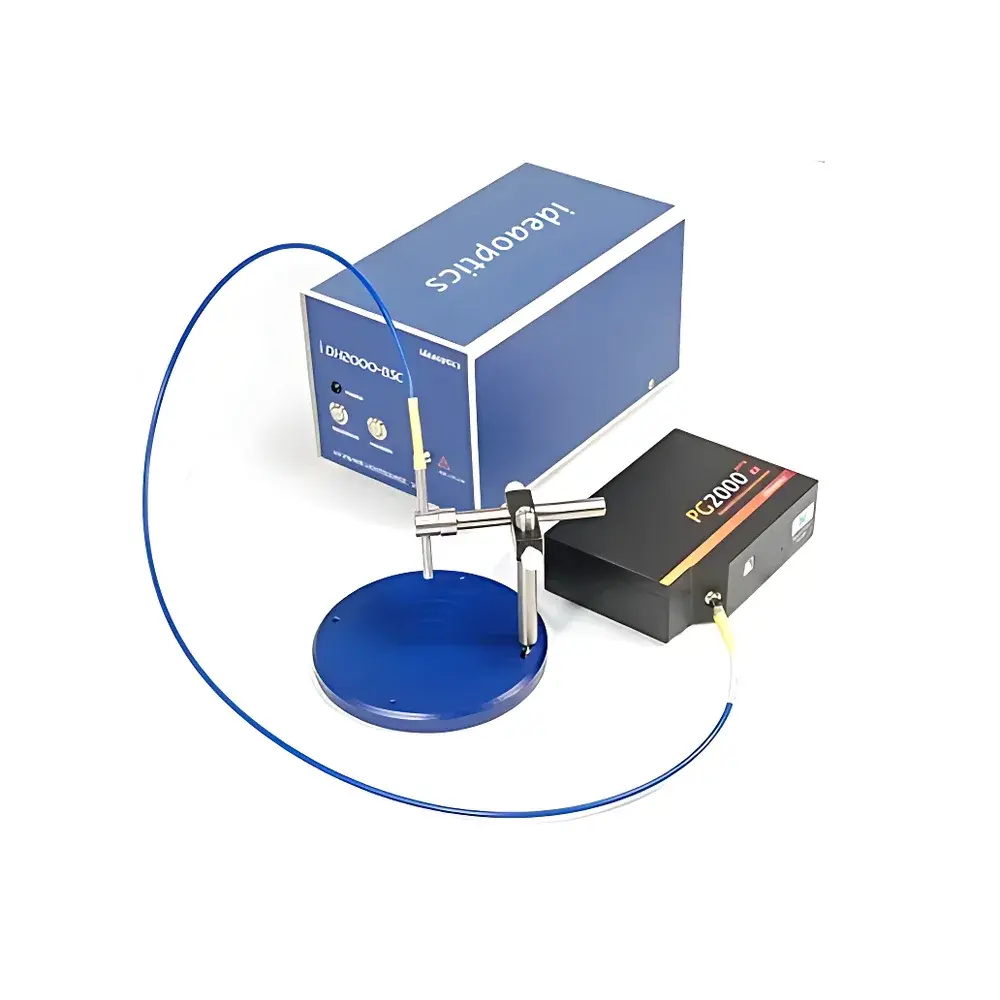
Fiber Optic Spectrometer PG2000-Pro — High-Sensitivity Research-Grade CCD Spectrometer with Deep-UV Capability
| Origin | Shanghai, China |
|---|---|
| Manufacturer Type | Authorized Distributor |
| Origin Category | Domestic (PRC) |
| Model | PG2000-Pro |
| Price Range | USD 4,200 – 7,000 |
| Spectral Range | 185–1100 nm |
| Detector | Back-Illuminated FFT-CCD (Hamamatsu S10420) |
| Optical Resolution (FWHM) | 0.13–7.05 nm (configurable via grating/slit) |
| Quantum Efficiency | 75% peak, 65% @ 250 nm |
| Sensitivity | 6.5 V/e⁻ |
| Signal-to-Noise Ratio | 500:1 (at full well, 1 s integration) |
| Dynamic Range | 50,000:1 (system), 5,000:1 (single acquisition) |
| Stray Light | < 0.1% @ 600 nm |
| Pixel Array | 2048 × 64 |
| A/D Conversion | 16-bit, 500 kHz |
| Integration Time | 11 ms – 8 s |
| Weight | 1.0 kg |
Overview
The PG2000-Pro is a high-performance fiber-optic spectrometer engineered for demanding research applications requiring deep-ultraviolet (DUV) sensitivity, high quantum efficiency, and broad spectral coverage. Based on the Hamamatsu S10420 back-illuminated, full-frame transfer (FFT) CCD detector, it delivers exceptional photon detection capability across an extended range of 185–1100 nm—enabling reliable measurements in critical DUV regions (e.g., 185–300 nm) where conventional front-illuminated detectors exhibit severe quantum efficiency roll-off. Its optical architecture integrates proprietary EX wideband diffraction gratings and EX multi-bandpass filters to suppress higher-order diffraction artifacts while maintaining high throughput and low stray light (< 0.1% @ 600 nm). The instrument operates on a robust, thermally stable platform optimized for laboratory and field-deployable spectroscopic tasks—including fluorescence, reflectance, transmission, plasma emission, and micro-spectroscopy—where signal fidelity, long-integration stability, and spectral accuracy are non-negotiable.
Key Features
- Back-illuminated FFT-CCD detector (2048 × 64 pixels) with 75% peak quantum efficiency and 65% QE at 250 nm—optimized for weak-signal and DUV applications
- Configurable optical resolution from 0.13 nm to 7.05 nm (FWHM), selectable via 18 interchangeable gratings and slit options (10–200 µm)
- Low electronic noise design enabling stable, low-drift integrations up to 8 seconds—critical for time-resolved or low-flux measurements
- Integrated EX wideband optical train featuring patented EX gratings and EX bandpass filters for seamless 185–1100 nm spectral coverage without mechanical scanning or detector switching
- Omnidirectional stray light suppression using order-sorting filters and optimized internal baffling—meeting ASTM E275 and ISO 9001-compliant optical metrology requirements
- USB 2.0 interface providing both high-speed data transfer (up to 500 kHz sampling) and bus-powered operation—eliminating external power supplies for portable deployment
- Thermally stabilized optical bench with passive cooling—ensuring wavelength repeatability < ±0.05 nm over 8-hour continuous operation
Sample Compatibility & Compliance
The PG2000-Pro interfaces seamlessly with standard SMA-905 optical fibers (core diameters 50–600 µm), microscope couplers, integrating spheres, reflection probes, and custom sample holders. It supports compliance-critical workflows in regulated environments: spectral calibration traceability follows NIST-traceable standards (e.g., HG/Ne lamps, deuterium-halogen sources); linearity validation conforms to ISO/IEC 17025 guidelines; and firmware logging meets GLP/GMP documentation prerequisites for audit-ready data capture. While not FDA 21 CFR Part 11–certified out-of-the-box, its software architecture supports timestamped, user-authenticated acquisition logs—facilitating validation under pharmaceutical, materials science, or environmental testing protocols aligned with USP , ASTM E308, and IEC 61000-4-3.
Software & Data Management
The spectrometer is supplied with SpectraSuite Pro—a cross-platform (Windows/macOS/Linux), API-accessible application supporting real-time spectral acquisition, multi-channel averaging, dark/baseline correction, and spectral math (e.g., absorbance, reflectance, ratio, derivative). Raw data export is supported in CSV, HDF5, and vendor-neutral JCAMP-DX formats. The SDK includes C/C++, Python (PySpectra), and MATLAB bindings, enabling integration into LabVIEW, Python-based automation pipelines, or custom QC dashboards. All acquisitions embed metadata (integration time, grating ID, slit width, temperature sensor reading), and optional hardware-triggered acquisition ensures synchronization with pulsed lasers, shutter systems, or stage controllers—essential for time-resolved photoluminescence or pump-probe configurations.
Applications
- Deep-UV reflectance and absorption spectroscopy of thin-film semiconductors (e.g., SiN-coated polysilicon, GaN, AlGaN)
- Micro-spectroscopy coupling with confocal or SNOM platforms (e.g., Nanonics MV-2000) for sub-diffraction-limited spatial spectral mapping
- Plasma diagnostics and atomic emission analysis (Ar, He, N₂ lines), including ionization state monitoring via line-ratio thermometry
- LED and laser diode characterization—blue LED spectral narrowing, linewidth measurement, and mode-hop detection
- Fluorescence lifetime precursor analysis via intensity-modulated excitation and phase-sensitive detection (when paired with lock-in amplifier)
- In-line process monitoring in semiconductor fabrication, photovoltaics R&D, and OLED material screening
FAQ
What spectral calibration standards are included with the PG2000-Pro?
A NIST-traceable mercury-argon calibration lamp (HG/Ar) is provided for factory and user-performed wavelength calibration; optional deuterium-halogen source (iDH2000-BSC) enables radiometric calibration across 195–1100 nm.
Can the PG2000-Pro be used in vacuum or controlled-atmosphere chambers?
Yes—the spectrometer housing is sealed and rated IP52; fiber-coupled operation allows remote placement outside vacuum chambers, with UV-grade fused silica fibers (e.g., Ocean Insight QP200-2-SR) recommended for DUV transmission.
Is the 185 nm lower limit achievable in ambient air?
No—oxygen absorption strongly attenuates below ~195 nm in air; operation at 185–195 nm requires purging with nitrogen or argon, or integration into a vacuum-compatible optical path.
How is stray light performance verified and documented?
Stray light is measured per ASTM E275 using a 600 nm primary bandpass filter and secondary narrowband rejection test; certified test reports are available upon request for quality assurance audits.
Does the system support synchronized multi-instrument triggering?
Yes—TTL-compatible trigger input/output ports enable hardware-level synchronization with lasers, shutters, motorized stages, or oscilloscopes at ≤10 ns jitter.




