
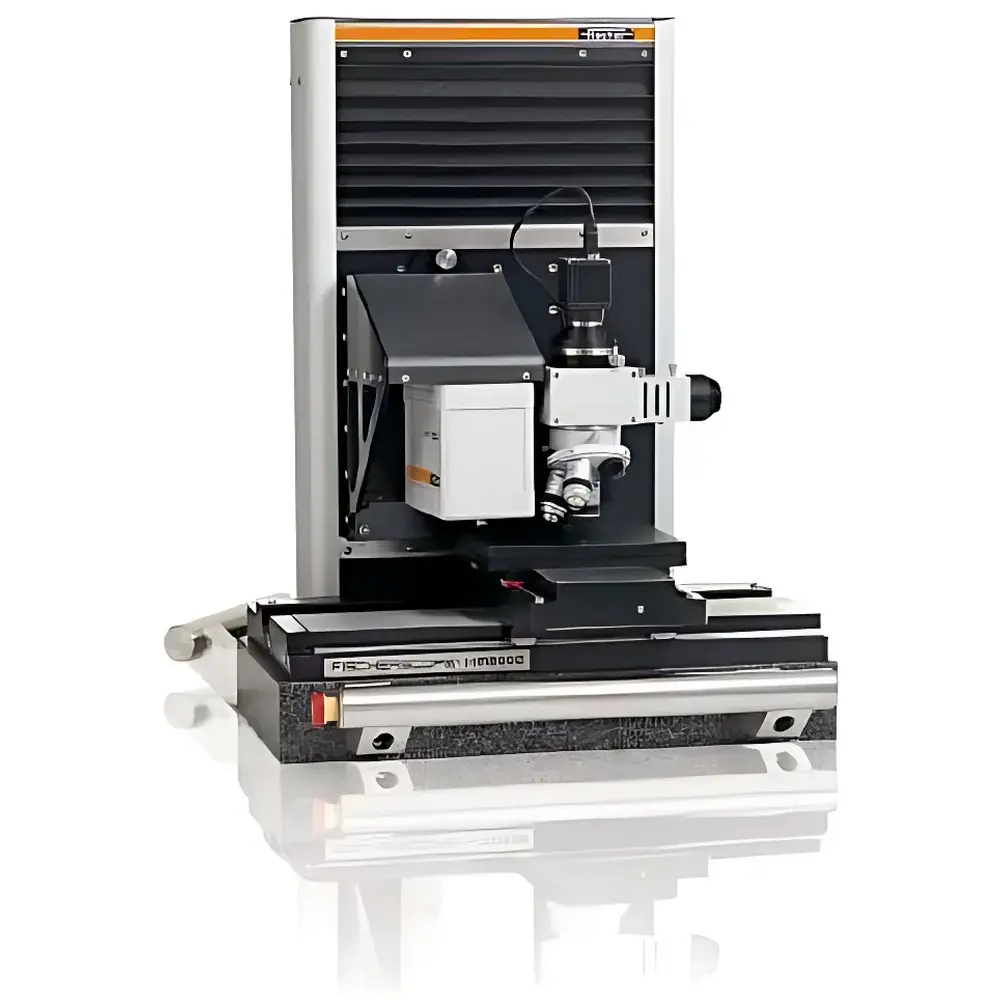
FISCHERSCOPE HM2000 Nanoindentation and Scratch Testing System
| Brand | Fischer |
|---|---|
| Origin | Germany |
| Model | HM2000 |
| Instrument Type | Nanoindentation Tester |
| Max Indentation Depth | 500 µm |
| Effective Load Range | 0.1–2000 mN |
| Load Resolution | 150 nN |
| Displacement Range | 130 mm |
| Displacement Resolution | 0.01 nm |
| Max Friction Force | 50 N |
| Indenter Types | Vickers, Berkovich, Tungsten Carbide Sphere |
Overview
The FISCHERSCOPE HM2000 is a high-precision nanoindentation and micro-scratch testing system engineered for quantitative mechanical characterization of surfaces and thin films at sub-micron scales. Based on the quasi-static depth-sensing indentation principle—compliant with ISO 14577-1 and ASTM E2546—the instrument measures load-displacement curves in real time to derive fundamental material properties including hardness, elastic modulus, creep compliance, and energy dissipation ratios. Its monolithic granite base, thermally stable frame, and active vibration isolation architecture ensure measurement repeatability better than ±1.5% (k = 2) under ambient laboratory conditions. Designed for both R&D laboratories and production-integrated quality control environments, the HM2000 supports fully automated multi-point mapping across complex geometries—including curved substrates, medical implants, and PCB traces—without operator intervention.
Key Features
- High-fidelity force and displacement sensing: 150 nN load resolution and 0.01 nm displacement resolution enable reliable quantification of ultra-thin coatings (e.g., DLC, TiN, AlTiN) and soft polymers.
- Modular indenter turret supporting interchangeable Vickers, Berkovich, and spherical tungsten carbide indenters—calibrated per ISO 14577 Annex B and traceable to PTB (Physikalisch-Technische Bundesanstalt).
- Integrated motorized XYZ stage with 130 mm travel range and <500 nm positioning accuracy; programmable for grid-based, contour-following, or custom path indentation sequences.
- Tri-magnification optical microscope (5×/20×/50×) with motorized focus and auto-target recognition for rapid, unambiguous location of measurement sites—even on optically challenging surfaces such as matte anodized aluminum or rough PVD layers.
- Zero-point auto-calibration via fast-approach algorithm, eliminating thermal drift artifacts during long-duration creep tests (up to 10,000 s).
- Comprehensive parameter calculation engine compliant with ISO 14577-1: outputs >30 standardized mechanical descriptors—including Martens hardness (HM), indentation hardness (HIT), indentation modulus (EIT), indentation creep (CIT), and elastic work ratio (Welast/Wtotal).
Sample Compatibility & Compliance
The HM2000 accommodates samples up to Ø150 mm × 50 mm height, including irregularly shaped components (e.g., stents, turbine blades, semiconductor wafers). Its open-stage design allows direct integration with environmental accessories: heated sample holders (up to 300 °C), enclosed measurement chambers (ISO Class 5 cleanroom compatible), and optional AFM modules for post-indentation topography and friction mapping. All hardware and software comply with GLP/GMP documentation requirements, supporting 21 CFR Part 11–compliant electronic signatures, full audit trails, and raw data export in ASCII/CSV formats. Measurement uncertainty budgets are documented per ISO/IEC 17025 and validated against NIST-traceable reference standards.
Software & Data Management
WIN-HCU software provides intuitive workflow management—from test definition and real-time curve visualization to statistical reporting and comparative analysis. It features embedded ISO 14577–validated algorithms for Oliver–Pharr method refinement, enhanced stiffness measurement (ESP), and depth-dependent property profiling. Data files include metadata on calibration history, environmental conditions, and operator identity. Export options support integration with LIMS platforms and third-party analysis tools (MATLAB®, Python pandas). Batch processing enables automatic pass/fail evaluation against user-defined specification limits—critical for high-volume QC applications in electroplating, aerospace coating, and biomedical device manufacturing.
Applications
- Mechanical validation of wear-resistant coatings (e.g., CrN, TiAlN) on cutting tools and bearing surfaces.
- Hardness and modulus profiling across graded anodized layers on aluminum aerospace alloys.
- Creep behavior assessment of polymer electrolytes in solid-state battery development.
- Quantitative adhesion strength evaluation of thin-film metallization on flexible PCBs using micro-scratch mode.
- Correlation of nanoindentation-derived modulus with bulk tensile properties in additive-manufactured metal parts.
- Quality gate testing of decorative chrome plating on automotive trim—measuring both hardness uniformity and ductility indicators (e.g., pile-up ratio, plasticity index).
FAQ
Does the HM2000 support ISO 14577-compliant hardness reporting?
Yes—WIN-HCU calculates and reports Martens hardness (HM), indentation hardness (HIT), and Vickers-equivalent hardness (HV) directly from load-displacement data, with full traceability to ISO 14577-1 Annex A.
Can it measure coatings thinner than 100 nm?
Yes, provided substrate effects are minimized via depth-of-penetration rules (typically ≤10% of coating thickness); the 0.01 nm displacement resolution and low-noise transducers enable reliable analysis down to ~30 nm functional coatings.
Is the system suitable for in-line production monitoring?
While primarily designed for lab-based metrology, its automated XY stage, barcode-triggered test protocols, and OPC UA–enabled connectivity allow integration into Industry 4.0 environments for periodic sampling and SPC charting.
What calibration standards are supplied with the instrument?
Each system ships with NIST-traceable fused silica and stainless steel reference samples, plus certified indenter tip geometry certificates issued by PTB.
How is thermal drift compensated during extended creep measurements?
The HM2000 employs dual-sensor thermal compensation (load cell + displacement sensor), combined with adaptive zero-tracking algorithms that re-evaluate baseline drift every 30 seconds during hold phases.



