
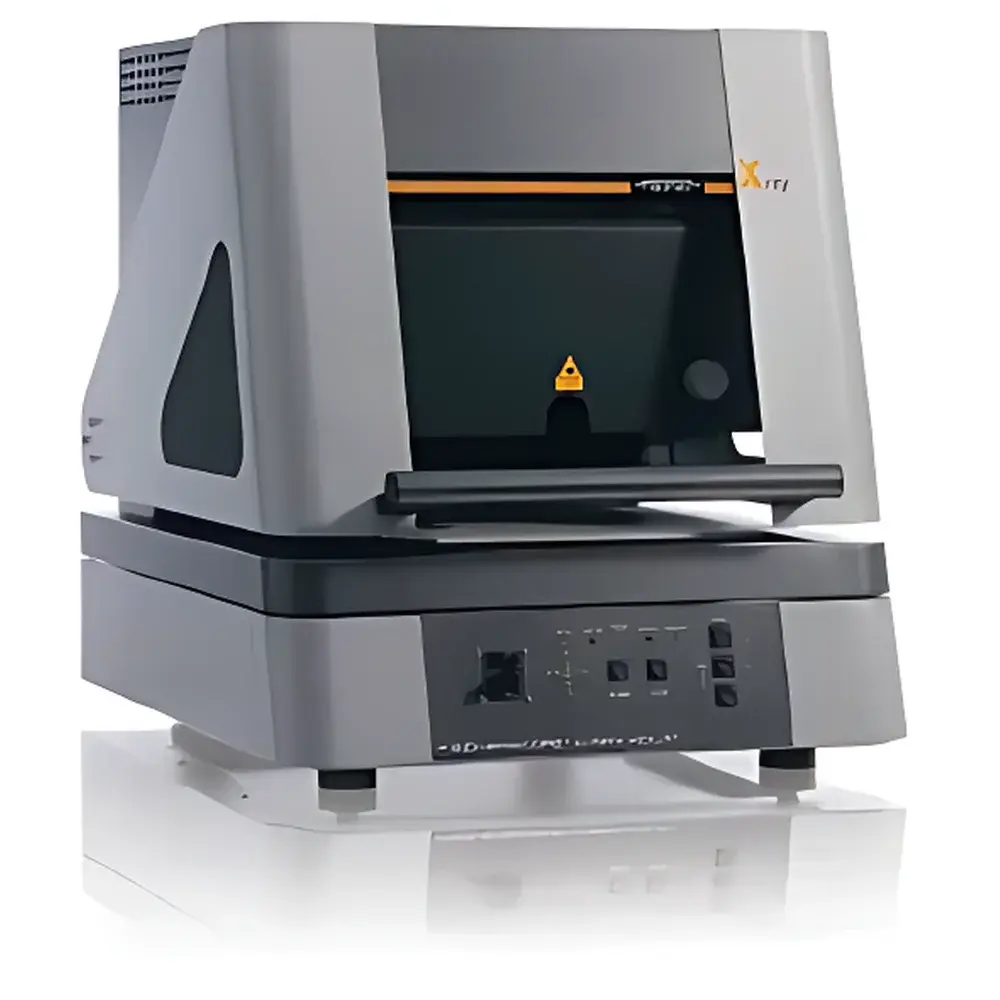
FISCHERSCOPE X-RAY XDLM Series Energy-Dispersive X-ray Fluorescence Coating Thickness Analyzer
| Brand | Fischer |
|---|---|
| Origin | Germany |
| Model | XDLM |
| Measurement Principle | Energy-Dispersive X-ray Fluorescence (EDXRF) |
| Sample Positioning | Motorized Z-axis (standard) |
| Collimators | 4 interchangeable (diameters: 0.1, 0.2, 0.3, 0.5 mm) |
| Primary Filters | 3 interchangeable Al, Cu, Ti |
| Detector | Proportional counter with high-count-rate capability |
| Measurement Distance | 0–80 mm (adjustable via motorized Z-axis) |
| Optical Alignment | Integrated high-resolution color CCD camera with 10× digital zoom |
| Operating Temperature | 10–40 °C |
| Relative Humidity | ≤95% RH (non-condensing) |
| Instrument Weight | 100–120 kg |
| PC Interface | PCI/PCIe expansion slot required for spectrometer control and data acquisition |
Overview
The FISCHERSCOPE X-RAY XDLM Series is a benchtop energy-dispersive X-ray fluorescence (EDXRF) analyzer engineered for non-destructive, quantitative measurement of ultra-thin metallic coatings and trace elemental composition in industrial quality assurance environments. Based on fundamental parameter (FP) and empirical calibration methodologies, the system excites characteristic X-ray fluorescence from sample surfaces using a micro-focus X-ray tube (typically Pd or Mo anode), and resolves emitted photons via a gas-filled proportional counter optimized for high count-rate stability and low background noise. Its design emphasizes metrological rigor for coatings ranging from sub-nanometer to several micrometers—particularly critical for electroplated layers (e.g., Au/Ni/Cu on PCBs), conversion coatings (e.g., Cr(VI)/Cr(III) on aluminum), and multi-layer systems (e.g., Sn/Cu/Ni on leadframes). Unlike wavelength-dispersive systems, EDXRF enables rapid multi-element analysis without mechanical scanning, making the XDLM series especially suitable for inline process verification, supplier qualification, and failure root-cause investigation in electronics, automotive, and precision engineering sectors.
Key Features
- Motorized Z-axis positioning (standard across all models) ensures repeatable source-to-sample distance control within ±5 µm accuracy, essential for maintaining geometric consistency in thin-film quantification.
- Configurable stage options: XDLM 231 features a fixed-stage platform; XDLM 232 adds manual X/Y translation for localized spot analysis; XDLM 237 integrates fully motorized X/Y/Z axes with automated sample loading protocol—triggered upon safety interlock release—to support unattended batch measurement of up to 20 parts per run.
- Four precision-machined collimators (0.1 mm to 0.5 mm diameter) enable spatial resolution adaptation—from micro-area analysis of solder bumps (<100 µm) to macro-area averaging over heterogeneous substrates.
- Three selectable primary filters (Al, Cu, Ti) optimize excitation efficiency for specific element groups: Al enhances sensitivity for light elements (Mg–Cl); Cu improves signal-to-background for mid-Z elements (Fe–Zr); Ti suppresses Bremsstrahlung continuum when analyzing high-Z coatings (Ag, Sn, Pb) on low-Z substrates (e.g., plastics).
- Integrated 1.3 MP color CCD camera with real-time overlay of measurement spot crosshair and adjustable white-light illumination supports precise targeting—even on reflective, curved, or patterned surfaces—without physical contact.
- Rugged cast-aluminum housing with lead-lined chamber meets IEC 61000-6-3 EMC standards and provides inherent radiation shielding compliant with German RöV and EU Directive 2013/59/Euratom.
Sample Compatibility & Compliance
The XDLM series accommodates flat, curved, or irregularly shaped samples up to Ø200 mm × 50 mm height, including printed circuit boards, stamped metal parts, injection-molded housings with metallized surfaces, and wafer-level packaging substrates. It supports both single-layer and complex multilayer stacks (up to 5 layers), provided layer densities and atomic numbers are sufficiently differentiated for spectral deconvolution. All configurations comply with ISO 3497:2022 (Metallic coatings — Measurement of coating thickness — X-ray spectrometric methods) and ASTM B568–98(2021) (Standard Test Method for Thickness of Metallic Coatings by X-Ray Spectrometry). Firmware includes audit-trail logging per FDA 21 CFR Part 11 requirements when paired with validated WinFTM® software, enabling full traceability for GLP/GMP-regulated laboratories.
Software & Data Management
Operation is managed via WinFTM®—Fischer’s proprietary Windows-based application—supporting method creation, spectrum acquisition, FP-based quantification, statistical process control (SPC) charting, and automated report generation (PDF/Excel). The software implements matrix correction algorithms for substrate effects and incorporates certified reference material (CRM) libraries traceable to BAM (Federal Institute for Materials Research and Testing) and NIST SRMs. Raw spectral data (.spe) and processed results (.csv) are stored in hierarchical project folders with user-defined metadata tagging. Optional network licensing allows centralized instrument management across multiple sites, while API access enables integration with MES/SCADA platforms via TCP/IP or OPC UA protocols.
Applications
- Quantitative thickness measurement of Au, Pd, Ni, Sn, Ag, Cu, Cr, Zn, and alloy coatings on PCBs, connectors, and semiconductor leadframes.
- Analysis of hexavalent vs. trivalent chromium passivation layers on aerospace-grade aluminum alloys per MIL-DTL-5541F.
- Verification of selective plating uniformity across high-density interconnect (HDI) substrates.
- Identification and thickness assessment of nanoscale barrier layers (e.g., TiW, TaN) in MEMS fabrication.
- Compliance screening for RoHS-restricted substances (Pb, Cd, Hg, Cr⁶⁺, Br) in finished goods prior to shipment.
FAQ
What is the minimum detectable thickness for gold on nickel using the XDLM?
For a 0.1 mm collimator and standard measurement time (30 s), typical detection limits range from 0.5 nm to 1.2 nm Au on Ni, depending on surface roughness and instrument calibration status.
Can the XDLM analyze coatings on flexible polymer substrates?
Yes—provided the substrate is mechanically stable during measurement and its X-ray absorption is accounted for in the calibration model; low-energy filters and extended counting times improve sensitivity for light-element coatings on PET or PI films.
Is external cooling required for continuous operation?
No—the system uses passive thermal management and operates reliably within ambient temperatures of 10–40 °C without auxiliary chillers.
How is measurement reproducibility verified?
Fischer supplies certified reference standards (e.g., Au/Ni/Cu on brass) with NIST-traceable thickness values; daily verification routines include peak intensity stability checks and dead-time correction validation.
Does the instrument support remote diagnostics?
Yes—via secure HTTPS-enabled web interface and optional TeamViewer integration for firmware updates and spectral troubleshooting under ITAR-compliant data-handling protocols.



