
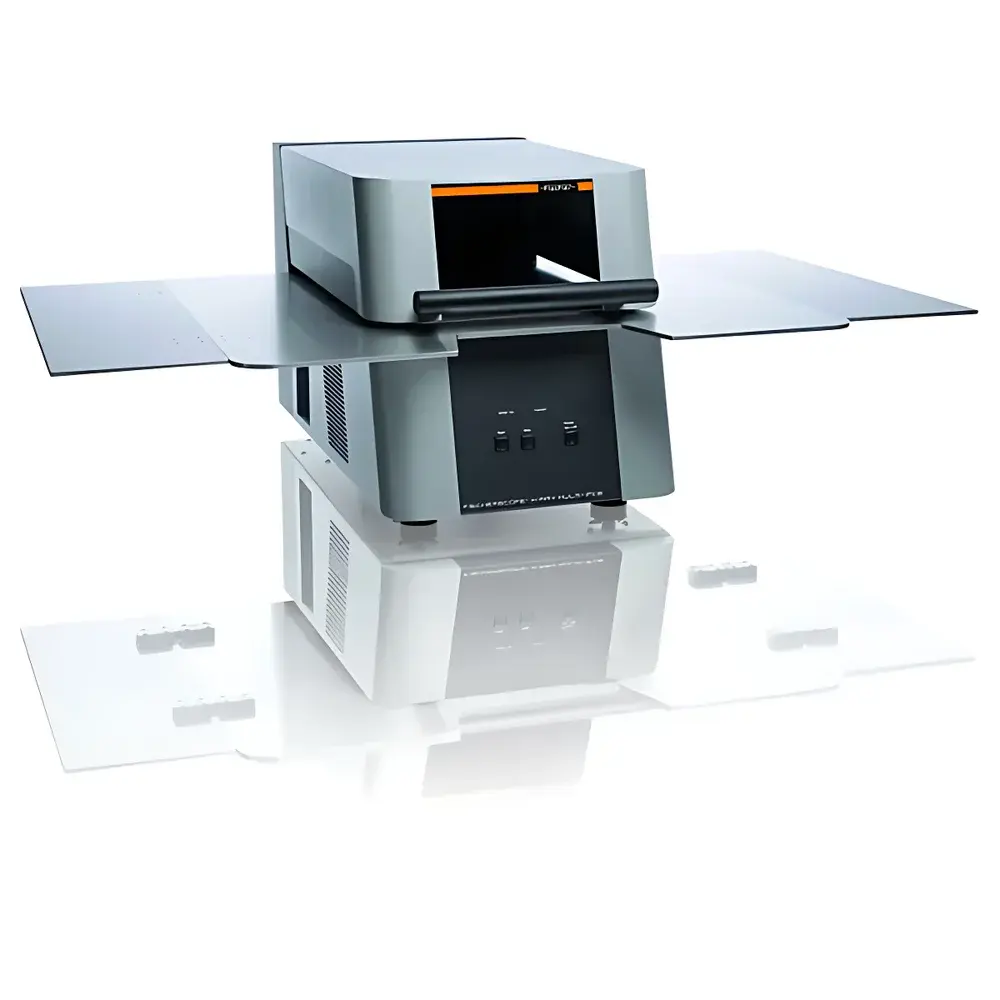
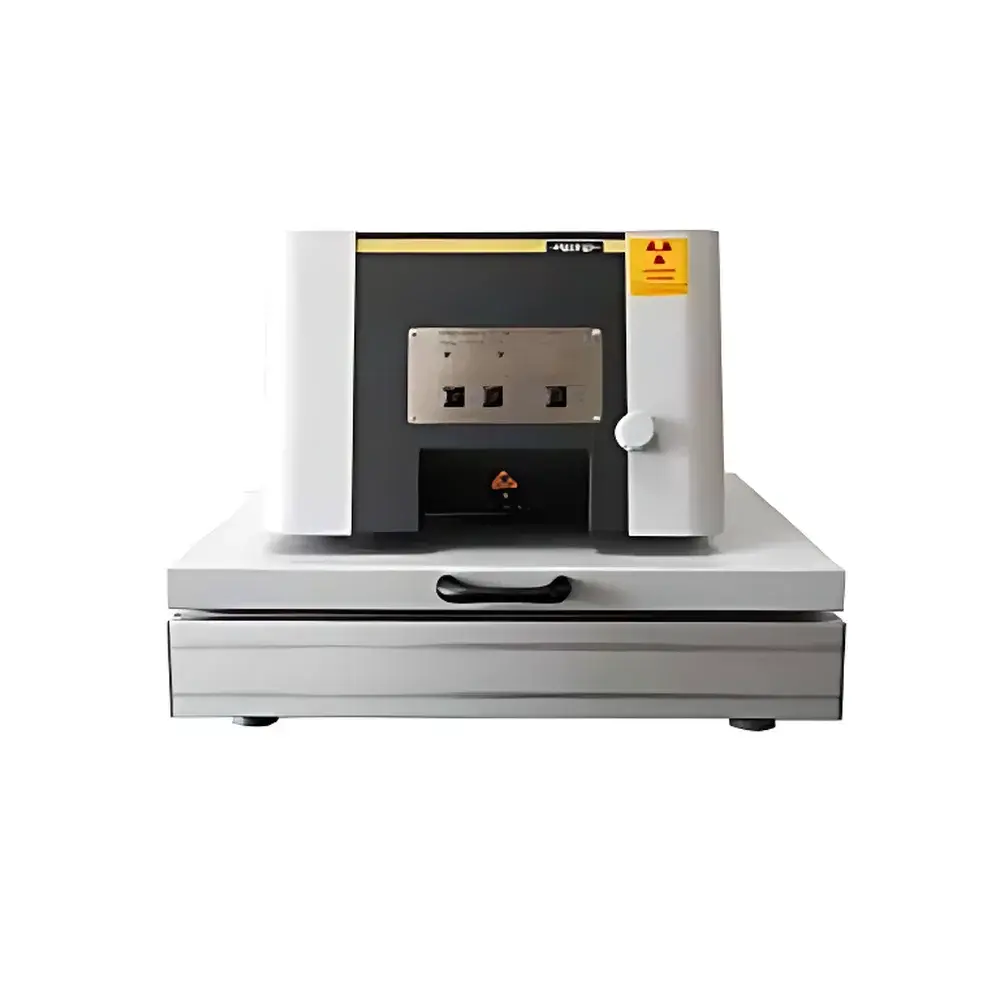
FISCHERSCOPE X-RAY XRF Coating Thickness & Material Analyzer
| Origin | Germany |
|---|---|
| Manufacturer Type | Authorized Distributor |
| Origin Category | Imported |
| Model | X-RAY |
| Pricing | Available Upon Request |
Overview
The FISCHERSCOPE® X-RAY XRF Coating Thickness & Material Analyzer is a benchtop energy-dispersive X-ray fluorescence (EDXRF) spectrometer engineered for non-destructive, quantitative elemental analysis and precise thickness measurement of single- and multi-layer metallic coatings on conductive or non-conductive substrates. Based on fundamental parameter (FP) quantification algorithms and calibrated with certified reference standards, the instrument operates by irradiating the sample with an X-ray beam, exciting characteristic secondary (fluorescent) X-rays from constituent elements, and resolving their energies and intensities via a high-resolution silicon drift detector (SDD). This enables simultaneous determination of coating composition, layer sequence, individual layer thicknesses (down to sub-nanometer resolution for ultra-thin films), and bulk material chemistry — all without sample preparation or physical contact. Designed for integration into production QA/QC laboratories, R&D facilities, and incoming inspection stations, the system complies with international metrological principles defined in ISO 3497, ASTM B568, and DIN EN ISO 3497–1.
Key Features
- High-resolution Si-drift detector (SDD) with Peltier cooling for optimal peak separation and counting efficiency
- Micro-focused X-ray beam (spot sizes down to 30 µm) enabling spatially resolved analysis of small features, solder pads, and fine-pitch interconnects
- Motorized XYZ stage with programmable positioning for automated multi-point measurements and mapping
- Multi-layer analysis capability supporting up to 5 layers per stack, including alloyed or graded interfaces
- Integrated helium purge or vacuum chamber option for enhanced detection of light elements (Na–Cl)
- Robust mechanical design with vibration-damped optical path and temperature-stabilized electronics for long-term measurement reproducibility
- Compliance-ready firmware supporting audit trails, user access levels, electronic signatures, and data integrity protocols aligned with FDA 21 CFR Part 11 and GLP/GMP requirements
Sample Compatibility & Compliance
The analyzer accommodates flat, curved, or irregularly shaped samples up to 150 × 150 mm in footprint and 100 mm in height. Substrate compatibility spans metals (e.g., Cu, Ni, Fe, Al, Zn), ceramics, polymers, and printed circuit boards. Measurement validity is traceable to NIST- and BAM-certified reference materials for coating thickness and composition. The system supports compliance verification against RoHS (Directive 2011/65/EU), ELV (2000/53/EC), and China RoHS II, with preconfigured method libraries for Pb, Cd, Hg, Cr(VI), Br (as PBB/PBDE), and other restricted substances. All calibration and measurement data are stored with full metadata (operator ID, timestamp, instrument conditions, environmental parameters) to satisfy ISO/IEC 17025 accreditation requirements.
Software & Data Management
Operating under FISCHER’s proprietary WinFTM® software platform, the instrument provides intuitive workflow-driven measurement setup, real-time spectral visualization, and automated report generation in PDF, CSV, or XML formats. Advanced functions include spectrum deconvolution using fundamental parameters, matrix correction for heterogeneous substrates, and statistical process control (SPC) charting with Cp/Cpk calculation. Data export supports LIMS integration via ODBC and OPC UA protocols. All measurement files are digitally signed and encrypted; revision history and change logs are retained for full traceability. Software updates follow a validated release cycle compliant with IEC 62304 for medical device-grade software safety classification.
Applications
- Electronics manufacturing: Au/Ni/Cu stack thickness verification on PCB vias and connectors; Sn/Pb/Bi solder composition analysis
- Semiconductor packaging: measurement of electroless Ni–P/immersion Au thickness on leadframes and wire bond pads
- Jewelry and precious metals: quantitative assay of Pt–Ir, Au–Ag–Cu alloys and plating uniformity assessment
- Aerospace fasteners: Cr(VI)-free passivation layer thickness and Cr/Fe ratio validation on aluminum alloys
- Photovoltaics: CdTe, CIGS, and perovskite thin-film stoichiometry and interfacial diffusion profiling
- Automotive electroplating: Zn–Ni alloy coating thickness and Fe/Zn ratio control on steel components
- Toys and consumer goods: screening for regulated heavy metals (Pb, Cd, As, Sb) in paints, plastics, and surface finishes
FAQ
What elements can be measured with this XRF analyzer?
The system detects elements from sodium (Na, Z=11) to uranium (U, Z=92); light-element performance improves significantly with helium purging or vacuum operation.
Is sample preparation required?
No — measurements are fully non-destructive and require no coating dissolution, sputtering, or metallurgical sectioning.
Can it measure non-metallic coatings such as anodized layers or polymer films?
Yes, provided the coating contains detectable elements (e.g., Al₂O₃, TiO₂, SiO₂) and substrate contrast allows sufficient fluorescence yield.
How is calibration maintained over time?
Calibration stability is verified daily using built-in check standards; full recalibration is performed quarterly or after hardware maintenance, following ISO 17025-compliant procedures.
Does the system support automated reporting for ISO 9001 audits?
Yes — WinFTM® generates compliant reports with full measurement uncertainty budgets, operator authentication, and revision-controlled templates.



