
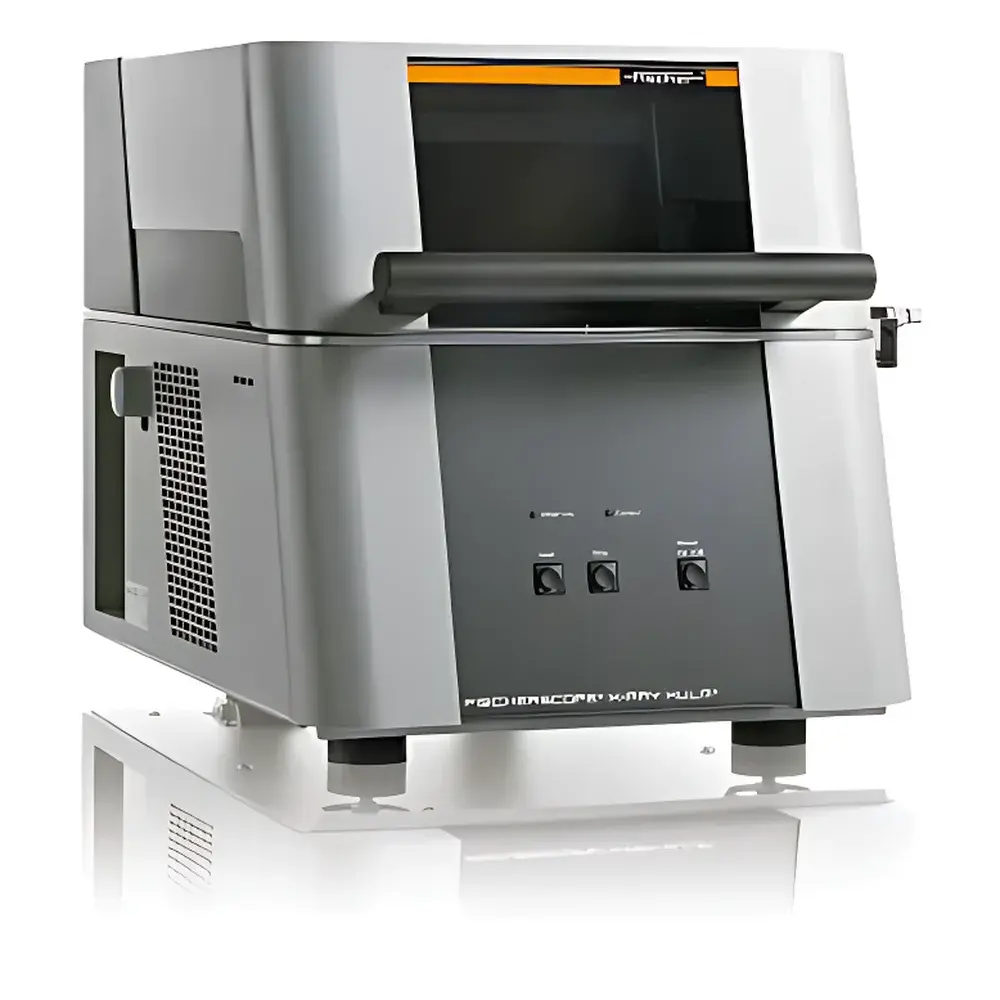
FISCHERSCOPE X-RAY XULM Series X-Ray Fluorescence Coating Thickness Analyzer
| Brand | Fischer |
|---|---|
| Origin | Germany |
| Model | XULM |
| Detector Type | Proportional Counter |
| Optical System | High-Resolution CCD Color Camera with Manual Focus |
| Collimators | 4 Switchable (e.g., 0.1 mm, 0.2 mm, 0.3 mm, 0.5 mm) |
| Primary Filters | 3 Switchable |
| Operating Temperature | 10–40 °C |
| Relative Humidity | ≤95% RH (non-condensing) |
| Form Factor | Benchtop with Manual XY Stage |
Overview
The FISCHERSCOPE® X-RAY XULM Series is a benchtop energy-dispersive X-ray fluorescence (EDXRF) analyzer engineered for non-destructive, quantitative measurement of metallic and multi-layer coating thicknesses down to sub-micrometer levels—as well as elemental composition analysis of bulk materials and thin films. Based on fundamental parameter (FP) quantification and peak deconvolution algorithms, the system excites characteristic X-ray emission from sample atoms using a micro-focused X-ray tube (typically Pd or Mo anode), and detects emitted photons via a gas-filled proportional counter optimized for high count-rate stability and low background noise. Its compact, vibration-insensitive architecture makes it suitable for integration into quality control laboratories, incoming inspection bays, and production floor environments where space, reliability, and repeatability are critical. Unlike handheld or large-floor models, the XULM balances analytical rigor with operational simplicity—enabling precise positioning of small, irregular, or high-value components without requiring vacuum or helium purge.
Key Features
- Manual high-precision XY stage with fine-thread adjustment for accurate placement of micro-samples (e.g., connector pins, PCB vias, watch components, semiconductor leads)
- Four interchangeable collimators (standard options: 0.1 mm, 0.2 mm, 0.3 mm, 0.5 mm) enabling spatial resolution adaptation for heterogeneous surfaces or edge measurements
- Three selectable primary beam filters (e.g., Al, Cu, Ti) to optimize excitation conditions for specific element groups (e.g., Cr/Ni/Cu/Zn in electroplated steel; Au/Pd/Ni in ENEPIG finishes)
- Integrated high-resolution color CCD camera with manual focus and adjustable LED illumination—supporting real-time visual correlation between optical field of view and measured spot location
- Proportional counter detector with pulse-height discrimination, delivering stable count rates up to 500 kcps and minimizing spectral pile-up during high-flux analysis
- Firmware and calibration libraries compliant with ISO 3497, ASTM B568, and DIN EN ISO 3497–1 for coating thickness validation and uncertainty estimation
Sample Compatibility & Compliance
The XULM accommodates flat, curved, or irregularly shaped samples up to 150 × 150 mm footprint and 80 mm height (with optional extended Z-stage). It supports measurement of single-layer, duplex, and triple-layer systems—including common industrial combinations such as Sn over Cu, NiP over Al, Cr over Ni, and Au over Ni over Cu. Sample holders are configurable for standardized fixtures (e.g., ISO 2064-compliant test coupons) or custom jigs. All measurement protocols adhere to GLP principles: full audit trail logging (operator ID, timestamp, calibration status, measurement parameters), electronic signature support per FDA 21 CFR Part 11 (when paired with WinFTM® software), and traceable calibration using NIST-traceable multilayer reference standards (e.g., Fischer-certified CAL-STD-XULM series).
Software & Data Management
Controlled by WinFTM® (Fischer Thickness Measurement) software v7.x or later, the XULM provides intuitive workflow management—from method creation and calibration curve generation to batch reporting and SPC charting. The software supports matrix correction for substrate effects, inter-element absorption/enhancement modeling, and automated layer sequence recognition. Measurement data exports natively to CSV, XML, and PDF formats; raw spectra are stored in SPE format for post-acquisition reprocessing. Database integration (ODBC-compatible) enables direct linkage to MES or LIMS platforms. Software validation documentation (IQ/OQ/PQ templates) and 21 CFR Part 11 configuration guides are provided for regulated environments.
Applications
- Quality assurance of decorative and functional electroplated coatings (e.g., automotive trim, fasteners, jewelry)
- Incoming material verification of supplier-coated parts per IPC-4552A (ENIG) or ASTM B734 (anodic oxide)
- Process monitoring in PCB manufacturing—measuring solder mask thickness, immersion gold (ENIG), or electroless nickel (ENEPIG)
- Failure analysis of delamination or under-plating in MEMS packaging and medical device connectors
- Compliance testing for RoHS-restricted substances (Pb, Cd, Hg, Cr⁶⁺, Br) alongside thickness verification in a single measurement
FAQ
Is vacuum or helium purging required for light element analysis (e.g., Mg, Al, Si)?
No—the XULM operates in ambient air and is optimized for elements from Na (Z=11) upward. For enhanced sensitivity below Na, external purge systems may be integrated—but are not part of standard configuration.
Can the XULM measure coating thickness on curved or recessed surfaces?
Yes—manual Z-axis adjustment and the high-magnification optical system allow focused measurement on radii ≥2 mm and shallow cavities (depth ≤5 mm), subject to geometric correction in WinFTM.
What calibration standards are recommended for routine verification?
Fischer supplies certified multi-layer reference standards traceable to PTB (Physikalisch-Technische Bundesanstalt); annual recalibration is advised per ISO/IEC 17025 guidelines.
Does the system support automated measurement sequences for high-throughput QA?
Not natively—the manual XY stage requires operator intervention per point. For automation, the XULM serves as the analytical core in semi-automated setups using third-party motorized stages and API-controlled WinFTM scripting.
How is measurement uncertainty reported in compliance with ISO 3497?
WinFTM calculates expanded uncertainty (k=2) incorporating type A (repeatability) and type B (calibration, drift, geometry) components, fully documented in measurement reports per ISO/IEC 17025 Annex A.3.



