

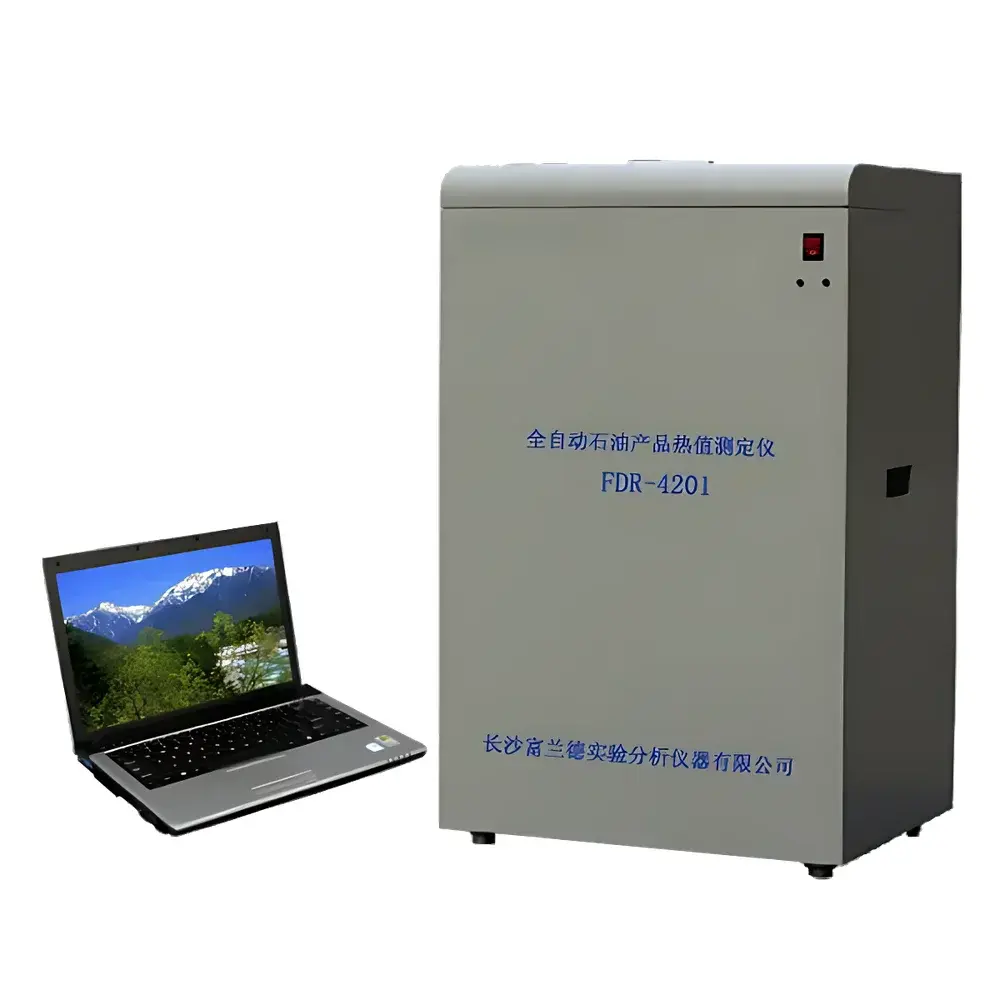
Fland FDR-4251 Fully Automated Calorimeter for Petroleum Products
| Brand | Fland (csfriend) |
|---|---|
| Model | FDR-4251 |
| Origin | Hunan, China |
| Temperature Range | 5–40 °C |
| Temperature Resolution | 0.0001 °C |
| Heat Capacity Precision | ≤0.1% |
| Test Duration (Main Period) | ~8 min |
| Detection Method | Fully Automatic |
| Control Interface | PC-based |
| Optional Integration | Electronic Balance (RS-232/USB), LAN |
| Oxygen Bomb Charging | Integrated Auto-Fill Unit |
| Compliance | ASTM D240, ASTM D4809, ISO 1928, GB/T 213 |
Overview
The Fland FDR-4251 Fully Automated Calorimeter is a precision oxygen-bomb calorimetry system engineered for the accurate determination of gross calorific value (GCV) and net calorific value (NCV) of petroleum products—including gasoline, diesel, biodiesel, jet fuel, and light distillates. It operates on the principle of adiabatic or isoperibol bomb calorimetry, wherein a precisely weighed sample is combusted under high-pressure oxygen in a sealed stainless-steel bomb, and the resulting temperature rise in a thermally stabilized water jacket is measured with ultra-high-resolution thermometry. Designed to meet stringent regulatory requirements for energy content certification, the FDR-4251 eliminates operator-induced variability through full automation of water filling, thermal equilibration, oxygen pressurization, ignition sequence, and data acquisition—reducing manual intervention to sample weighing and bomb loading only.
Key Features
- Standard-compliant capsule-based combustion: Equipped with certified ASTM/GB-compliant ampoule capsules for volatile fuels (e.g., biodiesel, ethanol-blended gasoline), minimizing evaporation loss and ensuring representative combustion behavior.
- Ultra-high thermal resolution: Dual platinum resistance thermometers (PRTs) with 0.0001 °C resolution enable sub-millikelvin stability tracking during the main period and equilibrium phases.
- Intelligent water management system: Automatically detects outer-jacket water level, regulates inner-can water volume to ±0.1 g accuracy, and maintains continuous circulation for uniform thermal distribution.
- Dedicated Fland oxygen bomb: Features optimized ignition electrode geometry and low-resistance crimp contacts to prevent misfires caused by oxidized or bent ignition wires—significantly improving test success rate across high-volume QC labs.
- Integrated auto-oxygenation module: Eliminates manual hand-pumping; delivers consistent 3.0 MPa O₂ pressure with real-time pressure feedback and automatic shutoff.
- Modular interface architecture: Standard RS-232 and Ethernet ports support seamless integration with analytical balances (auto-import of sample mass), LIMS, and enterprise networks via TCP/IP.
Sample Compatibility & Compliance
The FDR-4251 is validated for liquid hydrocarbon fuels with flash points ≥38 °C (per ASTM D93) and vapor pressures compatible with sealed-bomb combustion. It supports routine analysis of ASTM Class 1–3 fuels, including EN 590 diesel, ASTM D7467 biodiesel blends (B5–B20), and aviation turbine fuels (Jet A-1, JP-8). All calibration, verification, and operational procedures align with ISO/IEC 17025 requirements for testing laboratories. The instrument’s firmware implements audit-trail logging per FDA 21 CFR Part 11 (when operated with compliant software configuration), and raw data files retain full metadata—including operator ID, timestamp, ambient conditions, and calibration certificate traceability—to support GLP/GMP documentation workflows.
Software & Data Management
The embedded Windows-based control software provides full lifecycle calorimetric data handling: automatic baseline correction, thermal lag compensation, nitric acid and sulfur correction algorithms (per ASTM D240 Annex A), and multi-point calibration curve generation. Each test generates a structured XML report containing raw thermogram data, corrected temperature differentials, heat capacity values, and uncertainty estimates per GUM (JCGM 100:2008). Software features include real-time diagnostic alerts (e.g., incomplete combustion, water leakage, thermistor drift), configurable pass/fail thresholds, and export options for CSV, PDF, and LIMS-compatible HL7/ASTM E1384 formats. Remote monitoring and asynchronous multi-instrument control are supported via Fland’s LabLink™ protocol—enabling one workstation to manage up to eight FDR-4251 units or mixed-device clusters (e.g., viscometers, distillation analyzers).
Applications
- Quality control in petroleum refineries and blending terminals for compliance with ASTM D3343, ISO 4297, and GB/T 1884 standards.
- Research and development of alternative fuels, including fatty acid methyl ester (FAME) formulations and synthetic paraffinic kerosene (SPK).
- Regulatory submission testing for EPA Renewable Fuel Standard (RFS) reporting and EU RED II sustainability certifications.
- Educational laboratories requiring reproducible, hands-on instruction in thermochemical measurement principles and uncertainty analysis.
- Contract testing laboratories accredited to ISO/IEC 17025 seeking a cost-effective, low-maintenance calorimeter platform with documented metrological traceability.
FAQ
What types of samples require the optional ampoule capsule kit?
Ampoules are mandatory for samples with Reid Vapor Pressure (RVP) > 60 kPa (e.g., gasoline, ethanol blends, light naphthas) to prevent pre-ignition volatility losses. Biodiesel (B100) and low-sulfur diesel may be tested in standard crucibles unless specified otherwise by method.
Is the FDR-4251 compliant with ASTM D4809 for distillate fuels?
Yes—the instrument meets all procedural, calibration, and precision requirements outlined in ASTM D4809 when used with certified benzoic acid reference material (NIST SRM 39j) and following prescribed cooling correction methodology.
Can the system operate without a connected computer?
No. Full functionality—including method selection, calibration, result calculation, and report generation—requires continuous PC control. Standalone operation is not supported.
What maintenance intervals are recommended for the oxygen bomb and ignition circuit?
The bomb body requires visual inspection and cleaning after every 50 tests; ignition electrodes should be polished and contact resistance verified quarterly. Oxygen seals must be replaced after 200 firings or annually, whichever occurs first.
Does the software support multi-language UI and audit trail export?
The interface is English-only; however, audit logs (including user actions, parameter changes, and result modifications) are exportable as encrypted CSV with SHA-256 hash verification for regulatory review.




