
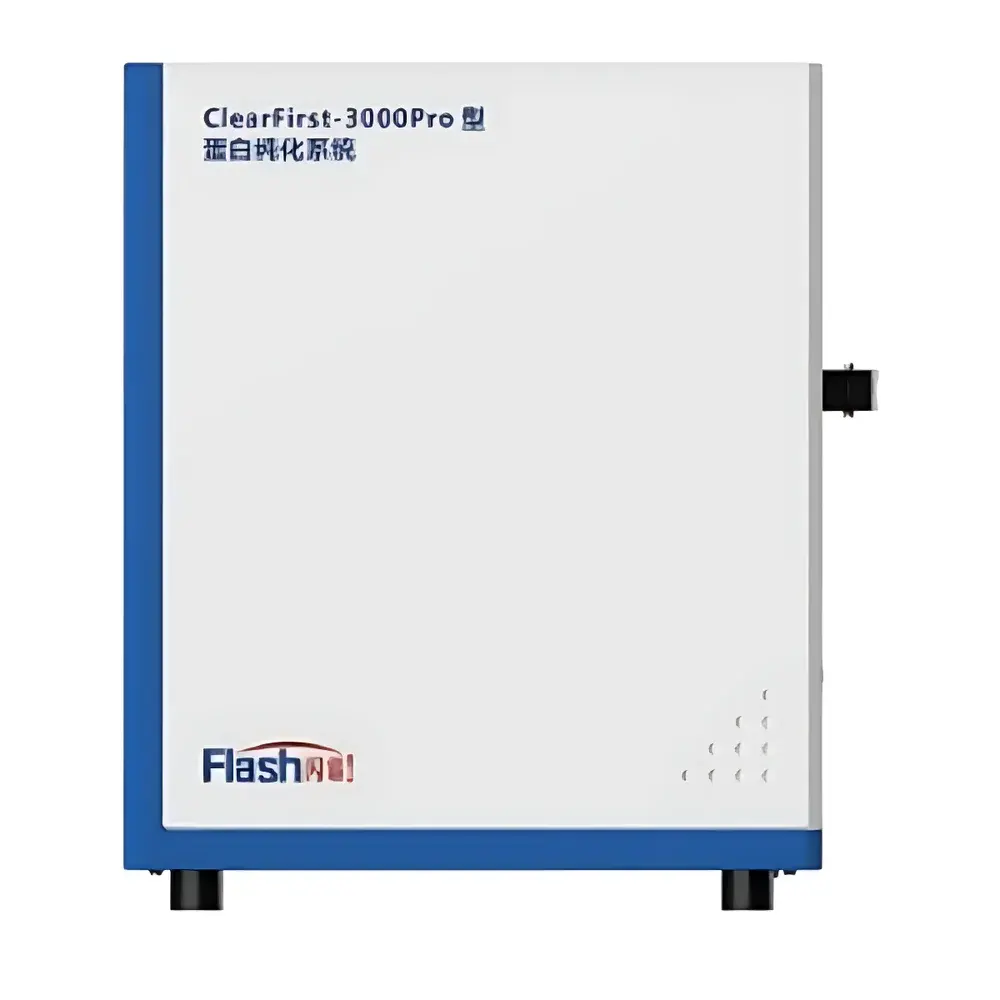
Flash Spectrum ClearFirst-3000Pro Protein Purification System
| Brand | Flash Spectrum |
|---|---|
| Origin | Shanghai, China |
| Model | ClearFirst-3000Pro |
| Flow Rate Range | 0.01–50 mL/min (optional 0.01–100 mL/min) |
| Max Pressure | 27 MPa (270 bar) at ≤25 mL/min |
| UV Wavelength Range | 190–850 nm |
| Wavelength Accuracy | ±1 nm |
| Wavelength Repeatability | ±0.2 nm |
| Conductivity Range | 0–999.9 mS/cm |
| Path Length Options | 2 mm (standard), 5 mm & 10 mm (optional) |
| Gradient Formation | High-precision dual-pump gradient mixing |
| Detection Channels | Quad-wavelength simultaneous UV-Vis detection |
| Column Compatibility | Single-column configuration (expandable via optional multi-column switching valve) |
| Fraction Collection | X-Y matrix collector with 96-position 18×150 mm tube rack (standard), configurable for multiple tube formats |
| Software | ClearFirst-3000 Series Workstation (Windows-based, GLP-compliant audit trail, method database, user management, instrument self-test) |
Overview
The Flash Spectrum ClearFirst-3000Pro Protein Purification System is an integrated, high-pressure liquid chromatography (HPLC)-based platform engineered for reproducible, scalable purification of proteins, nucleic acids, and other biomacromolecules. It operates on the principle of preparative liquid chromatography under controlled pressure and flow conditions, supporting affinity, ion exchange, hydrophobic interaction, size exclusion, and other orthogonal separation modalities. Designed for both analytical characterization and milligram-to-gram scale preparation, the system integrates a dual high-precision piston pump architecture to generate stable, low-pulsation solvent gradients—eliminating bubble formation common in peristaltic or gradient cup systems. Its fully biocompatible fluidic path—constructed from PEEK, titanium, and inert stainless-steel components—ensures compatibility with aggressive aqueous buffers, chaotropic agents, and low-pH eluents while maintaining structural integrity up to 27 MPa (270 bar). The system’s modular design enables seamless integration of optional modules including pH monitoring, column switching, reverse-flow flushing, and large-volume sample injection—making it suitable for academic core facilities, biopharma process development labs, and QC/QA environments requiring traceable, auditable workflows.
Key Features
- High-accuracy dual-piston high-pressure pumps delivering 0.01–50 mL/min (extendable to 100 mL/min), with pulse dampening and real-time flow calibration for <±0.5% flow accuracy across dynamic ranges.
- Quad-wavelength UV-Vis detector based on precision grating monochromator optics, enabling simultaneous acquisition at four user-defined wavelengths between 190–850 nm; wavelength repeatability ±0.2 nm ensures robust peak identification across protein absorbance profiles (e.g., 280 nm, 260 nm, 214 nm, reference).
- Variable-pathlength flow cells (2 mm standard; 5 mm and 10 mm optional) accommodate diverse concentration ranges—from dilute monoclonal antibody samples to concentrated inclusion body lysates—without manual recalibration.
- Dedicated conductivity detector with full-scale range 0–999.9 mS/cm, utilizing electrode geometry and temperature compensation aligned with ASTM D1125 and ISO 7888 standards for buffer composition verification.
- Integrated pressure sensing at pump outlet and column inlet/outlet positions, with configurable alarm thresholds and automatic flow reduction to protect packed columns from overpressure damage.
- Automated fraction collection using an X-Y robotic matrix platform with zero-motor design beneath the collection tray—enhancing mechanical stability, reducing vibration-induced tube misalignment, and improving safety in cold room installations.
- Onboard buffer selection manifold with four independent solvent inlets per pump, supporting complex multi-step gradients and rapid mobile-phase equilibration without manual tubing reconfiguration.
- Bypass and reverse-flush capability for in-line column regeneration, minimizing downtime and extending resin lifetime in repeated purification cycles.
Sample Compatibility & Compliance
The ClearFirst-3000Pro is validated for use with biological samples in aqueous buffer systems commonly employed in protein biochemistry—including Tris-HCl, phosphate, acetate, imidazole, NaCl, arginine, guanidine HCl, and urea solutions—with viscosity tolerance up to 5 cP. All wetted materials comply with USP Class VI and ISO 10993-5 cytotoxicity requirements. The system supports GxP-aligned operation through its workstation software, which includes electronic signatures, role-based user access control, full audit trail logging (per FDA 21 CFR Part 11), method versioning, and instrument qualification templates compatible with IQ/OQ/PQ protocols. It meets essential performance criteria referenced in ICH Q5E (comparability studies), USP (analytical instrument qualification), and ISO/IEC 17025 (for accredited testing laboratories).
Software & Data Management
The ClearFirst-3000 Series Workstation is a Windows-based application offering complete system orchestration via a unified GUI. It features a hierarchical method database supporting preconfigured protocols for His-tag purification, antibody capture, desalting, and polishing steps—each with embedded parameter validation, inter-step logic checks, and auto-recovery from minor anomalies. Raw data are stored in vendor-neutral .csv and .chm formats, with optional export to CDF (NetCDF) for third-party analysis tools such as UNICORN-compatible viewers or Python-based chromatogram processing pipelines. All method executions generate timestamped run reports with metadata (operator ID, instrument serial, environmental logs), raw chromatograms, and fraction mapping coordinates—enabling full traceability from sample input to purified product vial.
Applications
This system is routinely deployed in applications requiring rigorous purity assessment and yield optimization: purification of recombinant therapeutic proteins (e.g., Fc-fusion constructs, bispecific antibodies), isolation of native enzymes from tissue extracts, removal of endotoxin and host-cell DNA from vaccine intermediates, and preparative isolation of CRISPR-Cas ribonucleoprotein complexes. Its flexibility extends to non-standard workflows such as tag-cleavage-on-column strategies, multi-step tandem chromatography (e.g., capture → intermediate wash → polish), and buffer exchange under continuous flow. Academic users leverage its open architecture for method development in novel ligand screening or resin evaluation studies, while contract development and manufacturing organizations (CDMOs) utilize its compliance-ready features for regulatory submissions.
FAQ
Does the system support 21 CFR Part 11 compliance?
Yes—the workstation implements electronic signatures, audit trail logging with immutable records, and user permission tiers meeting baseline requirements for Part 11 adherence.
Can the system operate inside a 4°C cold room?
Yes—its compact footprint (W × D × H: 580 × 620 × 520 mm) and motor-free fraction collector enable safe, stable installation in refrigerated environments.
Is method transfer possible from AKTA systems?
While not directly interoperable, gradient profiles, flow rates, and detection parameters can be replicated with equivalent hardware performance; method translation guides and conversion utilities are available upon request.
What column formats are supported?
Standard 10/10, 16/10, and 26/10 mm ID columns are natively compatible; optional column switch valves expand support to five parallel columns plus bypass.
How is system sanitization performed?
The inert fluidic path allows NaOH (0.1–1.0 M), 70% ethanol, or 20% isopropanol flushes; automated cleaning-in-place (CIP) sequences can be programmed within the workstation.





