
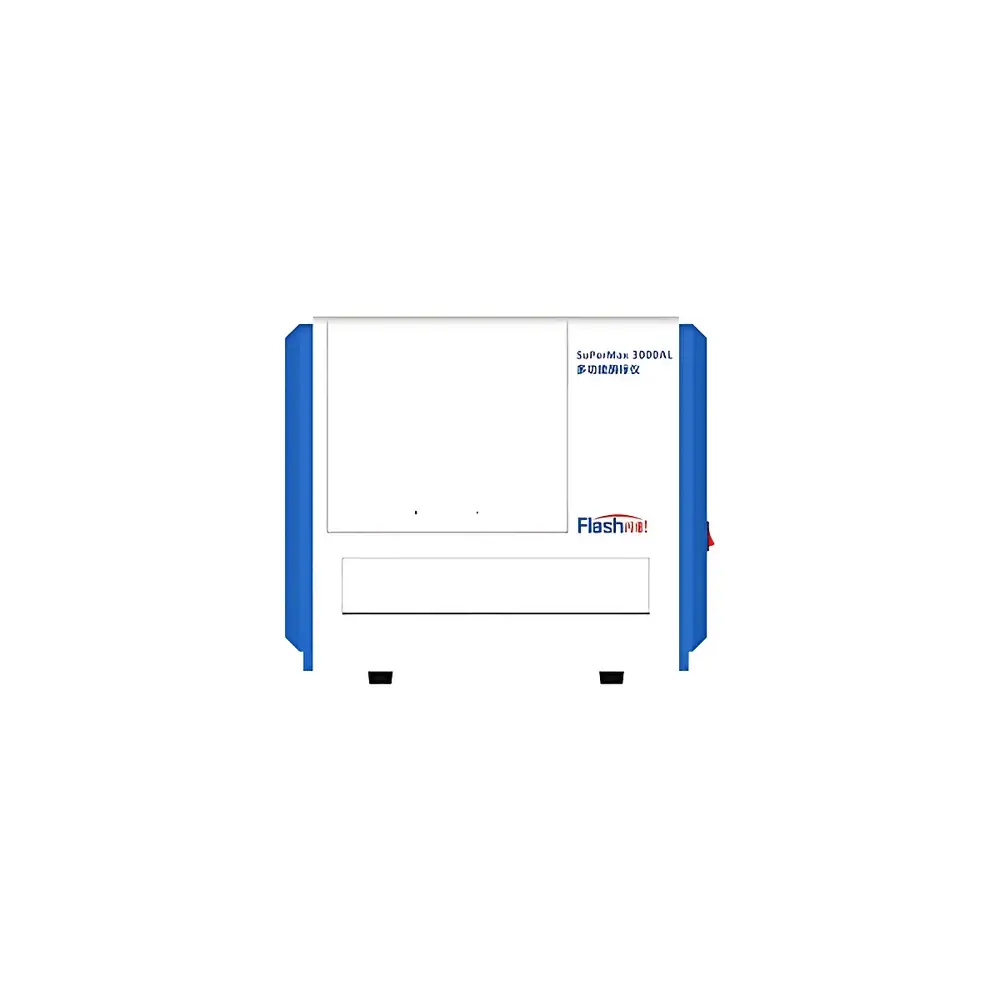
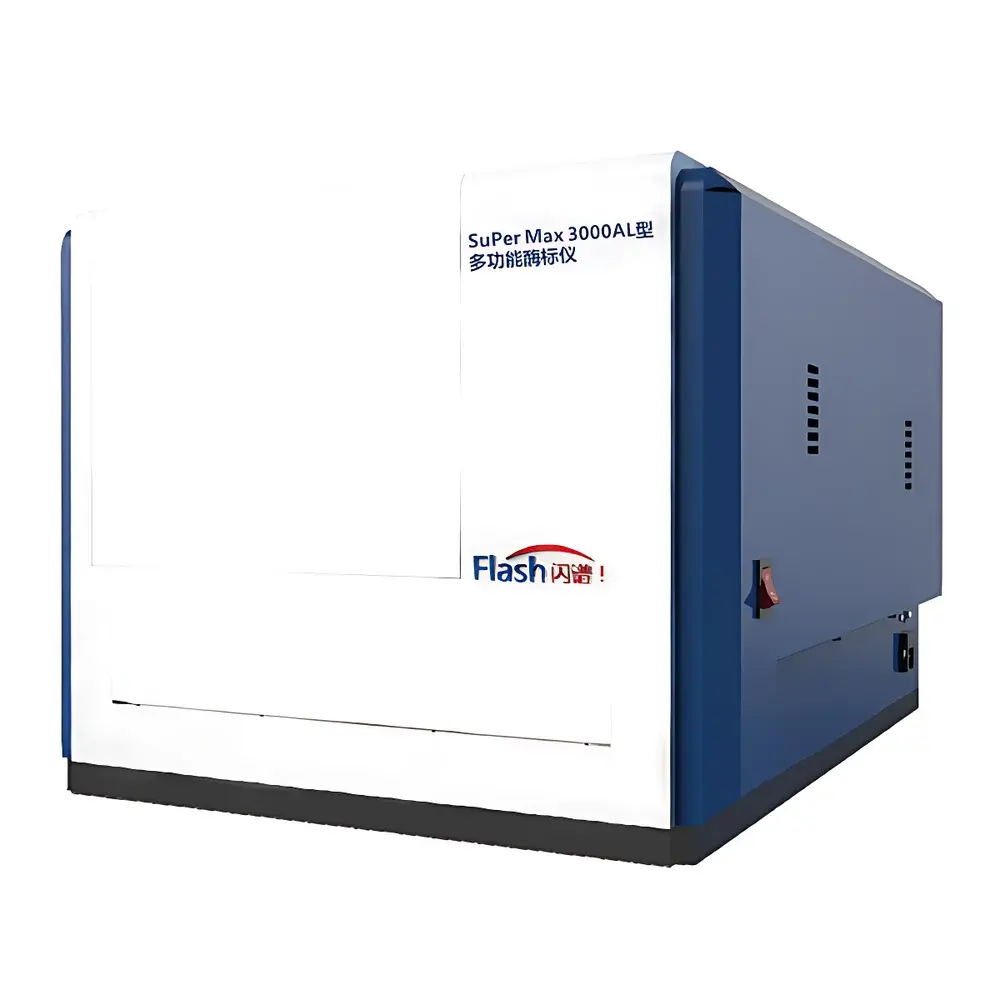
Flash Spectrum SuPerMax 3000AL Multimode Microplate Reader
| Brand | Flash Spectrum (Shanghai Flash Spectrum Biotech Co., Ltd.) |
|---|---|
| Origin | Shanghai, China |
| Model | SuPerMax 3000AL |
| Automation Level | Fully Automated |
| Assay Modes | Endpoint, Kinetic, Spectral Scan |
| Curve Fitting | Linear regression |
| Detection Technologies | UV-Vis Absorbance, Chemiluminescence |
| Wavelength Range | 190–1000 nm (monochromator-based) |
| Absorbance Range | 0–4 OD (96-well, 450 nm) |
| Absorbance Linearity | 0–4 OD (±2% at 450 nm, 96-well) |
| Wavelength Scanning Speed | 6 sec per wavelength (kinetic mode) |
| Chemiluminescence Sensitivity | <7 amol ATP/well (flash-type ATP assay), dynamic range >7 decades |
| Wavelength Accuracy | ±1.0 nm |
| Wavelength Repeatability | <0.2 nm |
| Temperature Control | Ambient +2°C to 65°C |
| Plate Types | 96-well and 384-well microplates |
| Detection Detectors | Photodiode (absorbance), Photon-counting PMT (chemiluminescence) |
| Light Source | Xenon flash lamp |
| Plate Agitation | Linear, orbital, and circular shaking (adjustable amplitude) |
| Data Interface | USB 2.0 |
| Optional Modules | Dual-channel liquid dispenser (10–1000 µL), audit trail module, incubation shaker (MF-10) |
Overview
The Flash Spectrum SuPerMax 3000AL Multimode Microplate Reader is an engineered solution for quantitative, high-fidelity detection across absorbance, chemiluminescence, and spectral scanning modalities in life science laboratories. Built upon a monochromator-based optical architecture, it delivers precise wavelength selection from 190 nm to 1000 nm—enabling broad-spectrum compatibility with standard colorimetric assays (e.g., Bradford, Lowry, BCA), NADH/NADPH kinetics, ELISA, and enzymatic activity profiling. Its photon-counting photomultiplier tube (PMT) detector ensures ultra-low-light sensitivity critical for flash-type chemiluminescent reactions such as ATP quantification, achieving detection limits below 7 amol per well with a dynamic range exceeding seven orders of magnitude. The system integrates thermal control (up to 65°C), programmable plate agitation (linear, orbital, circular), and automated endpoint/kinetic/spectral acquisition—making it suitable for demanding applications including reporter gene assays, cell viability screening (MTT/XTT), microbial growth monitoring, and endotoxin analysis under controlled environmental conditions.
Key Features
- Monochromator-based wavelength selection (190–1000 nm) with 1 nm resolution and <0.2 nm repeatability
- Dual-detection architecture: photodiode for absorbance (0–4 OD, ±2% linearity at 450 nm) and photon-counting PMT for chemiluminescence (300–650 nm)
- Integrated temperature-controlled incubation (ambient +2°C to 65°C) with real-time monitoring and PID regulation
- Programmable microplate agitation: selectable modes (linear, orbital, circular) and amplitude levels (high/medium/low)
- Xenon flash lamp source ensuring stable intensity, low heat emission, and extended lifetime versus halogen or LED alternatives
- Automated kinetic read intervals as short as 6 seconds per wavelength, supporting rapid enzyme turnover and luciferase decay profiling
- Built-in reference detector for real-time signal normalization and drift compensation during extended assays
- USB 2.0 interface for direct instrument control, method transfer, and secure data export compliant with GLP documentation workflows
- Optional dual-channel liquid dispenser (10–1000 µL) enabling on-board reagent addition for kinetic initiation or multi-step protocols
- Audit trail module available for 21 CFR Part 11–compliant environments requiring electronic record integrity and user accountability
Sample Compatibility & Compliance
The SuPerMax 3000AL supports standardized microplate formats including 96-well and 384-well plates; custom configurations are accommodated upon request. It meets fundamental performance criteria aligned with ISO 15197:2013 (in vitro diagnostic devices), ASTM E2518 (standard practice for microplate reader verification), and USP (bacterial endotoxins test) for turbidimetric and chromogenic endpoints. While not pre-certified for IVD use, its optical stability, inter-plate reproducibility (<0.006 OD peak-to-peak variation across full 96-well reads), and traceable wavelength calibration support validation under GMP/GLP frameworks. Cross-talk between adjacent wells remains below 0.2% on white opaque plates—critical for high-sensitivity luminescence assays. All firmware and software modules undergo version-controlled release cycles with documented change logs for regulatory traceability.
Software & Data Management
The proprietary SuPerMax Workstation software provides a modular, scriptable environment for assay design, instrument control, and statistical analysis. It supports batch processing of multiple plate maps, automatic curve fitting (linear, quadratic, four-parameter logistic), and export of raw OD/luminescence values in CSV, Excel, and XML formats compatible with third-party platforms (e.g., GraphPad Prism, Spotfire). Audit trail functionality—when enabled—records operator identity, timestamp, parameter changes, and data modifications in an immutable log file, satisfying FDA 21 CFR Part 11 requirements for electronic signatures and record retention. Data encryption during USB transfer and optional password-protected method libraries further reinforce data governance in shared-core facilities.
Applications
- Enzyme kinetics: Protease, kinase, phospholipase, GST, and dehydrogenase activity assays using NADH oxidation or coupled colorimetric substrates
- Cell-based assays: MTT/XTT proliferation, LDH cytotoxicity, caspase apoptosis markers, and intracellular ATP quantification
- Molecular detection: DNA/RNA quantification (UV260), protein concentration (NanoOrange, Bradford), and endotoxin testing via LAL chromogenic methods
- Reporter systems: Dual-luciferase (Firefly/Renilla), alkaline phosphatase, and β-galactosidase assays with kinetic or endpoint readouts
- Spectral characterization: Full-scan acquisition (e.g., 200–800 nm at 1 nm steps) for compound fingerprinting, binding stoichiometry, or pH-sensitive dye profiling
- High-throughput screening: Integration-ready for robotic deck interfaces and LIMS synchronization via standardized API calls
FAQ
Does the SuPerMax 3000AL support 384-well plates without hardware modification?
Yes—the optical path and plate carrier are mechanically optimized for both 96-well and 384-well formats without recalibration or accessory swaps.
Is wavelength calibration traceable to NIST standards?
Factory calibration uses certified holmium oxide and didymium filters; users may perform periodic verification using optional calibration kits with NIST-traceable reference standards.
Can kinetic chemiluminescence data be acquired with reagent injection synchronized to measurement?
When equipped with the optional dual-channel dispenser, the system triggers injection and initiates kinetic acquisition within 100 ms, enabling precise timing for flash luminescence assays.
What level of temperature uniformity is maintained across a 384-well plate at 37°C?
Uniformity is ±0.5°C across all wells under steady-state conditions, verified by embedded thermistor array mapping during IQ/OQ protocols.
Is remote instrument monitoring supported over Ethernet or only USB?
Remote operation is currently limited to USB-connected host PCs; network-enabled control requires integration via third-party middleware or custom API development.
Related Products




