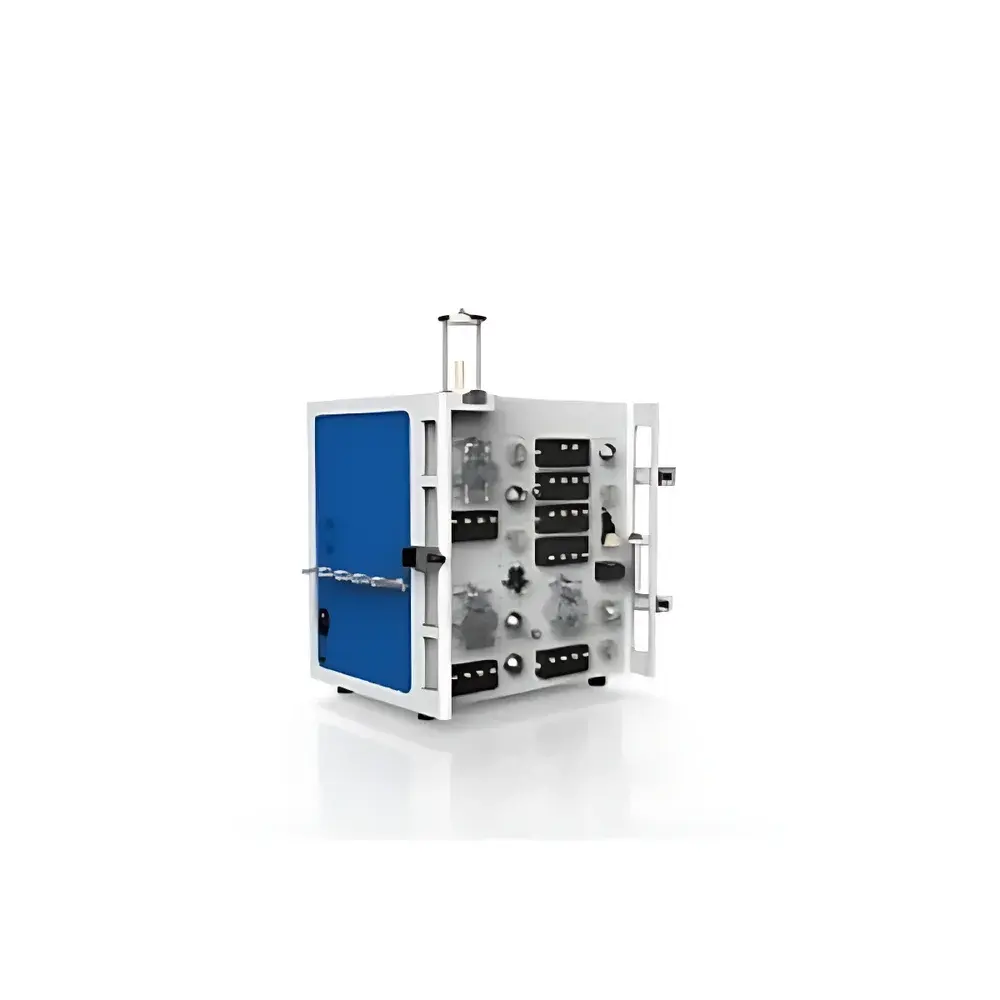
Flash Spectrum ClearFirst-4000 Protein Purification System
| Brand | Flash Spectrum (Shanghai Flash Spectrum Co., Ltd.) |
|---|---|
| Origin | Shanghai, China |
| Model | ClearFirst-4000 |
| Flow Rate | 0–500 mL/min (optional 0–1000 mL/min) |
| Pressure Range | 0.01–10 MPa (0.1–250 mL/min) |
| UV Detection | Four-wavelength simultaneous detection (190–850 nm), wavelength accuracy ±1 nm, repeatability ±0.2 nm, pathlength 2 mm |
| Conductivity Range | 0–999.9 mS/cm |
| Collection Valve | 7-port high-volume fraction collector |
| Sample Inlet | 8-channel sample selection valve |
| Buffer Selection | 4-channel buffer expansion module |
| pH Detector (optional) | with temperature compensation |
| System Compatibility | Aqueous biological buffers up to 5 cP viscosity |
| Compliance | Designed for GLP/GMP-aligned workflows |
Overview
The Flash Spectrum ClearFirst-4000 Protein Purification System is a high-performance, modular preparative chromatography platform engineered for scalable purification of recombinant proteins, monoclonal antibodies, nucleic acids, vaccines, and other biopharmaceuticals. Based on dual high-pressure constant-flow piston pump architecture, it delivers precise gradient formation, low pulsation, and exceptional baseline stability—critical for reproducible separation of complex biomolecules across analytical to pilot-scale applications. Unlike peristaltic or low-pressure systems, the ClearFirst-4000 operates under true high-pressure conditions (up to 10 MPa / 100 bar), enabling compatibility with rigid, high-resolution resins such as POROS™, Capto™, and SOURCE™ media. Its fluidic design employs bio-inert wetted materials—including PEEK, titanium, and sapphire—to ensure minimal leachables, chemical resistance to common aqueous buffers (e.g., Tris-HCl, sodium acetate, NaCl, imidazole), and long-term stability in repeated cleaning-in-place (CIP) cycles.
Key Features
- Dual high-pressure piston pumps with four independent solvent inlets support linear, step, or multi-segment gradients with <0.5% RSD flow accuracy across 0–500 mL/min (optional 0–1000 mL/min), eliminating bubble formation and ensuring robust gradient fidelity.
- Four-channel simultaneous UV-Vis detection (190–850 nm) using a precision grating monochromator provides superior wavelength resolution (<0.2 nm repeatability) and sensitivity over diode-array alternatives—enabling real-time monitoring of protein absorbance (A280), nucleic acid (A260), and impurity peaks (A230).
- Integrated conductivity detector (0–999.9 mS/cm) with matched flow cell geometry ensures accurate salt gradient tracking during ion exchange and hydrophobic interaction chromatography (HIC).
- Optional temperature-compensated pH detector meets ISO 7888 and ASTM D1293 requirements for process-critical pH monitoring during elution and equilibration.
- Modular valve architecture includes an 8-position sample selector, 4-port buffer expansion module, pressure-regulated bypass loop, reverse-flow backflush system, and a 7-output high-volume fraction collector—all controlled via synchronized timing and volume-triggered logic.
- Standard column inlet/outlet pressure sensors (0–10 MPa range) provide real-time column health diagnostics and automatic pressure-limit shutdown to protect expensive chromatographic media.
- Automated high-pressure injection valve (optional) enables air-free, volumetrically precise loading—essential for large-volume sample application without dilution or carryover.
Sample Compatibility & Compliance
The ClearFirst-4000 accommodates a broad spectrum of biomolecular samples, including His-tagged and GST-fusion proteins, IgG subclasses, plasmid DNA, mRNA, viral vectors, and glycoproteins. It supports all major chromatographic modalities: affinity (Ni-NTA, Protein A/G/L), ion exchange (Q, SP, DEAE), size exclusion (SEC), hydrophobic interaction (HIC), and multimodal resins. All wetted components comply with USP Class VI biocompatibility standards. The system architecture supports ALCOA+ data integrity principles: electronic signatures, role-based user access control, full audit trail logging (including method edits, parameter changes, and run execution), and secure data export in CSV and native binary formats. While not pre-certified, its software framework aligns with FDA 21 CFR Part 11, EU Annex 11, and ICH GCP/GLP expectations for regulated environments.
Software & Data Management
The ClearFirst-4000 workstation is a Windows-based, fully integrated control and analysis platform. It features a validated method database supporting version-controlled storage of >1,000 purification protocols—including gradient profiles, valve sequencing, collection logic, and detector synchronization. Automated system suitability tests (SST) verify pump performance, detector linearity, and baseline noise prior to each run. Raw data—including UV, conductivity, pH, pressure, and fraction triggers—is time-stamped, digitally signed, and stored with metadata (operator ID, timestamp, instrument serial, method version). Export options include PDF reports compliant with internal SOPs, as well as ASCII/CSV for integration with LIMS or ELN systems. Remote monitoring via secure HTTPS interface allows off-site supervision without compromising network security.
Applications
The ClearFirst-4000 serves as a primary workhorse in academic core facilities, CROs, and bioprocess development labs. Typical use cases include: purification of milligram-to-gram quantities of research-grade monoclonal antibodies for functional assays; isolation of endotoxin-free plasmid DNA for transfection and vaccine development; capture and polishing of bispecific antibodies using sequential affinity and SEC steps; removal of host-cell proteins and DNA from E. coli or CHO lysates; and scale-down modeling of manufacturing processes for regulatory filings. Its capacity to handle viscous feedstocks (up to 5 cP) and high-salt mobile phases makes it suitable for crude harvest processing directly from bioreactors or tangential flow filtration (TFF) retentates.
FAQ
What chromatographic resins are compatible with the ClearFirst-4000?
All commercially available rigid, high-pressure stable resins—including agarose-, methacrylate-, and silica-based media—are supported, provided they are rated for ≥10 MPa operating pressure.
Can the system be integrated into a cleanroom or cold room environment?
Yes—optional refrigerated column compartments (2–8°C) and IP54-rated enclosures enable deployment in controlled environments; all electronics meet IEC 61000-4 EMC standards.
Is method transfer from AKTA systems possible?
Gradient and valve timing parameters can be imported via CSV; however, due to differences in dwell volume and detector response time, empirical re-optimization is recommended for critical applications.
Does the software support electronic batch records (EBR) for GMP production?
While the base software provides audit trail and user management, full EBR functionality requires integration with third-party MES or QMS platforms via OPC UA or REST API.
What maintenance intervals are recommended for the high-pressure pumps?
Piston seals should be inspected every 500 hours of operation; seal replacement kits and factory calibration services are available through authorized Flash Spectrum service centers.